


Edwardian Lead Crystal Glassware
Edwardian lead crystal glassware brings heavy substance and crisp cut decoration to the table, offering a brilliant weight that modern glass simply cannot match.
Edwardian Lead Crystal Glassware
When searching for Edwardian lead crystal glassware, a buyer is looking at drinkware, decanters, and serving pieces produced around the turn of the twentieth century. These items include spirit decanters, ewers, and fruit bowls shaped by the demands of Edwardian hospitality and dining customs.
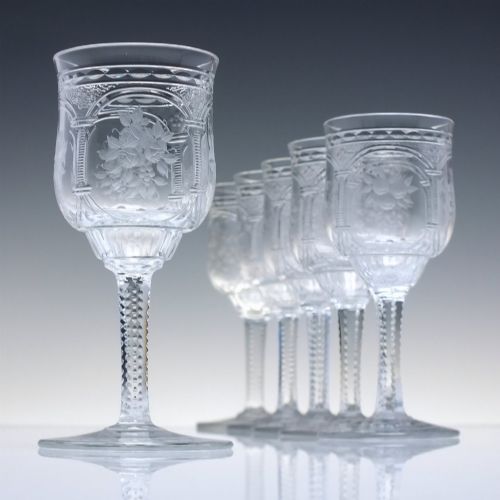
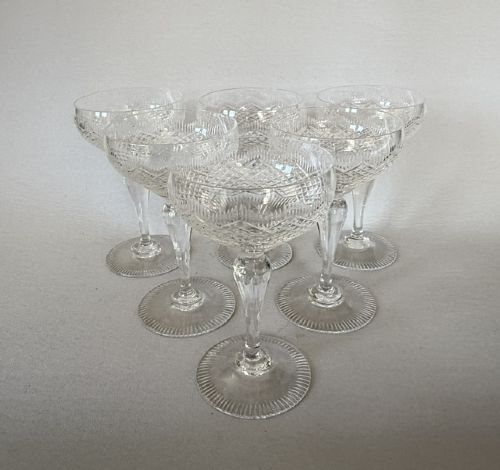
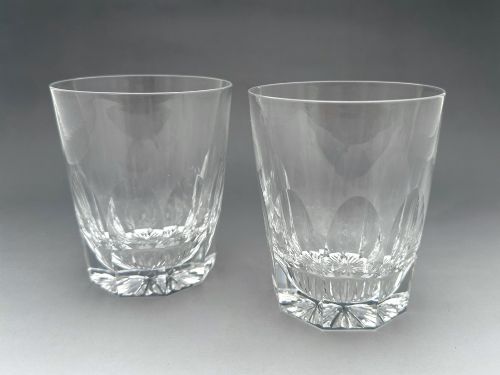
The version most commonly met on this page is the functional drinking vessel, particularly tumblers, wine glasses, and champagne coupes. Alongside these drinking glasses, decanters and commemorative goblets appear, often displaying the heavy wheel-cut patterns typical of the period.
Materials and methods
The pieces are formed from lead crystal and crystal glass, materials chosen for their heavy weight and high refractive index. This dense glass allows deep, sharp facets to be cut into the surface without compromising the structural integrity of the vessel.
Decoration is achieved through several distinct techniques including wheel-cutting, optical blowing, and acid etching. Optically blown vessels show subtle internal ripples from the mould, while cut decoration creates geometric facets that catch the light from every angle.
Listings span the Victorian, Edwardian, and Art Deco periods, encompassing lead crystal, cut glass, and standard crystal compositions.
Judging quality
Quality in these items rests on the crispness of the cutting and the clarity of the metal itself. Superior examples show deep, clean facets with polished surfaces inside the cuts, whereas lesser pieces exhibit shallow markings and duller glass.
Proportion and weight also dictate the standard of a piece. A well-balanced decanter or tumbler feels substantial in the hand, with uniform thickness across the body and a neatly finished pontil mark or flat base.
James Powell
The Edwardian Lead Crystal Glassware Glossary
- Lead crystal
- Glass containing a significant percentage of lead oxide, which increases density, weight, and light dispersion. This material permits sharper cutting than standard soda-lime glass.
- Optically blown
- A method where molten glass is inflated in a ribbed or patterned mould before being expanded. This technique produces characteristic subtle surface ripples.
- Acid etched
- A decoration process using acid to eat away exposed areas of glass while protecting the rest with a resist. It creates fine, matte designs contrasting with polished surfaces.
- Pontil mark
- A scar left on the base of a blown glass vessel where the punty rod was attached during manufacture. Its presence indicates traditional hand-working methods.
Edwardian Lead Crystal Glassware: Frequently Asked Questions
How do I clean antique crystal?
Wash these items by hand in warm water using a mild detergent. Avoid sudden temperature changes to prevent cracking the heavy lead glass.
Dry them immediately with a lint-free cloth to maintain the bright clarity of the cut facets.
Can I use these glasses daily?
These pieces were built for regular service and handle daily use well if treated with proper care. Their robust lead crystal construction makes them durable enough for regular dining.
Keep them away from modern dishwashers, as the heat and harsh detergents will cloud the surface over time.
What defines the Edwardian style?
The aesthetic draws on heavy, brilliant-cut patterns that reflect the optimism and display of the Edwardian era. Form follows function closely, producing sturdy decanters and capacious tumblers for entertaining.
Decoration tends to be geometric and deep, creating maximum sparkle under dining room gas or electric light.
Are decanters marked with names?
Many decanters and serving pieces carry acid-etched labels naming specific contents like brandy or whisky. These inscriptions help identify the original purpose of matching drinkware suites.
Maker signatures remain uncommon, though specific workshops occasionally marked their production on the base or mounts.