

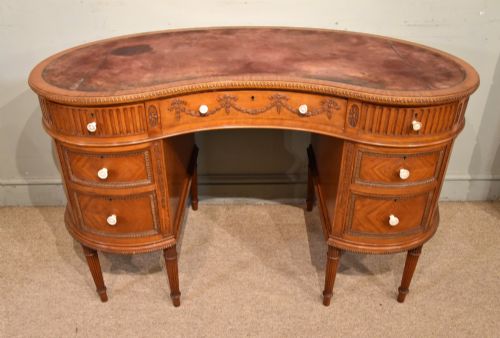
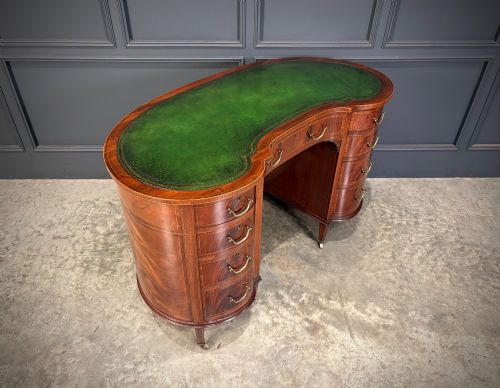
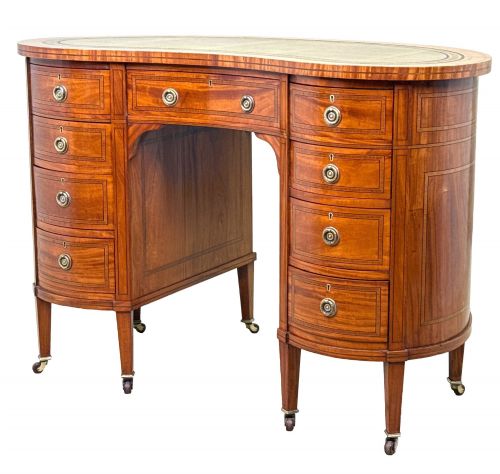
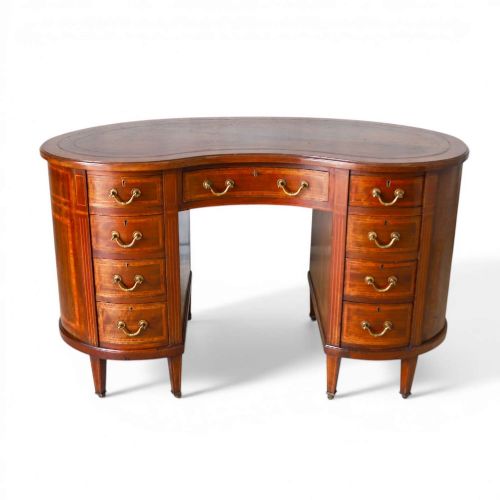
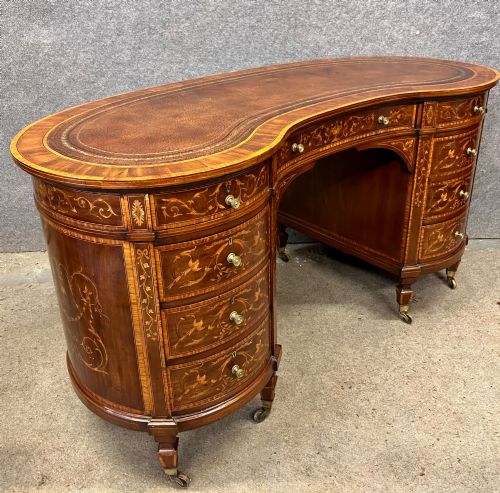

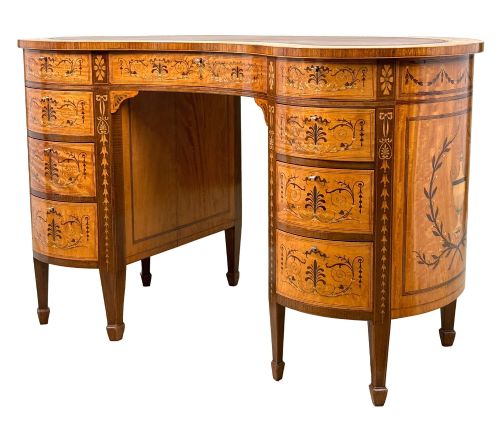

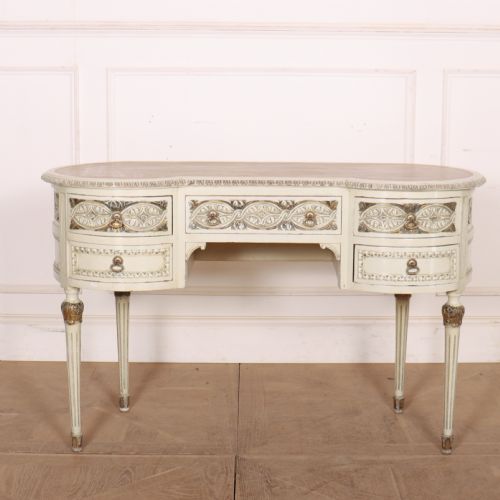


Edwardian Kidney Writing Desk
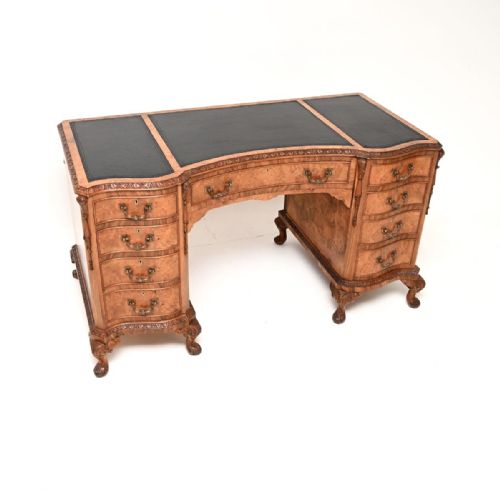
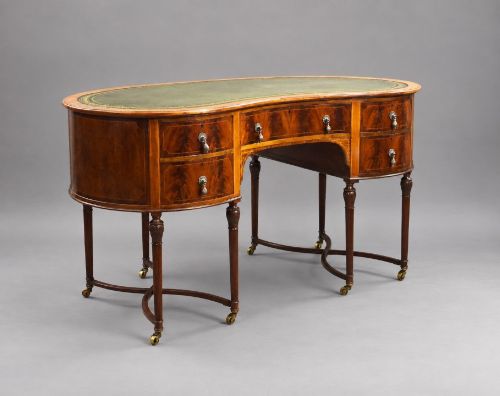
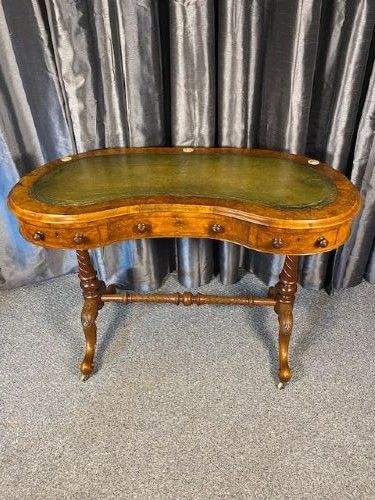
An edwardian kidney writing desk offers a curved silhouette and polished writing surface, designed to sit comfortably in the centre of a room.
Edwardian Kidney Writing Desk
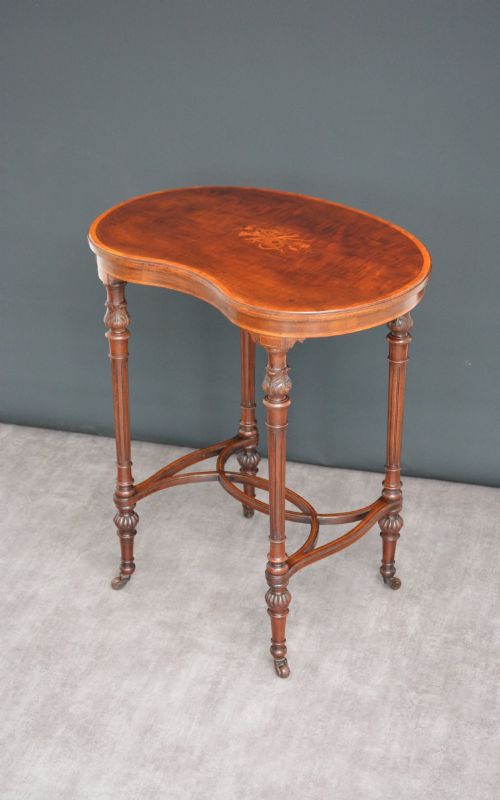
An edwardian kidney writing desk takes its name from its distinctive bean-shaped curve, which wraps around the sitter. These pieces appear predominantly in Edwardian and late Victorian periods, alongside related forms such as writing tables, side tables, and dressing tables.
Makers shaped these items primarily from mahogany, satinwood, and burr walnut, frequently embellishing the timber with delicate inlay and marquetry. The layout typically incorporates a central drawer flanked by pedestals or smaller drawers, topped with a fitted leather writing surface.
Materials and construction
Cabinet makers built these pieces using solid timbers and fine veneers like flame mahogany, rosewood, and satinwood, applied over sturdy secondary woods. Curved drawer fronts and the sweeping kidney outline demanded advanced carpentry techniques, including steam bending and precise multi-piece framing.
Surfaces were frequently inlaid with contrasting woods, brass details, and marquetry motifs, then paired with inset leather skivers tooled in gold. Drawers often incorporated hand-cut dovetail joints and retained original brass hardware.
Listings feature mahogany, satinwood, burr walnut, and rosewood, highlighting the fascination with figured tropical and domestic timbers during the 19th and early 20th centuries.
What separates the best from the rest
Quality rests in the precision of the curved joinery and the selection of figured timbers, such as highly grained burr walnut or rich flame mahogany. Superior examples demonstrate meticulous marquetry work, harmonious proportions, and finished timber panels on the reverse for freestanding placement.
Lesser pieces rely on simpler construction, plainer flat veneers, and minimal inlay. The refinement of the brass mounts, the subtlety of the painted decorations, and the preservation of the original tooled leather surface separate standard production from exhibition pieces.
Maple & Co·Edwards & Roberts·Wolfe & Hollander·Shapland & Petter·Gillows
The Edwardian Kidney Writing Desk Glossary
- Kidney desk
- A desk featuring a curved, bean-shaped top designed to curve around the user. This configuration allows the writer to sit close to the centre while accessing side drawers.
- Marquetry
- Decorative patterns formed by fitting together thin veneers of various woods, shells, or other materials. Artisans applied these designs across the writing surface and drawer fronts.
- Pedestal desk
- A freestanding desk comprising two supporting columns of drawers with a central writing space between them. Many curved writing tables adapt this multi-drawer pedestal format.
- Skiver
- A piece of split leather fitted to the top of a desk to provide a smooth writing surface. These panels are often bordered with gold-tooled leaf patterns.
- Sheraton Revival
- A late 19th and early 20th century design movement inspired by the neoclassical furniture of George Sheraton. Pieces in this style often use satinwood, delicate inlay, and tapered legs.
Edwardian Kidney Writing Desk: Frequently Asked Questions
Were these desks meant for women?
Historical evidence suggests these smaller writing surfaces were frequently utilised as ladies' writing desks or dressing tables due to their compact dimensions. Their elegant curved profiles suited boudoirs and private drawing rooms.
At the same time, larger freestanding versions served successfully in libraries and studies for general correspondence.
Can an edwardian kidney writing desk float in a room?
Many examples are finished on all sides, including the back, making them suitable for placement in the middle of a room rather than flat against a wall. This freestanding capability was an important feature for period interior layouts.
Buyers should inspect the rear panels to confirm the timber and inlay quality match the front.
How do I distinguish Edwardian from Victorian models?
Edwardian pieces often display lighter satinwood timbers, delicate marquetry, and a brighter overall finish reflecting Sheraton Revival influences. Victorian examples tend to utilise heavier rosewood, darker mahogany, and denser carved details.
Both periods embraced the kidney shape, so construction methods and veneer choices provide the clearest dating clues.
What is the leather top called?
The inset leather panel is known as a skiver, and it provided a smooth, non-slip surface for writing with ink quills and fountain pens. These panels were frequently bordered with decorative gold tooling.
Original leather surfaces often show patination from decades of use.