
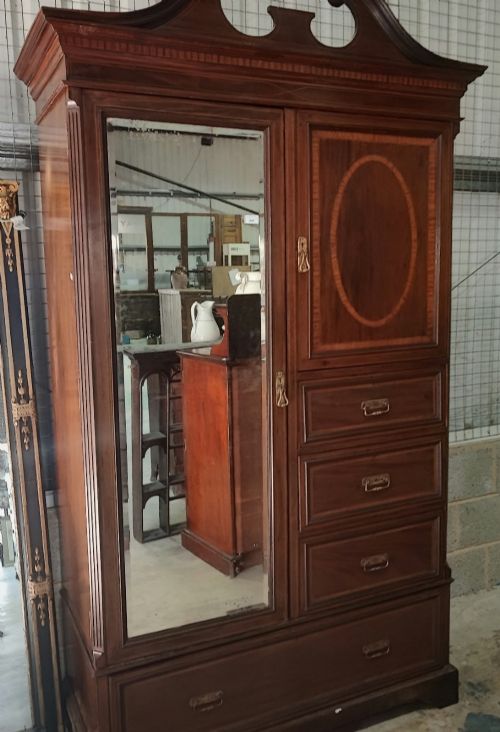
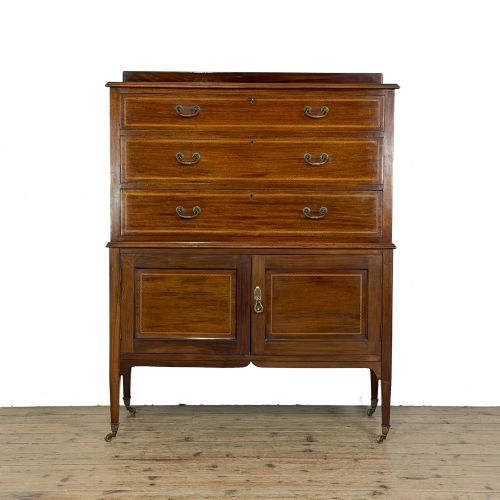
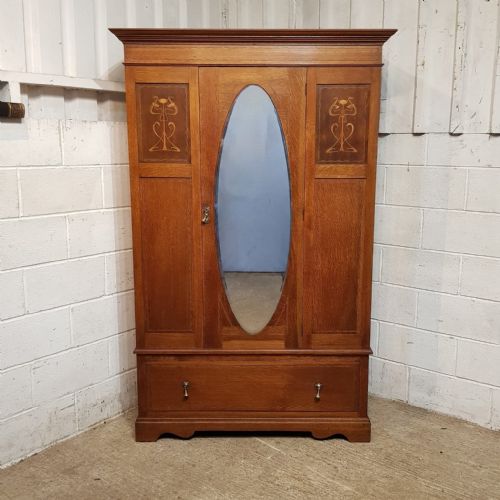
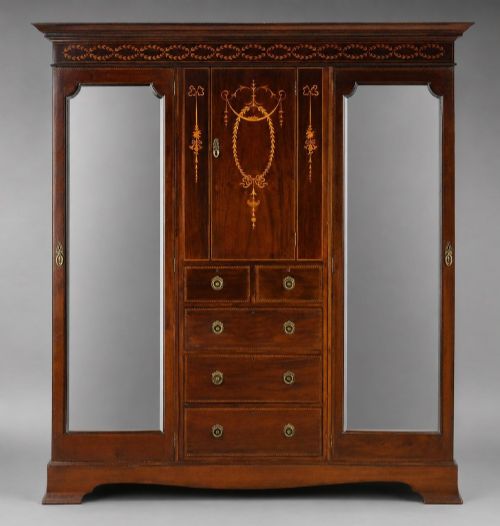

Edwardian Inlaid Press
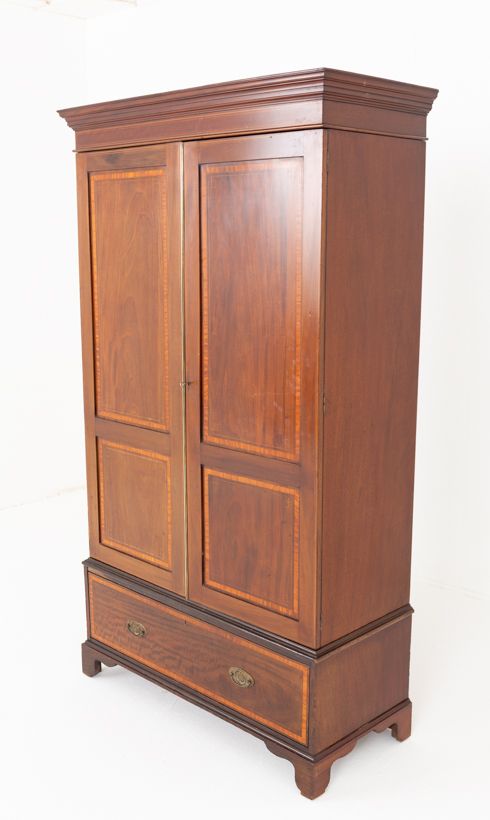
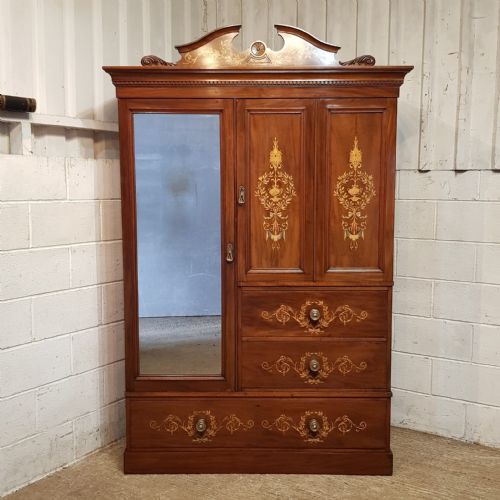
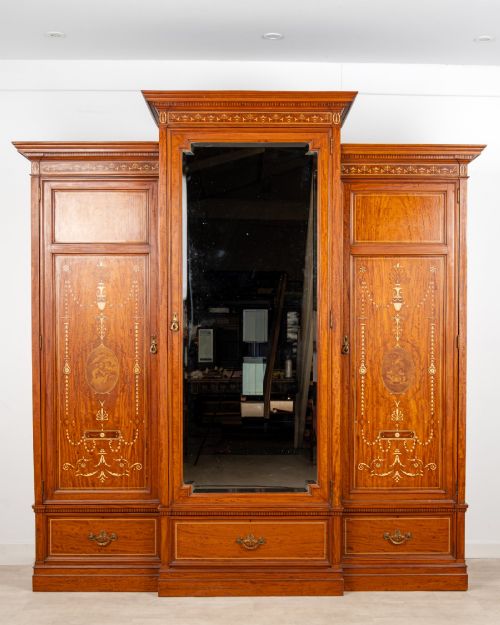
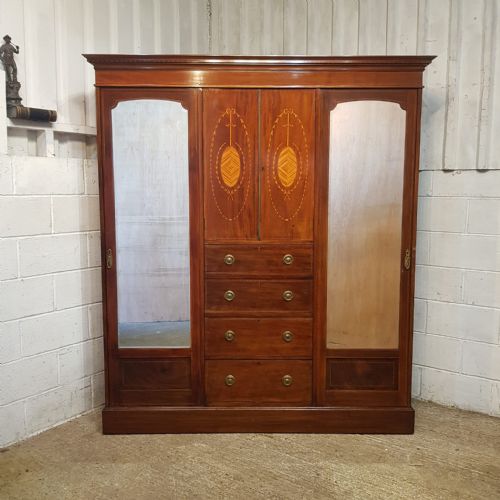
An edwardian inlaid press brings architectural timber and subtle contrast to a bedroom, offering serious storage disguised as fine cabinet-making.
Edwardian Inlaid Press
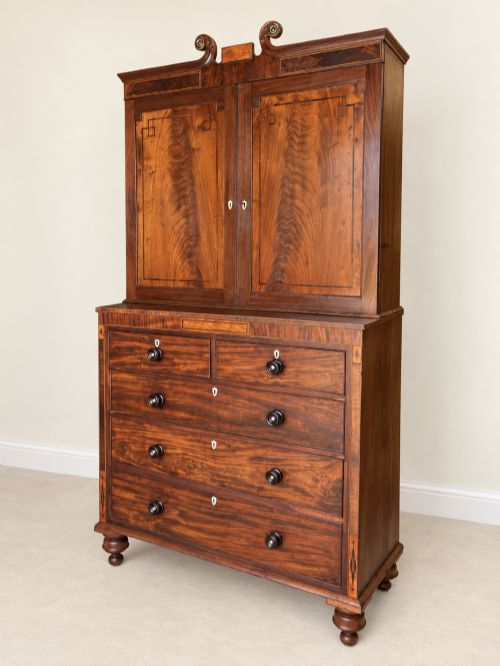
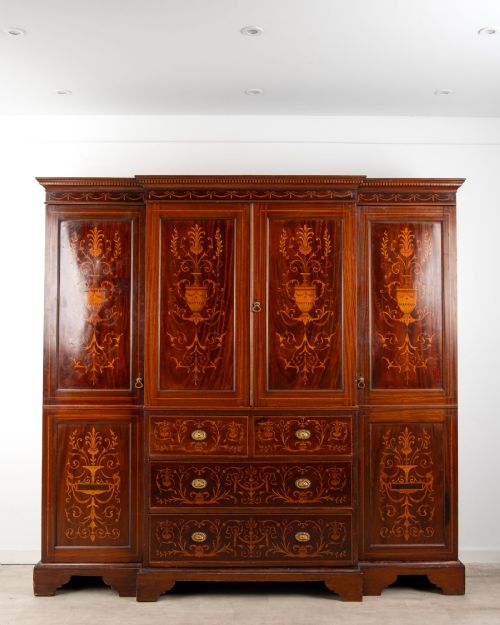
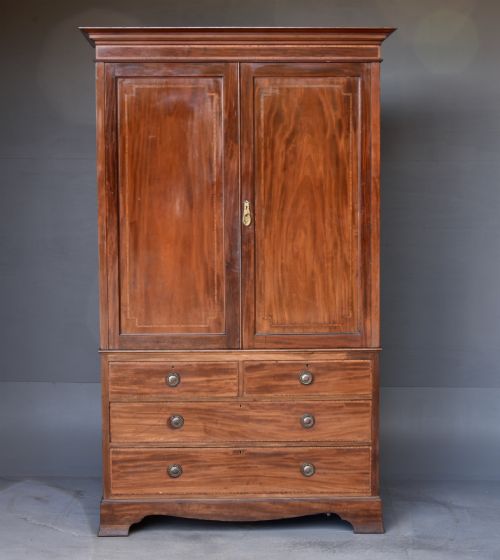
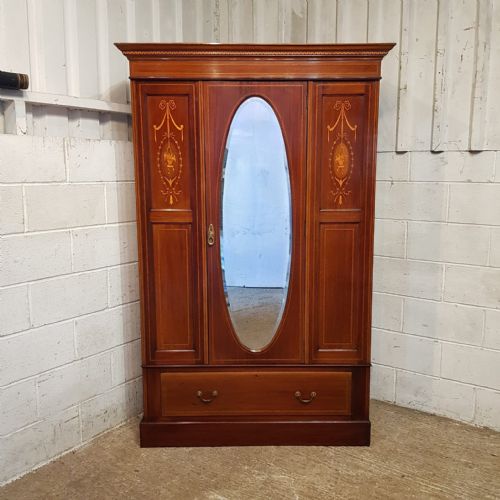
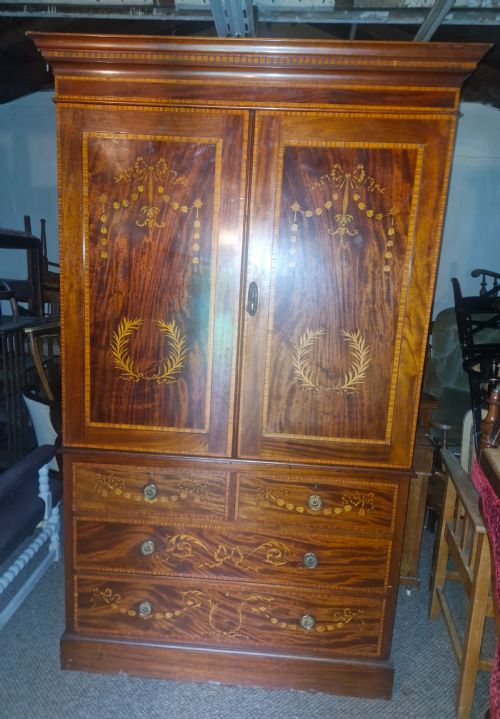
An edwardian inlaid press stands as a substantial piece of bedroom furniture, typically combining hanging space, linen drawers and shallow sliding trays behind panelled doors. Buyers seeking this phrase usually encounter large mahogany or satinwood carcasses made around nineteen hundred, carrying the decorative vocabulary of the Edwardian and Sheraton Revival periods.
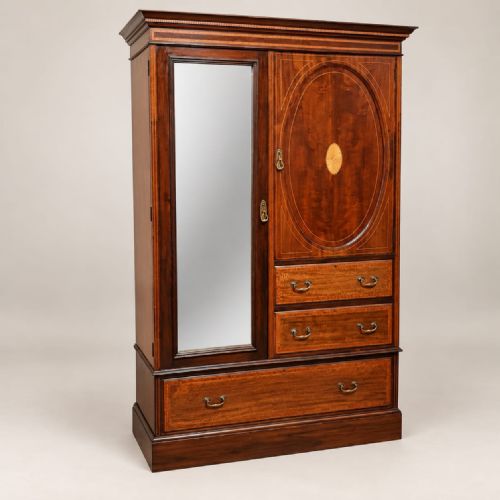
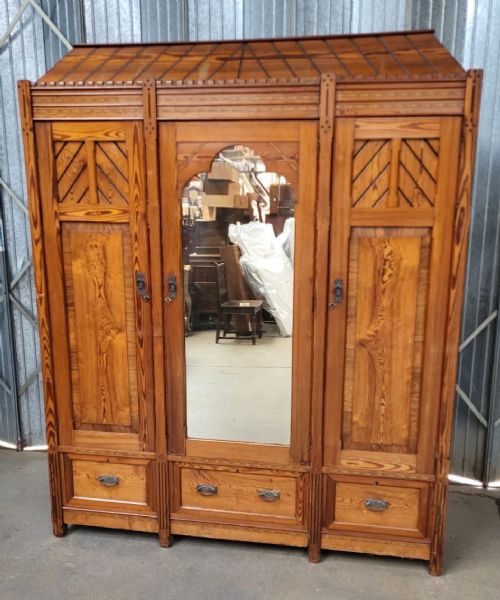
The evidence shows these large pieces appearing in various configurations, from compact single wardrobes to triple breakfront armoires and traditional linen presses with lower drawer chests. While Victorian and Georgian precursors also emerge in the records, the defining focus remains the Edwardian interpretation of inlaid cabinetry.
Materials and construction
Cabinet-makers built these carcasses primarily in mahogany, satinwood and oak, applying contrasting timber veneers and delicate stringing to accent the panel borders. Brass fittings secure the doors and internal slides, while mirror glass frequently appears inset into the full-length central door panels.
Joinery relied on sturdy carcase construction designed to support heavy linen loads and hanging garments, finished with hand-cut dovetails on internal drawers. Decorative motifs depended on precision sawing and fitting of lighter woods into darker ground timbers rather than surface painting.
Materials span common bedroom timbers like mahogany and oak alongside decorative satinwood, rosewood, brass hardware, and inset mirror glass.
Judges of execution
The hierarchy among these pieces rests on the crispness of the cabinet work, the depth and variety of the timber grain, and the ambition of the internal layout. Finer examples display meticulous alignment in their banded inlay and integration of original brass hardware without timber shrinkage splitting the primary panels.
Workshops of higher standing employed thicker primary timbers and more intricate marquetry, whereas simpler pieces relied on printed or minimal veneer work to achieve the prevailing Sheraton Revival look.
maples & co·Edwards and Roberts·Waring & Gillow·Gillows of Lancaster·Wylie Lochhead
The Edwardian Inlaid Press Glossary
- Compactum
- A multi-compartment wardrobe that combines hanging space, shelf sections and banks of internal drawers within a single unified piece. This form maximises storage in Edwardian bedchambers.
- Press
- A traditional cupboard or wardrobe primarily intended for storing folded linens and garments upon interior sliding trays rather than on hangers. Eighteenth and nineteenth-century examples often sit a cupboard directly upon a chest of drawers.
- Inlay
- A decorative technique where small pieces of contrasting wood or shell are fitted flush into a carved recess on the primary timber surface. It creates geometric or floral patterns across door panels and drawer fronts.
- Sheraton Revival
- A late nineteenth and early twentieth-century design movement copying the lighter, neoclassical furniture forms of the seventeen-nineties. It favours straight tapered legs, satinwood veneers and delicate banding.
- Marquetry
- An elaborate form of inlay assembling pictorial or decorative veneers across a broad surface. Cabinet-makers used varied natural woods to achieve tonal shading without pigments.
Edwardian Inlaid Press: Frequently Asked Questions
What is the difference between a press and a wardrobe?
A traditional press relies primarily on internal sliding trays designed to hold folded linens flat, whereas a wardrobe focuses on vertical hanging space for garments.
Many Edwardian combination pieces blur this distinction by housing both hanging compartments and linen slides behind a shared bank of panelled doors.
How do I fit a large press into a modern bedroom?
These pieces were designed as substantial architectural items and usually require careful measurement of ceiling height and stair clearance before placement. Most larger examples feature modular dismantling systems allowing the main cornice, sides and internal banks to separate for transit.
Positioning them away from direct heat sources prevents the timber panels and fine veneer work from drying and splitting over time.
How do I distinguish Edwardian pieces from Victorian ones?
Edwardian furniture generally adopts a lighter, brighter palette featuring satinwood, paler mahogany and delicate neoclassical stringing inspired by the Sheraton Revival style. Victorian pieces lean towards heavier proportions, darker rosewood or pitch pine timbers, and more assertive carving.
Makers working around nineteen hundred discarded the heavier ornamentation of the late nineteenth century in favour of cleaner, airier interior aesthetics.
Can these large cabinets be dismantled for moving?
Many multi-section wardrobes and compactums were constructed with knock-down frames held together by internal bolts, allowing them to be taken apart into manageable sections. Checking the interior sides reveals whether the original cabinet-makers built the carcase for reassembly in situ.
Careful handling of the mirrored doors and heavy crown mouldings remains essential during any relocation.