




Edwardian Inlaid Demi Lune
An Edwardian inlaid demi lune brings graceful half-moon curves and fine woodwork into a hallway or drawing room.
Edwardian Inlaid Demi Lune
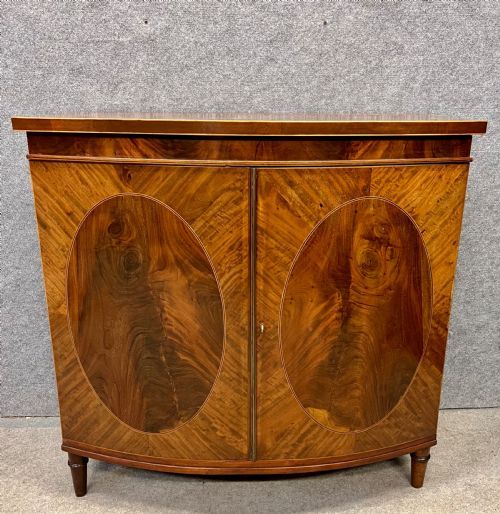
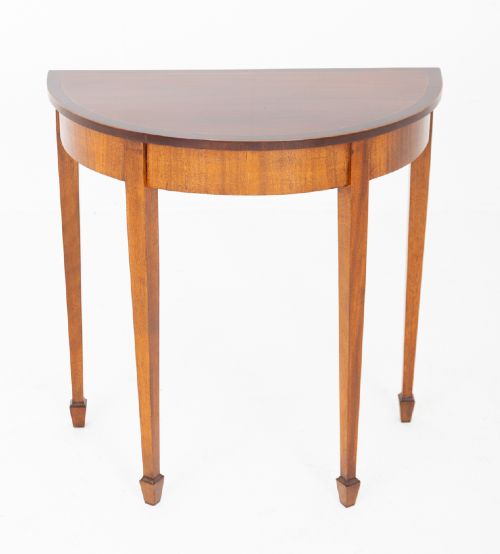
The search phrase edwardian inlaid demi lune describes semi-circular tables and cabinets made with flat backs to stand flush against a wall. The pieces appearing most often in these selections date from the Edwardian period, frequently adopting Sheraton Revival styles with classical motifs.
Makers produced these semi-circular forms primarily as console tables, card tables, and display cabinets. Card and tea tables feature fold-over tops that open to reveal baize-lined playing surfaces, while sideboards and cabinets provide enclosed storage beneath curved surfaces.
Origins stretch from genuine 18th-century George III pieces through 19th-century interpretations up to Edwardian and later 20th-century revivals. Mahogany and satinwood form the foundation of most items, embellished with contrasting stringing and marquetry.
How They Were Made
Cabinet makers utilised solid timbers and selected veneers of mahogany and satinwood over pine or oak carcases, bending wood or constructing curved rails to form the half-moon shape. Burr elm, burr yew, and rosewood also appear in select pieces.
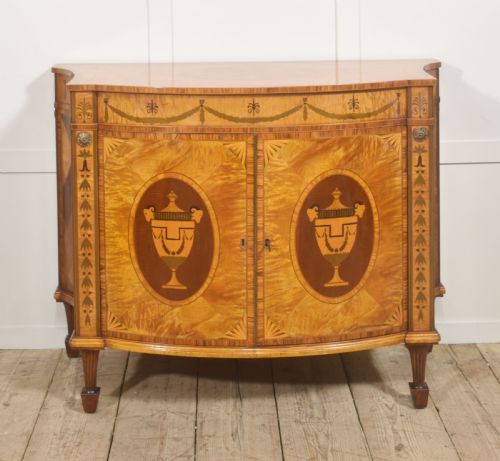
Wood inlay, boxwood inlay, and satinwood inlay create crisp geometric borders, floral swags, and classical urn motifs across the curved aprons and top surfaces. Brass hinges and swing-leg mechanisms support the folding tops of card tables.
Card tables often conceal secret double-lift tops designed to hide winnings away from prying eyes.
What Varies in Quality
The crispness and depth of the marquetry and stringing separate standard production from finer workshop output, where individual pieces show meticulous hand-cut contrasts in boxwood and satinwood. Figured timber selection on the top surface changes the visual impact entirely.
Construction methods distinguish everyday furniture from superior examples, particularly the stability of the curved frame and the smooth action of folding card table tops. Original brass hardware and well-fitted internal pivot legs indicate higher workshop standards.
Edwards and Roberts
The Edwardian Inlaid Demi Lune Glossary
- Demi-lune
- A half-moon shape used for console tables, commodes, and card tables designed to sit flat against a wall.
- Marquetry
- Decorative woodwork where pieces of veneer are fitted together to form pictorial or geometric patterns on a surface.
- Stringing
- Thin lines of contrasting wood inlaid into grooves to outline tabletops, drawers, and panel borders.
- Sheraton Revival
- A late 19th and early 20th-century style copying the lighter, neoclassical furniture designs of the 18th-century designer Thomas Sheraton.
- Console table
- A table supported by wall brackets or front legs, built to stand against a wall rather than free in a room.
Edwardian Inlaid Demi Lune: Frequently Asked Questions
What is a demi-lune table used for?
These half-moon pieces function as serving tables, hall consoles, or display surfaces against a flat wall. Folding versions open out to provide a stable surface for card games and tea.
Their shallow depth allows them to sit in narrow hallways and tight spaces where rectangular furniture blocks movement.
How do I spot a Sheraton Revival piece?
Sheraton Revival items date mainly from the late 19th and early 20th centuries, copying the lighter proportions and neoclassical decoration of the 18th century. Look for satinwood veneers, painted or inlaid swags, and tapered legs.
They combine earlier classical motifs with the cleaner manufacturing techniques of the Edwardian era.
Can I use a card table every day?
Folding card tables handle regular daily use provided you lift and support the swinging rear leg carefully when opening the top. The hinges and pivot joints bear weight when unfolded, so avoid placing heavy loads on the extended leaf.
Closed, the flat top functions identically to a standard console or pier table.
How do I care for inlaid wood surfaces?
Keep inlaid tables away from direct sunlight and strong heat sources to prevent the delicate boxwood and satinwood veneers from drying and lifting. Dust regularly with a dry cloth and apply a quality furniture wax sparingly.
Avoid using liquid polishes or placing damp glasses directly on the polished timber.