
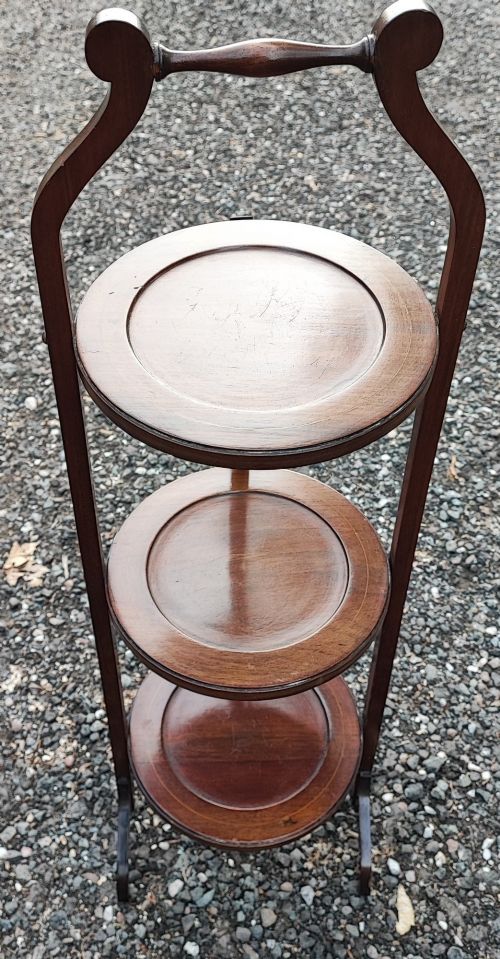


Edwardian Inlaid Cake Stand
These edwardian inlaid cake stand pieces are tiered wooden display furniture designed for serving afternoon tea.
Edwardian Inlaid Cake Stand
When you search for an edwardian inlaid cake stand, you encounter tiered wooden furniture primarily originating from the Edwardian period alongside examples from the early twentieth century. Most pieces take the form of three-tier folding stands, circular or oval etageres, and side tables designed to display items rather than serve as heavy tables.
The prevailing style reflects Sheraton Revival influences, dominated by mahogany structures decorated with contrasting wood details. While the majority of pieces date strictly to the Edwardian era, occasional Victorian precursors and pieces from around nineteen hundred appear in the selection.
Assessing quality and craftsmanship
The distinction between standard examples and finer pieces lies in the precision of the satinwood and boxwood inlay work. Crisp lines and intricate contrasting details elevate a piece above simpler timber frames.
Structural execution also determines standing quality, particularly in the stability of three-tier folding mechanisms and oval shelves. Finer examples maintain rigid alignment when extended while retaining smooth movement in the joints.
Some stands are described as double, providing extra tiers for when one level of cake simply is not enough.
The Edwardian Inlaid Cake Stand Glossary
- Etagere
- A set of open shelves for displaying small objects. This tiered form provides multiple circular or oval surfaces for presentation.
- Sheraton Revival
- A late nineteenth and early twentieth century design movement inspired by late eighteenth century neoclassicism. It relies on mahogany veneers and delicate contrasting inlay.
- Satinwood
- A durable exotic timber with a lustrous yellowish sheen. Cabinetmakers employed it as a contrasting veneer for inlay work.
- Boxwood
- A dense, pale wood used for fine stringing and geometric inlay. Its neutral light tone contrasts sharply against dark mahogany.
Edwardian Inlaid Cake Stand: Frequently Asked Questions
How do I use a cake stand today?
These tiered stands function well in modern interiors for displaying plants, books, or decorative objects rather than serving afternoon tea.
Their compact footprints make them suitable as side tables or corner display shelves in living spaces.
Can these stands be folded away?
Many examples feature hinged mechanisms that allow the tiers to collapse for flat storage when not in use.
Inspect the brass hardware to ensure the folding action operates smoothly without straining the surrounding mahogany frame.
What wood are most stands made from?
Mahogany serves as the primary structural timber for the vast majority of these pieces.
Cabinetmakers embellished this dark wood with lighter satinwood and boxwood inlay.
Are all these stands from the Edwardian era?
The majority of pieces date from the Edwardian period and the surrounding years of nineteen hundred to nineteen ten.
Occasional pieces reflect Victorian origins from the eighteen sixties while sharing similar tiered wooden forms.