
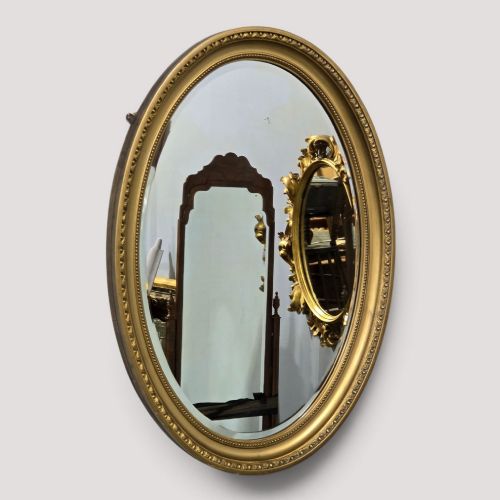

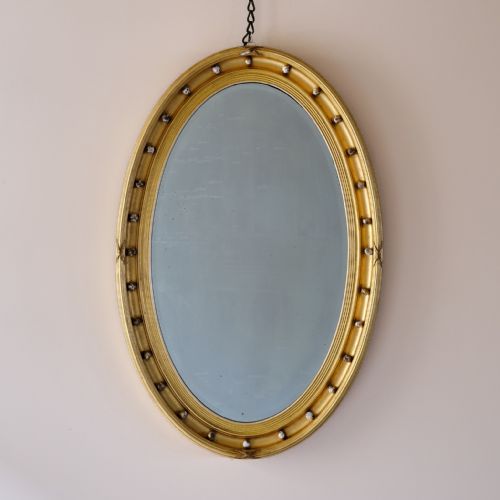


Edwardian Giltwood Oval Mirror
An edwardian giltwood oval mirror brings light and neoclassical symmetry to a room, offering the refined proportions collectors seek.
Edwardian Giltwood Oval Mirror
The edwardian giltwood oval mirror combines the curved plates of the period with carved wooden frames finished in gold. These pieces appear frequently in Adam revival and classical styles, reflecting the taste of the early twentieth century.
Most examples function as wall mirrors or overmantels, designed to hang vertically or horizontally depending on the room. Buyers encounter both single frames and matched pairs finished with rope twists, gesso decoration, or eagle crests.
The materials span traditional timber bases coated in composition and gesso, carrying either standard or mercury glass plates. Pieces range from simple Edwardian framing to revival interpretations of eighteenth-century designs.
Materials and construction methods
Makers shaped wooden timbers to form the oval core, applying layers of gesso to build up decorative reliefs and classical motifs. Artisans then gilded these surfaces using gold leaf or composition leaf to achieve a bright metallic finish.
Mirror glass was set into the rebates, occasionally retaining original mercury plates that show characteristic age spots. Carved elements such as rope twists or crests were attached to the main frame before the final gilding process.
Some frames incorporate watchful wooden eagles perched above the glass, keeping a sharp eye on the drawing room.
Assessing quality in framing and glass
Quality depends upon the crispness of the gesso carving and the depth of the gilding applied over the timber base. Finer examples display hand-carved wooden details rather than heavy composition mouldings.
The condition of the mirror plate and the integrity of the original frame construction determine the standing of each piece. Retaining original mercury glass or untouched period surfaces marks the upper tier of available mirrors.
The Edwardian Giltwood Oval Mirror Glossary
- Giltwood
- Wood that has been coated with gold leaf. This finish provides the characteristic metallic sheen seen on period frames.
- Gesso
- A plaster-like mixture applied to wood frames to create a smooth surface for carving and gilding. Artisans use it to model fine decorative details.
- Mercury Plate
- A glass mirror backed with a tin-mercury amalgam. This historic silvering method produces a mottled, atmospheric reflection.
- Girandole
- A wall mirror featuring attached candle sconces. These reflective branches help amplify candlelight in historic interiors.
- Adam Revival
- A decorative style inspired by eighteenth-century neoclassical designs. It utilises symmetrical motifs, husks, and urns popular in Edwardian interiors.
Edwardian Giltwood Oval Mirror: Frequently Asked Questions
How do I hang a heavy giltwood mirror safely?
Ensure the wall fixings engage directly with structural studs or masonry rather than plaster alone. Use sturdy picture wire or D-rings rated well above the weight of the frame.
Position the mirror at eye level to balance the room and reflect natural light effectively across the space.
How should I clean an antique giltwood frame?
Dust the carved surfaces gently with a soft, dry brush to remove particles without disturbing the delicate gold leaf. Avoid liquid cleaners and chemical sprays, which can strip the historic finish.
Clean the glass plate using a cloth dampened slightly with distilled water, taking care not to let moisture seep beneath the frame.
What is the difference between Edwardian and Adam revival styles?
Edwardian mirrors reflect the domestic tastes of the early twentieth century, often drawing freely on earlier decorative vocabulary. Adam revival pieces specifically replicate the neoclassical symmetry and delicate urn motifs of the eighteenth century.
Both styles frequently utilise gilt gesso over wooden frames, making construction techniques similar across the two categories.
Are original mirror plates common on these pieces?
Many pieces retain their original glass, which may show light foxing and dark spots accumulated over a century. These signs of age confirm the historic nature of the plate.
Replacement glass appears on pieces where the original mirror suffered breakage, though surviving early plates remain desirable for collectors.