


Edwardian French Style Bureau
An edwardian french style bureau is a refined writing piece designed for private correspondence, bringing Continental elegance and compact practicality into the home.
Edwardian French Style Bureau
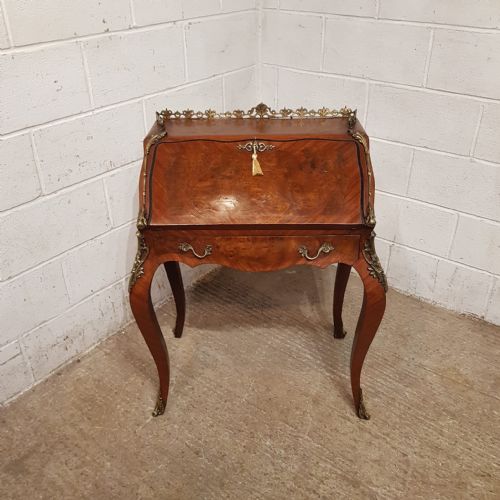
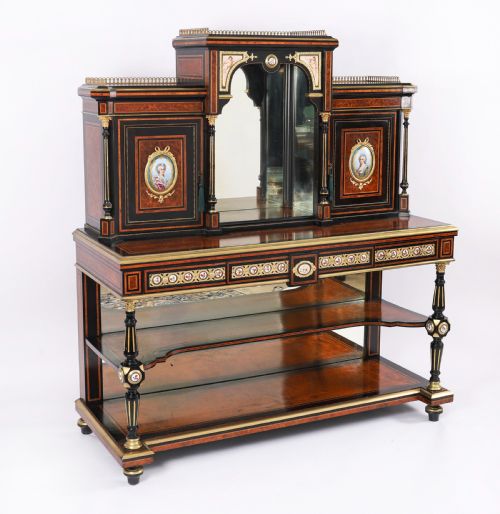
When you search for an edwardian french style bureau, you are looking at sophisticated writing desks and cabinets influenced by Continental tastes, particularly the bonheur du jour and ladies writing desk forms. These pieces bridge the gap between ornamental furniture and practical writing furniture, often featuring tiered superstructures, small drawers, and fitted compartments.
On this page, you will most frequently encounter variations like the bonheur du jour, alongside related writing desks and side cabinets from periods ranging from the Victorian era to around nineteen-twenty. Makers and cabinetmakers of the time drew heavily on Louis XV and Louis XVI revivals, producing refined items intended for the boudoir or drawing room.
The forms span compact walnut ladies desks, mahogany writing tables, and rosewood cabinets decorated with marquetry. While the search phrase points towards Edwardian interpretations, the actual selection encompasses nineteenth-century and later pieces that share the same French aesthetic lineage.
How they were made
Cabinetmakers constructed these desks using a solid timber frame veneered with choice hardwoods such as mahogany, walnut, rosewood, amboyna, and burr walnut. These decorative veneers were often arranged in symmetrical patterns and enhanced with intricate marquetry or floral inlay.
Metal ornamentation played a defining role, with cast brass and ormolu mounts applied to corners, legs, and framing elements to accentuate the continental curves and lines. Leather inserts were commonly fitted to the writing surfaces, providing a durable and tactile writing area framed by gilded tooling.
Several desks include secret compartments hidden behind tiny internal drawers for confidential correspondence.
What varies in quality
The distinction between standard examples and the finest work lies in the depth of detailing, the choice of veneer timbers, and the crispness of the bronze or brass mounts. Finer pieces exhibit hand-chased ormolu and meticulously cut marquetry rather than simpler stamped metal or printed decoration.
Structural refinement also separates the ranges, seen in the smooth operation of small drawers, the quality of internal pigeonholes, and the selection of secondary timbers used inside the carcase.
Edwards and Roberts·Linke
The Edwardian French Style Bureau Glossary
- Bonheur du jour
- A small, light ladies writing desk featuring a raised superstructure with drawers or pigeonholes above the main writing surface. This French form became immensely popular in various revival styles during the nineteenth and early twentieth centuries.
- Ormolu
- Gilded bronze mounted onto furniture as a decorative trim and structural accent. The best examples are finely chased and fire-gilded.
- Marquetry
- The art of applying decorative pieces of veneer to a structure to form intricate pictorial or geometric designs. Craftsmen used contrasting timbers to achieve naturalistic shading and detail.
- Secrétaire abattant
- A tall cabinet featuring a drop-down writing flap that conceals a fitted interior of small drawers and compartments. It combines vertical storage with a functional writing surface.
- Kingwood
- A dense, heavily figured exotic timber prized for its rich brown colour and contrasting dark grain. It frequently appeared as a prestige veneer on high-end cabinetwork.
Edwardian French Style Bureau: Frequently Asked Questions
What is a bonheur du jour?
A bonheur du jour is a small, elegant ladies writing desk featuring a raised back section with small drawers or shelves above the writing surface.
First appearing in France, these pieces were designed for reading letters and writing notes in private sitting rooms rather than formal studies.
How do I care for polished wood?
Keep these desks away from direct sunlight and heat sources to prevent the timber and veneers from drying out or splitting.
Dust regularly with a soft, dry cloth and apply a quality beeswax occasionally to nourish the polished surface without building up a heavy residue.
Where were these desks used?
These refined writing desks were traditionally kept in private chambers, boudoirs, and sophisticated drawing rooms rather than grand libraries.
Their compact proportions allowed them to function as decorative display pieces as well as practical writing furniture.
How do I distinguish revival styles?
Louis XV revival pieces generally display flowing serpentine curves, cabriole legs, and asymmetrical rococo mounts. Louis XVI style pieces introduce straighter architectural lines, fluted tapered legs, and neoclassical symmetry.