
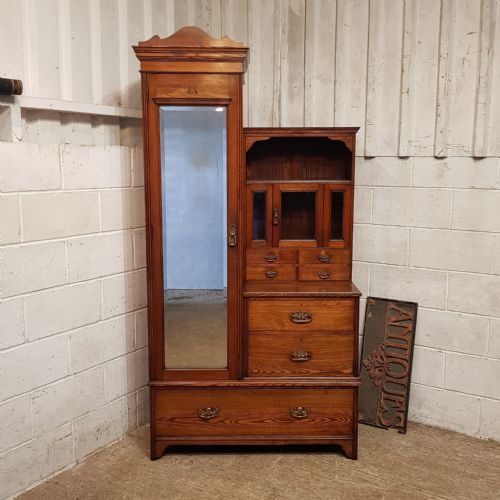


Edwardian Combination Wardrobe
An edwardian combination wardrobe brings together hanging space, drawers and shelving in one substantial bedroom piece, offering serious storage alongside period character.
Edwardian Combination Wardrobe
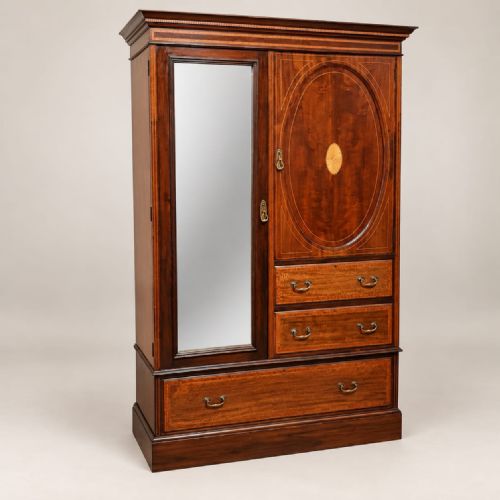
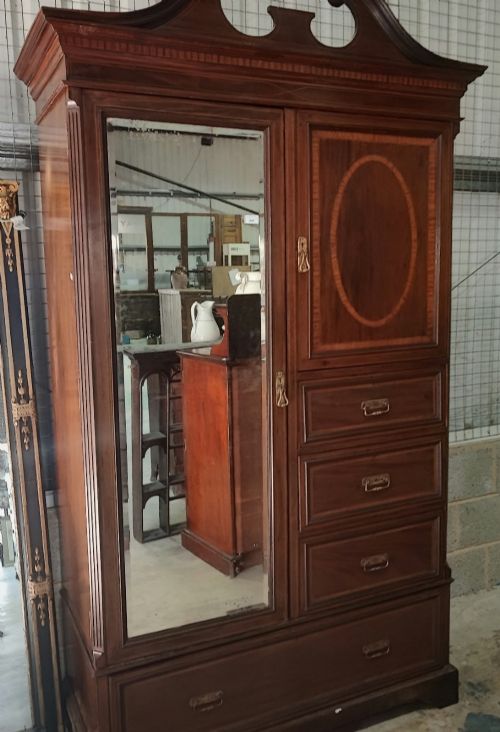
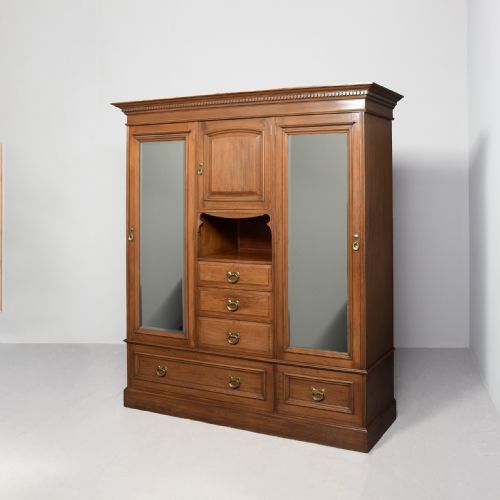
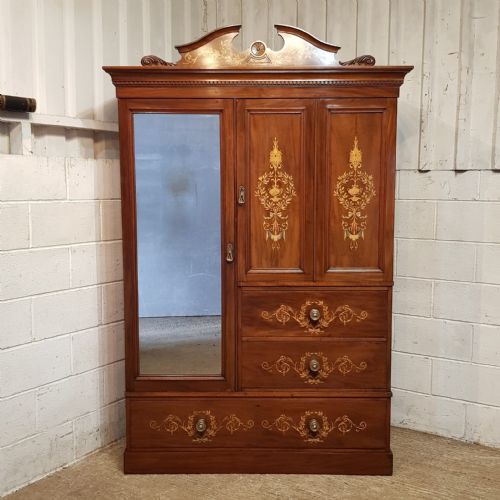
An edwardian combination wardrobe unites hanging compartments with integral drawer stacks and mirrored doors, emerging primarily from the period around 1900. Buyers encounter pieces spanning late Victorian to early twentieth-century production, incorporating styles from Arts and Crafts simplicity to Art Nouveau curves.
The format typically divides into multi-section units designed to dismantle for transport into domestic spaces. Alongside standard mahogany and walnut examples, forms range from compactum wardrobes to large triple configurations incorporating press sections.
How They Were Made
Cabinet makers utilised timbers such as mahogany, satinwood, walnut, ash, oak and pine, frequently selecting figured veneers to cover expansive door panels. Internal construction involved solid secondary woods for drawer framing and carcase backs, assembled with traditional jointing methods.
Surface enrichment relied on contrasting wood inlays, marquetry motifs and lead light glass panels. Hardware typically comprised brass handles, escutcheons and hanging hooks, paired with bevelled mirror glass set into central doors.
Listings feature mahogany, walnut, satinwood, ash, oak and pine across the Edwardian and Victorian periods.
What Varies in Quality
The grade of an edwardian combination wardrobe depends on timber selection, from plain pine and satin walnut up to finely figured mahogany and burr satinwood. Superior execution appears in crisp inlay work, substantial brass hardware and the precision of fitted internal drawers.
Structural integrity differentiates standard output from workshop pieces bearing maker stamps. The complexity of carcase dismantling systems and the quality of bevelled mirror glass further divide baseline utility from higher tier examples.
Edwards and Roberts·Maple & Co·James Shoolbred & Co
The Edwardian Combination Wardrobe Glossary
- Compactum
- A fitted wardrobe incorporating internal drawers, shelves and hanging space within a single multi-door carcase.
- Press
- A traditional storage unit with upper shelving enclosed by doors above a lower chest of drawers.
- Lead light
- Glass panels held together by lead cames, frequently seen in geometric or floral cabinet designs.
- Marquetry
- Decorative patterns formed by fitting together contrasting veneer slices onto a carcase surface.
Edwardian Combination Wardrobe: Frequently Asked Questions
Do these wardrobes dismantle?
Most large pieces separate into modular sections, cornices, plinths and doors to facilitate transport and installation in modern rooms.
Buyers should check individual listings to confirm whether a specific unit disassembles or remains fixed in one piece.
How do I identify the period?
Key indicators include timber choice, inlay styles, handle designs and construction methods typical of around 1900.
Late Victorian pieces often show heavier proportions, whilst Edwardian examples favour lighter satinwood or inlaid mahogany.
What is a compactum wardrobe?
A compactum is a multi-section piece combining hanging space, linen shelves and internal drawers in one footprint.
This format maximises bedroom storage by integrating functions that previously required separate furniture items.
How do I care for the wood?
Maintain timber surfaces by avoiding direct sunlight and excessive humidity shifts that affect antique veneers.
Regular dusting with a dry cloth preserves the polished finish without building up heavy wax layers.