

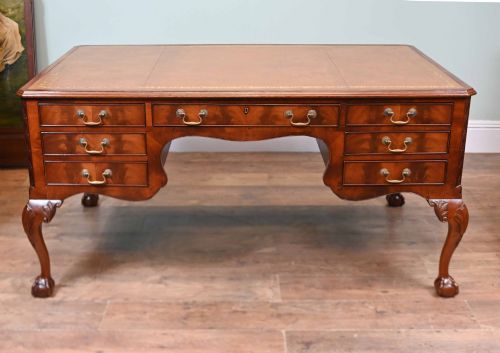
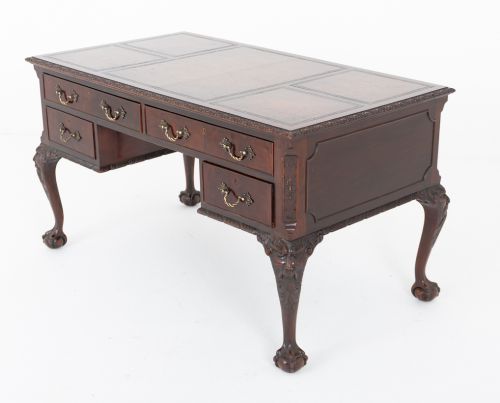
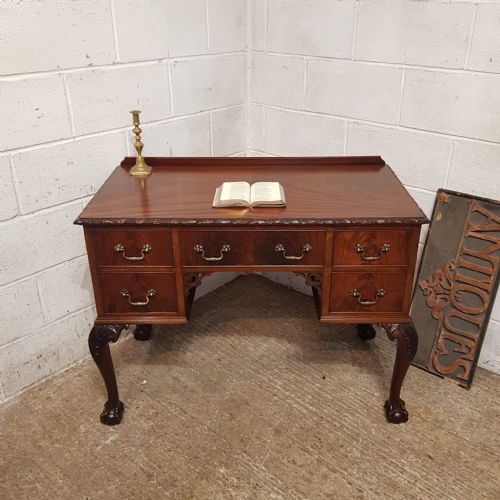


Edwardian Chippendale Writing Table
An Edwardian Chippendale writing table brings restrained classicism and rich timber to a study, built for daily correspondence and formal writing.
Edwardian Chippendale Writing Table
An edwardian chippendale writing table unites 18th-century revival aesthetics with the practical requirements of early 20th-century studies and libraries. Buyers encounter various forms on this page, ranging from compact side tables and kneehole desks to twin-pedestal configurations.
The revival aesthetic draws heavily upon Georgian design principles, reinterpreting classic proportions for Edwardian homes. Many examples date from around nineteen hundred to the nineteen-twenties, alongside pieces reflecting earlier 19th-century revivals.
Desks and writing tables dominate the selection, often featuring inset leather surfaces tailored for practical use. Side tables and drum tables also appear, offering alternative surfaces while retaining the characteristic aesthetic.
Materials and Construction
Mahogany serves as the primary timber across the selection, prized for its strength and rich grain. Selected pieces also incorporate walnut and burr walnut to introduce varied figure and tone.
Functional hardware utilises brass for handles, escutcheons and mounts, complementing the darker wood tones. Writing surfaces frequently incorporate inset leather panels to provide a durable and tactile working area.
Edwardian Chippendale Writing Table Retail Price Guide 2026
Typical asking prices for edwardian chippendale writing table among the pieces listed under this phrase on Sellingantiques today, from the lower quarter to the upper quarter. They describe what is for sale here now, not the wider market.
Listings feature mahogany as the predominant timber, alongside walnut and burr walnut.
Judging Quality
Quality rests upon the crispness of carved detail and the selection of timber veneers. Superior examples display refined proportions and careful matching of mahogany grain across prominent surfaces.
The integrity of the construction and the quality of secondary woods dictate longevity. Master cabinetmakers distinguished their work through precise joinery and substantial brass fittings that endure decades of use.
Gillows·Druce and Co·Shapland and Petter
The Edwardian Chippendale Writing Table Glossary
- Pedestal Desk
- A freestanding desk comprising two supporting pedestals beneath a top with a central writing space. They offer substantial storage through banks of drawers.
- Kneehole Desk
- A compact desk with a central recessed space for the user's legs, flanked by columns of drawers. This form allows for efficient storage in smaller rooms.
- Drum Table
- A circular table with a deep frieze containing drawers, revolving on a central pillar and tripod base. These tables function effectively as centre or writing pieces.
- Serpentine Front
- A furniture front curving outward at the centre and inward toward the ends. This curved profile adds visual movement and requires expert woodworking skill.
Edwardian Chippendale Writing Table: Frequently Asked Questions
What is an edwardian chippendale writing table?
It is a piece of furniture produced around the Edwardian period that reinterprets 18th-century Chippendale styles for writing and administrative tasks.
These desks combine traditional carved details with the practical domestic requirements of early twentieth-century homes.
How do I use one in a modern home?
They function effectively as traditional writing desks or as characterful dressing tables in bedrooms. Their compact proportions suit placement against living room walls or inside dedicated home offices.
The integrated leather writing surfaces and drawers provide practical storage for stationery and modern writing implements.
How do I tell a pedestal desk from a side table?
Pedestal desks feature two substantial columns of drawers supporting the main writing surface, offering significant internal storage. Side tables lack these flanking pedestals and generally present an open underframe.
Writing tables often sit between these two forms, containing a single row of shallow drawers beneath the top.
What woods were used to make these desks?
Mahogany forms the vast majority of the timber used in these pieces, providing durability and a deep reddish-brown colour. Walnut and burr walnut also appear occasionally to offer distinctive grain patterns.
Brass hardware and leather writing inserts complement the primary timber.