

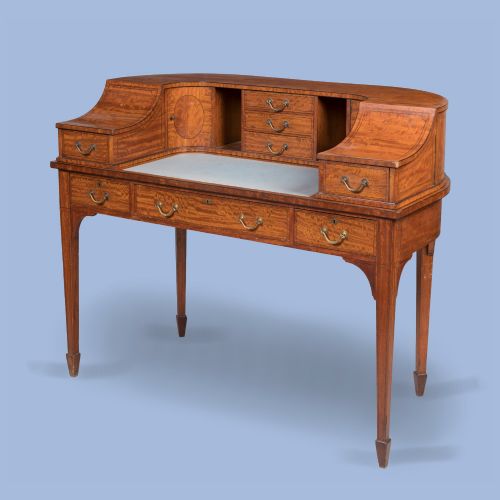


Edwardian Carlton Desk
An Edwardian carlton desk brings supreme elegance to a study with its distinctive tiered superstructure of small drawers and compartments.
Edwardian Carlton Desk
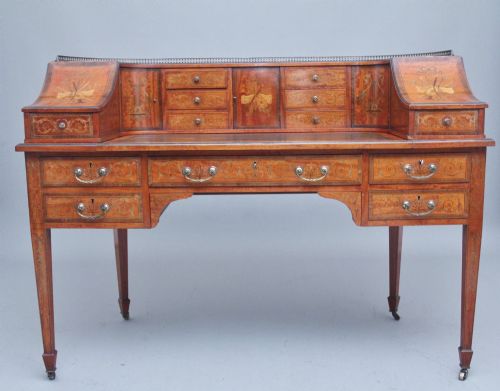
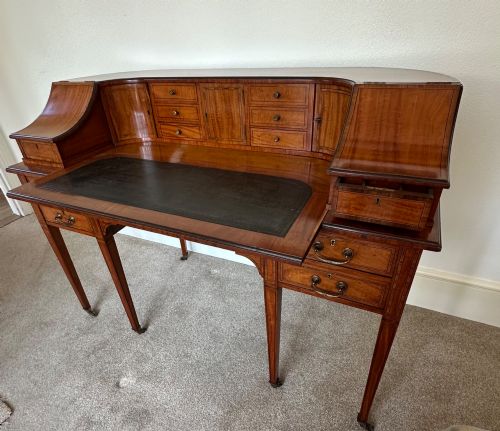
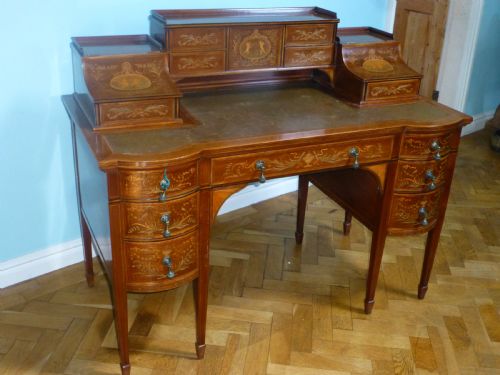
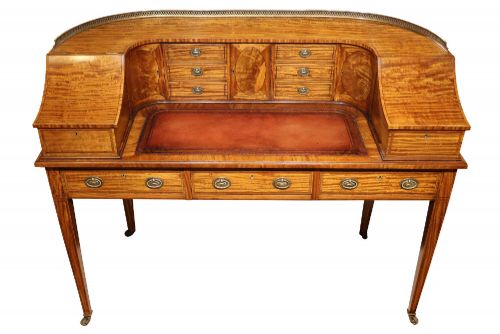
The edwardian carlton desk is a sophisticated writing table featuring a curved superstructure fitted around the back and sides with stationery drawers, pigeonholes, and cupboards. Most examples found here belong to the Edwardian period, often adhering to Sheraton Revival aesthetics.
Makers of the period also produced variations in mahogany, satinwood, and walnut, frequently incorporating marquetry inlay or kingwood crossbanding. These pieces combine compact proportions with multiple compartments designed for correspondence and paperwork.
While many date from around nineteen hundred, pieces associated with Victorian and late nineteenth century production also appear. The form builds upon eighteenth century origins, maintaining a refined writing surface flanked by storage tiers.
How they were made
Construction relies heavily on timber framing using mahogany, satinwood, and walnut, often lined with oak for drawer interiors. Cabinetmakers utilised brass handles, leather writing surfaces, and fine wood inlays to elevate the decorative scheme.
Marquetry and painted decoration embellish the flat surfaces and curved tiers, reflecting neoclassical and Sheraton revival tastes. Crossbanding in kingwood adds contrasting borders to mahogany and satinwood panels.
The superstructure curves seamlessly around the desk top, requiring skilled joinery to align the small drawers and compartments within the fitted back.
Edwardian Carlton Desk Retail Price Guide 2026
Typical asking prices for edwardian carlton desk among the pieces listed under this phrase on Sellingantiques today, from the lower quarter to the upper quarter. They describe what is for sale here now, not the wider market.
Listings feature mahogany, satinwood, walnut, and kingwood, alongside painted decoration and marquetry inlay.
What varies in quality
Quality rests upon the choice of timbers and the precision of the marquetry or wood inlay across the curved superstructure. Finely figured mahogany or meticulously matched satinwood distinguishes superior examples from standard production.
Interior details such as oak lined drawers, original brass hardware, and finely executed painted floral motifs elevate a piece. The crispness of the Sheraton revival detailing and the integration of secondary woods indicate the tier of craftsmanship.
Edwards and Roberts·Maple of London·Maple and Co·Shoolbred and Co
The Edwardian Carlton Desk Glossary
- Superstructure
- The tiered arrangement of small drawers and pigeonholes rising above the main writing surface. It defines the silhouette of the form.
- Crossbanding
- A strip of veneer applied around the border of a panel with the grain running perpendicular to the centre. This technique frames the primary wood.
- Marquetry
- Decorative patterns formed by fitting together small pieces of tinted or textured veneer. It appears across the curved backs of these desks.
- Kingwood
- A dense, dark exotic timber used for contrasting crossbanding and banding lines. It provides a rich visual border on satinwood surfaces.
- Sheraton Revival
- A late nineteenth and early twentieth century design movement drawing inspiration from eighteenth century neoclassical furniture. It prioritises light timbers and delicate inlay.
Edwardian Carlton Desk: Frequently Asked Questions
What is an edwardian carlton desk?
An edwardian carlton desk is a writing table featuring a curved superstructure of small drawers and pigeonholes around the back and sides. It offers compact writing space combined with structured stationery storage.
Most surviving examples date from around nineteen hundred, reflecting sheraton revival tastes with inlaid mahogany or satinwood surfaces.
How were these desks used?
They served as dedicated writing furniture for correspondence and private paperwork in domestic studies and drawing rooms. The numerous compartments kept writing materials and letters organised.
The leather inset surface provided a smooth plane for writing while the surrounding tiers kept essential papers within reach.
How do you date an edwardian carlton desk?
Dating relies on timber selection, construction methods, and stylistic cues such as sheraton revival marquetry or painted floral decoration. Edwardian examples typically feature oak drawer linings and precise wood inlays.
Late nineteenth century and victorian precursors often display similar mahogany and satinwood construction with neoclassical influences.
Where should you place one?
Because the curved superstructure is finished on all sides, many examples function well as freestanding pieces in the centre of a room. They suit studies, libraries, and living spaces where the decorative back remains visible.
Positioning them away from direct heat sources protects the polished veneer and leather writing inserts from drying out.