


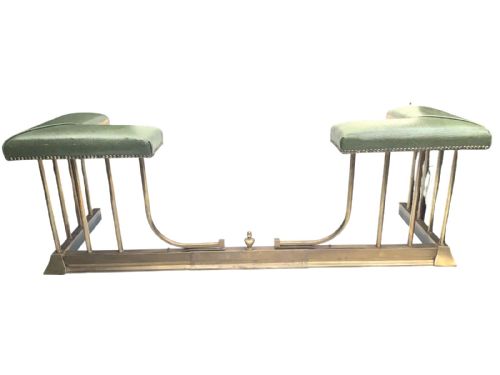


Edwardian Brass Club Fender
An edwardian brass club fender brings fireside seating and structural weight to a hearth, combining sturdy metal framework with low upholstered pads.
Edwardian Brass Club Fender
An edwardian brass club fender is a substantial hearth accessory designed to surround an open fireplace while providing low bench seating for warming feet. These pieces typically present a low open metal frame with corner or side uprights supporting cushioned seats at hearth level.
The versions most commonly met on this page span the Edwardian period and the late nineteenth century, frequently incorporating polished or patinated brass alongside leather upholstery. Examples range from simple low rails to extending designs and hybrid constructions incorporating copper or cast iron elements.
Beyond standard Edwardian brass club fenders, the selection includes variants with velvet cord, fabric, or Chesterfield-style leather seats tailored for traditional English country house interiors. Their primary function remains bridging the gap between functional fire safety and comfortable fireside lounging.
How they were made
Makers constructed the primary framework of an edwardian brass club fender using tubular or solid brass sections, often joined to cast iron or copper components for added structural stability. Metalwork surfaces received varying finishes, from bright polished brass to darker patinated or anodised treatments.
Seats incorporated traditional upholstery materials stretched over internal padding, utilising leather, velvet, or fabric secured directly to the upper frame. Many examples featured clever mechanical extenders allowing the width of the fender to adjust neatly to specific hearth dimensions.
Edwardian Brass Club Fender Retail Price Guide 2026
Typical asking prices for edwardian brass club fender among the pieces listed under this phrase on Sellingantiques today, from the lower quarter to the upper quarter. They describe what is for sale here now, not the wider market.
Listings feature Edwardian, Victorian, and early twentieth-century periods constructed from brass, leather, velvet, and copper.
What varies in quality
The distinction between standard examples and finer pieces rests in the weight of the brass gauge and the complexity of the upright supports. Heavier framework and cast bronze or solid brass details indicate superior construction intended for daily domestic use.
Upholstery execution and mechanism precision also define the tier of a piece, particularly in extendable models where smooth sliding action and deep-buttoned leather or velvet upholstery reflect higher workshop standards.
Maple & Co
The Edwardian Brass Club Fender Glossary
- Club fender
- A low fireside surround fitted with upholstered seats on either side. These pieces originated in gentlemen's clubs before entering domestic country houses.
- Extender
- A mechanical sliding mechanism built into the fender framework. This allows the overall width to expand or contract to fit different fireplace hearths.
- Uprights
- The vertical metal columns or spindles supporting the seat section. They appear in cylindrical, baluster, or plain configurations.
- Chesterfield seat
- A low padded bench cushion featuring deep button tufting. This style provides firm support and traditional visual depth.
- Patination
- The natural surface oxidation accumulated on brass and copper over time. Collectors value undisturbed patination for its historical authenticity.
Edwardian Brass Club Fender: Frequently Asked Questions
How do you use a club fender?
Club fenders are placed directly around the fireplace opening to form a physical boundary between the fire and the room. The integrated upholstered pads function as low seats for warming oneself near the flames.
Positioning one requires measuring the hearth width carefully to ensure the frame clears the fire surround. Many models include extendable frames to help achieve a precise fit against the brickwork.
How do I date a brass club fender?
Dating relies on examining construction methods, metal finishes, and upholstery styles alongside design proportions. Edwardian examples often feature polished brass and restrained detailing compared to heavier Victorian counterparts.
Makers occasionally incorporated specific materials like copper or cast iron that help narrow down the production era. Surviving trade labels or stamps, when present, provide definitive chronological markers.
Are club fenders adjustable?
Many club fenders were built with extending mechanisms that allow the overall width to be adjusted. These extending versions accommodated varying fireplace dimensions in large country houses.
Checking the inner rails reveals whether a specific piece possesses this extending capability. Fixed-width models remain equally common across the historical record.