




Brass Hearth Guard Seat
A brass hearth guard seat offers a sturdy fireside perch, combining metalwork with upholstered comfort.
Brass Hearth Guard Seat
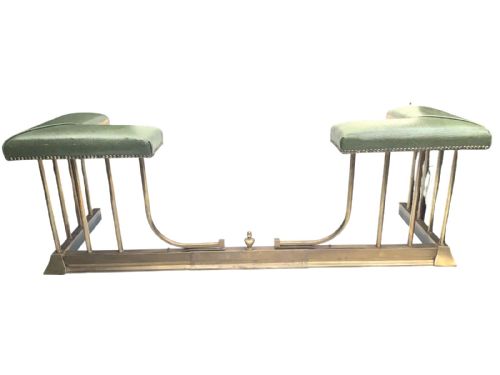
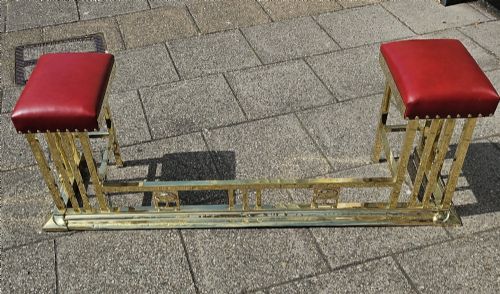
A brass hearth guard seat, commonly known as a club fender, provides a low, padded boundary around the fireplace while doubling as a convenient seat. These practical furnishings appear primarily in Victorian and Edwardian iterations, reflecting traditional English country house interiors.
Buyers encountering this page will frequently see club fenders constructed from polished brass, often paired with leather upholstery. Pieces range from straightforward metal frames to more elaborate designs incorporating copper or cast steel elements.
The form typically stays close to a low, open rectangular structure designed to sit directly on the hearth. Variations include models with extender sections or contrasting silvered finishes.
Materials and construction
Makers utilised solid brass tubing and structural metal to build the robust frames required to withstand daily sitting and hearth heat. Cast steel and copper occasionally feature alongside the primary brass framework, adding weight and tonal contrast.
Upholstered seats were finished in hard-wearing materials such as leather, fabric, or velvet, fixed securely across the top rails. Traditional padding methods ensured the seat remained firm and supportive during fireside use.
Brass Hearth Guard Seat Retail Price Guide 2026
Typical asking prices for brass hearth guard seat among the pieces listed under this phrase on Sellingantiques today, from the lower quarter to the upper quarter. They describe what is for sale here now, not the wider market.
Some models even feature a sneaky silvered finish to outshine the vicar's tea service.
Judging quality in a brass hearth guard seat
Quality rests in the substantial weight of the brass framework and the precision of the metal junctions. Heavier gauge metal and tight, secure joints distinguish superior examples from lighter, more utilitarian builds.
The upholstery standard further separates the grades, with fine leather or velvet work indicating a higher tier of production. Detail in the metal finishing, such as clean lines on brass and copper combinations or silvered accents, marks the better workshops.
The Brass Hearth Guard Seat Glossary
- Club fender
- A low fireside seat built around a hearth guard, featuring padded top rails for sitting. This form became popular in traditional English country houses.
- Hearth guard
- The protective metal barrier that surrounds an open fireplace to contain sparks and ash. It forms the structural base of the seat.
- Cast steel
- A strong metal alloy utilised in the construction of certain frames for added durability. It provides a darker, industrial contrast to bright brass.
- Extender
- An adjustable section allowing the fender to fit various hearth widths. This addition made standard models adaptable to different room dimensions.
- Silvered finish
- A metallic coating applied to portions of the metal frame for decorative effect. It offers a distinct visual contrast against traditional yellow brass.
Brass Hearth Guard Seat: Frequently Asked Questions
What is a club fender?
A club fender is a low, padded seat built over a metal hearth guard. It allows people to sit close to the fire while keeping a safe distance from the flames.
These pieces were staples of traditional English country houses, designed to make the fireside a social focal point of the room.
How do I date a brass hearth guard seat?
Dating relies on observing the construction methods, materials, and stylistic cues present in the frame and upholstery. Victorian and Edwardian examples often display distinct metalworking techniques and specific seating materials.
Examining the type of brass tubing and the style of the leather or fabric top helps place the piece within the nineteenth or early twentieth century.
Were these seats used in specific rooms?
These furnishings were primarily placed around the main fireplaces in libraries, drawing rooms, and halls of large country houses. Their dual function provided both room heating management and extra seating.
The sturdy construction suited high-traffic domestic spaces where family and guests gathered.
What materials are typical for the seat tops?
Leather remains the most common upholstery material found on these fireside seats, prized for durability and traditional appearance. Velvet and standard fabrics also appear on specific period examples.
These coverings were chosen to withstand the dry heat near the hearth while offering a comfortable surface.