
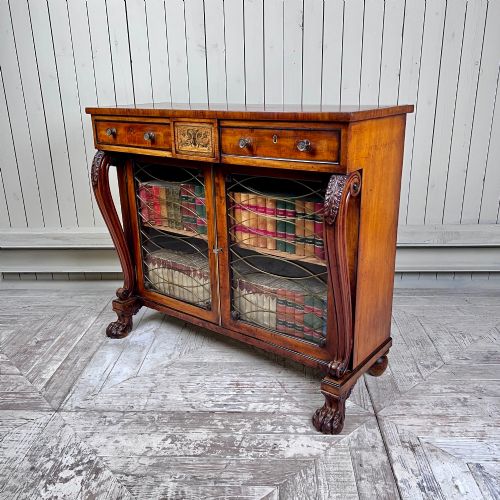
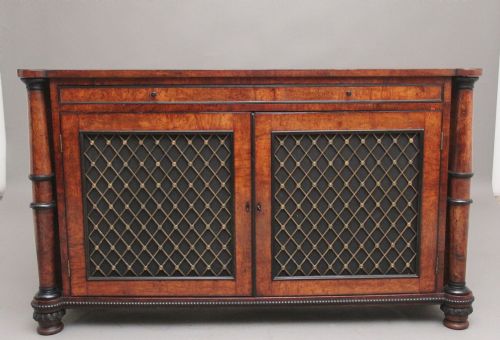

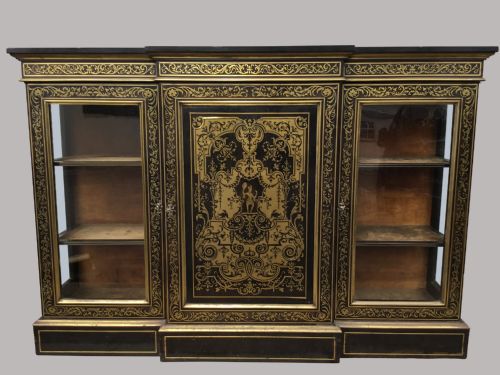


Ebony Inlaid Sideboard
An ebony inlaid sideboard brings rich contrast and linear sharpness to a room, uniting dense dark timber with pale inlay lines.
Ebony Inlaid Sideboard
An ebony inlaid sideboard unites substantial timber carcases with precise dark stringing, creating formal storage pieces for dining rooms and reception spaces. These pieces emerge predominantly from the Regency and Victorian eras, spanning periods from the early nineteenth century through to the late eighteen-eighties. Buyers encountering this selection find forms ranging from grand breakfront sideboards to compact chiffonier bookcases and pier cabinets.
The Regency examples favour mahogany carcases fitted with fine ebony stringing, brass inlay, and restrained proportions. Victorian interpretations lean towards burr walnut, rosewood, and pollard oak, sometimes incorporating French Boulle brass work and ormolu mounts. Side cabinets and credenzas appear alongside traditional sideboards, offering enclosed shelving behind glass or panelled doors.
Materials and construction methods
Cabinet makers constructed these pieces using dense primary timbers such as mahogany, rosewood, burr walnut, and pollard oak over sturdy secondary framing. Craftsmen channelled the timber surfaces to receive contrasting stringing and banding of dark ebony, often pairing the work with cast brass details or gilt ormolu mounts.
The technique relies on precise hand-cutting of wood and metal veneers to fit flush within the primary carcase. Glass panels are integrated into door frames for pier cabinets and glazed credenzas, while breakfront profiles require expert curving and jointing of the timber.
Listings feature periods from the Regency era through the late nineteenth century, using materials including mahogany, ebony, brass, burr walnut, rosewood, ormolu, and pollard oak.
Distinctions in craftsmanship
Quality rests in the crispness of the inlay work and the selection of the underlying timber veneers. Finer examples display perfectly flush ebony stringing that follows intricate curves without gaps or filler.
The choice of figured woods, such as burr walnut or pollard oak, dictates the visual depth of the piece. Superior construction shows in the weight of the carcase, the integration of brass mounts, and the condition of original glass panels.
The Ebony Inlaid Sideboard Glossary
- Ebony stringing
- A narrow inlaid line of dark wood set flush into the surface of a lighter timber carcase. This technique defines the edges and geometric panels of Regency and Victorian furniture.
- Breakfront
- A piece of furniture where the central section projects forward from the flanking wings. This architectural arrangement creates depth and shadow across the front of the sideboard.
- Boulle work
- An elaborate form of marquetry employing tortoiseshell and brass inlay, developed in France and seen on nineteenth-century credenzas. The technique creates a rich tortoiseshell and metal pattern across the cabinet doors.
- Pier cabinet
- A low freestanding cabinet designed to fit the wall space between windows. These pieces often feature glass doors and elaborate wood inlays suited to Victorian interiors.
- Chiffonier
- A compact sideboard featuring enclosed shelving below and sometimes a small bookcase superstructure above. It serves smaller reception rooms where a full dining sideboard proves too large.
Ebony Inlaid Sideboard: Frequently Asked Questions
How do I date an ebony inlaid sideboard?
Dating relies on combining the timber choices with the structural profile and inlay style. Regency pieces often feature mahogany with linear brass and ebony stringing, while Victorian variants introduce burr walnut and heavier proportions.
Examining the secondary woods inside drawers and the construction methods helps confirm whether the piece belongs to the early nineteenth century or the later Victorian decades.
Where should I place a pier cabinet?
Pier cabinets suit narrow wall spaces, particularly the architectural sections between windows or flanking a fireplace. Their shallow depth allows them to sit comfortably in hallways and drawing rooms without obstructing movement.
Glass-fronted variants work well for displaying decorative objects while adding light and reflection to darker corners of a room.
How do I care for antique ebony inlay?
Maintaining these pieces involves keeping them away from direct sunlight and sudden temperature changes that can dry out the timber veneers. Regular dusting with a soft cloth preserves the polished surface without the need for heavy chemical polishes.
Applying appropriate furniture wax occasionally helps nourish the primary woods and protects the flush inlay lines from moisture.