


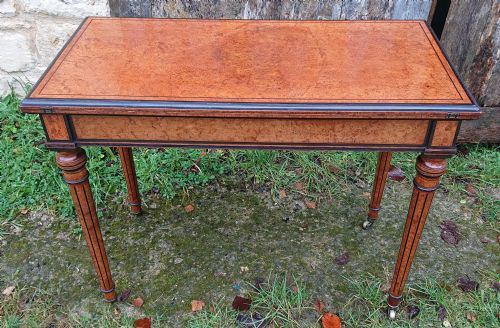


Ebony Console Table
An ebony console table brings dark timber and striking contrast to a room, offering both surface space and architectural presence.
Ebony Console Table
An ebony console table is a narrow furniture form designed to stand against a wall, frequently appearing in Regency, Victorian, and Georgian guises across the records. You will encounter solid dark timbers alongside ebonised wood surfaces, often enriched with contrasting stringing or brass mounts.
The selections span from neoclassical Regency designs attributed to makers like George Oakley to French Louis XV style Boulle work and late Victorian aesthetic movement pieces. Side tables, writing tables, and fold-over card tables frequently share this architectural category in the inventory.
How they were made
Cabinet makers utilised dense exotic timbers like solid ebony alongside secondary woods such as mahogany, oak, and satinwood for carcases and framing. Surface decoration relied on precision inlay, employing boxwood, bone, and brass stringing to define borders and geometric panels.
Techniques varied from parcel gilding and French polishing to elaborate boulle work integrating tortoiseshell and brass. Ebonising remained a prevalent method for transforming lighter fruitwoods or hardwoods into deep black finishes that mimicked solid ebony.
Periods represented span from the sixteenth century through the Georgian and Regency eras to late Victorian and Edwardian items.
What varies in quality
Quality rests upon the crispness of the timber preparation and the precision of the inlay work, where tight joints and flush brass stringing distinguish finer workshops. The structural integrity of the base, whether supported by slender reeded legs or heavy neoclassical columns, dictates the visual weight.
The choice of secondary veneers, such as burr walnut, amboyna, or thuya, alters the richness of the piece. Attribution to known firms like Gillows or Maison Millet elevates the standing of a table through documented craftsmanship.
Maison Millet·Gregory and Co·Gillows·George Oakley
The Ebony Console Table Glossary
- Ebonised
- Wood treated with stain or paint to achieve the deep black appearance of solid ebony. This process allowed makers to utilise more accessible timbers while maintaining a formal dark palette.
- Boulle
- An elaborate marquetry technique using brass and tortoiseshell inlaid into furniture surfaces. It appears primarily on French-inspired pieces from the nineteenth century.
- Stringing
- Thin strips of contrasting wood or light-coloured material set into flush channels on a table top or drawer front. It creates delicate linear borders around panels.
- Parcel Gilt
- Partially gilded surfaces where gold leaf highlights specific carved details, mouldings, or mounts. It provides a sharp visual contrast against dark ebony or ebonised wood.
- Crossbanding
- A border of veneer laid with the grain running perpendicular to the main surface panel. This technique frames the top of a console or card table.
Ebony Console Table: Frequently Asked Questions
What is an ebony console table used for?
These tables provide a narrow surface for display against a hallway or reception room wall, often accompanied by a matching mirror. Their shallow depth allows them to sit in circulation spaces without blocking pathways.
Historically, larger examples functioned as side tables for serving or writing, while variants with folding tops served multiple purposes in compact rooms.
How do I date an ebony console table?
Dating relies on the combination of secondary timbers, leg profiles, and inlay motifs that align with specific design movements. Regency pieces often feature neoclassical brass mounts and clean lines, whereas Victorian examples introduce rich burr veneers and parcel gilding.
Construction methods inside drawers and beneath table tops also offer physical clues to the period of manufacture.
Are these tables made of solid ebony?
True solid ebony is uncommon due to the density and scarcity of the timber, so most examples employ ebonised wood or apply ebony veneers over a stable secondary wood like mahogany or oak.
Contrasting details often incorporate stringing in boxwood or bone to highlight the dark surfaces.
How do I care for antique ebonised furniture?
Maintenance requires gentle dusting with a dry cloth and avoiding excessive moisture or direct sunlight that can dry out the polished finish. Periodic application of appropriate wax preserves the sheen on polished wooden surfaces.
Care should be taken around delicate brass stringing and bone inlay to prevent lifting.