


Ebonised Wood Table Clock
An ebonised wood table clock brings architectural presence and sharp contrast to a room through its dark, polished casing.
Ebonised Wood Table Clock
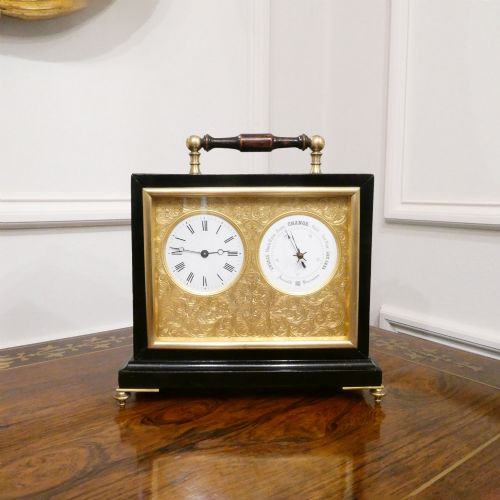
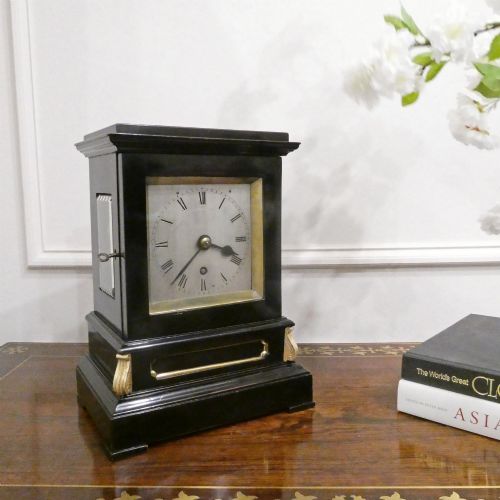
An ebonised wood table clock typically takes the form of a mantel clock, desk clock, or bracket clock designed to sit on a flat surface. These pieces span several distinct periods including the Regency, Victorian, and Edwardian eras, alongside earlier 18th century examples.
The domestic timepiece or striking clock is the version most frequently encountered on this page, often housed in a bell-top, architectural, or bracket case. Makers such as Charles Frodsham and John Taylor represent the calibre of horology found among these forms.
How they were made
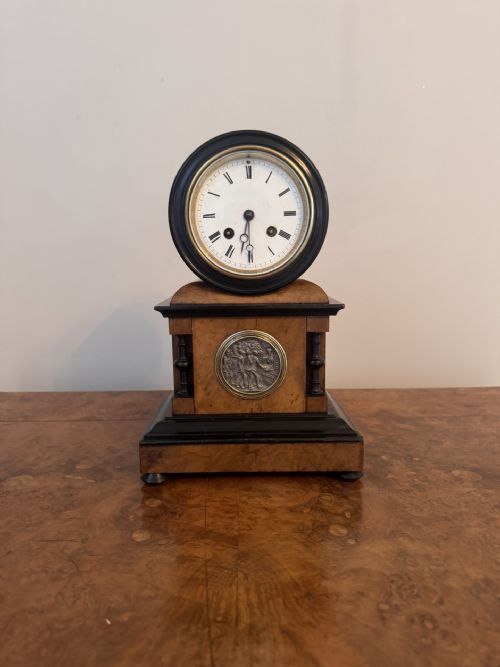
The construction relies on timber treated with a dark stain or finish to imitate ebony, paired with brass, gilt bronze, or ormolu mounts. Glass panels protect the dial and movement, while enamel is frequently used for the clock face itself.
Cases incorporate secondary woods such as burr walnut alongside the primary ebonised finish, often embellished with marquetry or fine metal details. Mechanical movements drive the striking, chiming, and fusee mechanisms housed within these solid enclosures.
Listings feature Victorian, Edwardian, and Regency periods alongside 18th century examples.
What varies in quality
The refinement of the ebonised finish and the crispness of the gilt bronze or brass mounts distinguish the finer examples from simpler production. Superior specimens demonstrate meticulous attention to case joinery and the integration of decorative elements like ormolu.
Horological sophistication also dictates standing, where complex fusee, chiming, or verge movements by recognised makers elevate a piece far above standard domestic timepieces. The harmony between the mechanical complexity and the architectural integrity of the wooden case defines the upper tier.
Des Granges of London·Charles Frodsham·Holingue Freres·John Taylor·D Robertson of Perth·Baldwin of Loughborough·Henry Marc
The Ebonised Wood Table Clock Glossary
- Ebonised wood
- Timber finished with a dark stain or polish to resemble genuine ebony. This treatment provides a uniform black surface popular in period cabinet making.
- Fusee
- A conical pulley used in mechanical clocks to maintain even force on the gear train as the mainspring unwinds. It represents a mark of higher horological quality.
- Ormolu
- Gilded bronze mounts applied to furniture and clock cases. The technique involves applying a mercury and gold amalgam to bronze.
- Verge
- An early escapement mechanism controlling the release of the gear train. It is commonly found in 18th century bracket clocks.
- Bell-top
- A distinctive case shape featuring a stepped or domed top resembling the profile of a bell. This silhouette frequently appears on bracket clocks.
Ebonised Wood Table Clock: Frequently Asked Questions
Where should I place an ebonised wood table clock?
These clocks sit well on mantelpieces, desks, or sturdy tables where their dark timber and metal mounts catch the light.
Ensure the surface is level to keep the mechanical movement running accurately.
How do I wind a mechanical table clock?
Use the correct key to turn the winding arbor gently until you feel resistance, taking care not to overwind the spring.
Most traditional movements require winding once a week or every eight days depending on the train.
What is the difference between a mantel clock and a bracket clock?
Bracket clocks historically featured a handle for carrying from room to room and often sat upon a matching wall bracket.
Mantel clocks are generally designed to rest directly on a shelf or fireplace mantel without a wall bracket.
How do I identify a Victorian ebonised clock?
Victorian examples often display heavy ebonised cases with Aesthetic Movement influences, brass inlay, or gilt bronze mounts.
Many house simple striking movements or fusee mechanisms suited to domestic interiors of the mid to late 19th century.