


Victorian Ormolu Bracket Clock
These Victorian ormolu bracket clocks are heavy, gilt timekeepers designed to anchor a room, bringing brass mounts and rich woods together in one commanding case.
Victorian Ormolu Bracket Clock
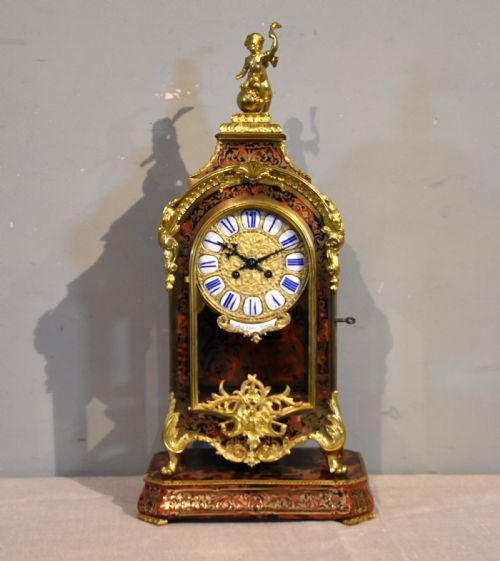
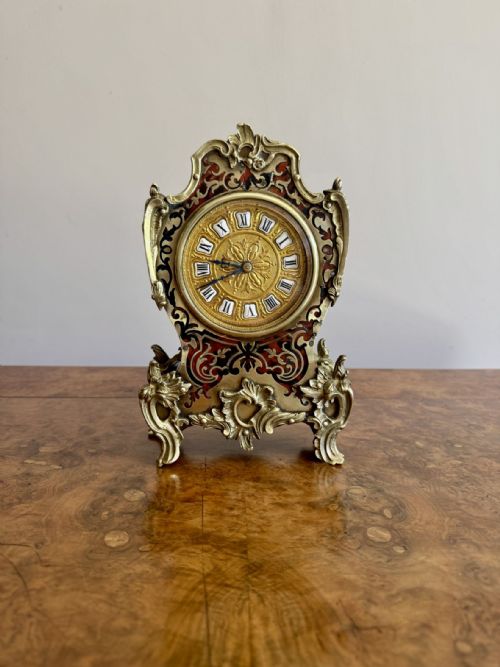
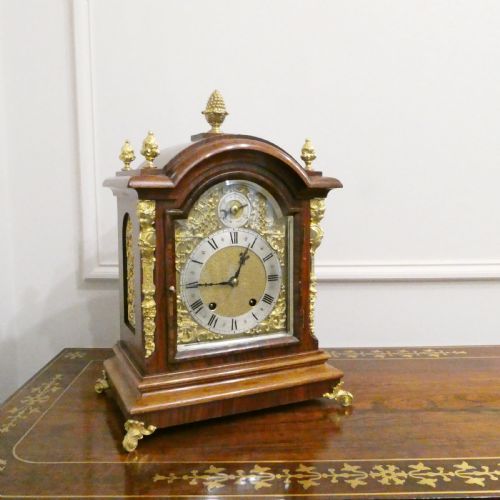
A victorian ormolu bracket clock is a domestic timekeeper housed in a substantial case of ebonised wood, mahogany, burr walnut, rosewood, or tortoiseshell, decorated with cast gilt bronze or brass mounts. These pieces draw heavily on French Rococo Revival, Louis XV, and Napoleon III styles, alongside English fusee traditions.
You will most commonly meet mantel clocks and bracket clocks dating from the nineteenth century, specifically spanning the decades between eighteen sixty and nineteen ten. Many examples incorporate Boulle marquetry or champleve enamel details alongside their prominent ormolu mounts.
The objects serve as both functional timepieces and decorative centrepieces, with several resting upon matching wall brackets. The forms range from lyre-shaped designs and four-glass cases to traditional table clocks with striking or chiming movements.
Materials and construction
Cases combine timbers such as ebonised wood, walnut, and mahogany with intricate veneers like tortoiseshell and Boulle marquetry. These wooden carcasses provide the structural foundation for the heavy metal decoration.
Ornate mounts and decorative frames utilise cast ormolu, gilt bronze, and brass, often paired with enamel dials and protective glass panels. Mechanical movements inside rely on brass gear trains, spring-driven or fusee mechanisms, and striking or chiming apparatus.
Some clocks sport a tiny keyhole hidden behind the dial, keeping the winding mechanism discreetly out of sight.
Judging the work
The standard of a victorian ormolu bracket clock rests upon the crispness of the bronze casting and the depth of the gilding on the ormolu mounts. Finer pieces display sharply chased surface details rather than soft, rounded edges.
The integration of the case materials dictates distinction, particularly in how cleanly tortoiseshell, Boulle marquetry, or exotic veneers meet the metal mounts. Movement makers also influence standing, with signed mechanisms by established makers commanding greater attention.
Schneckenburger·Lenzkirch·Payne and Co·Le Roy and Fils·Barraud and Lunds
The Victorian Ormolu Bracket Clock Glossary
- Ormolu
- Gilt bronze, created by applying a fine layer of gold amalgam to a bronze base and firing it to leave a rich golden finish.
- Boulle
- A form of marquetry using brass and tortoiseshell inlaid together in elaborate patterns, named after the French cabinetmaker.
- Fusee
- A conical pulley inside a clock that equalises the diminishing power of the mainspring as it unwinds, ensuring steady timekeeping.
- Champleve
- An enamelling technique where troughs are dug into metal and filled with vitreous enamel before firing and polishing.
Victorian Ormolu Bracket Clock: Frequently Asked Questions
What is a bracket clock?
A bracket clock is a portable timepiece traditionally designed to sit upon a matching wooden wall bracket or shelf. Many of these clocks include carrying handles on top for moving between rooms.
Over time, the term expanded to describe table clocks of similar proportions and architectural form, even without a wall bracket.
How do I care for ormolu?
Dust the gilt bronze mounts gently with a soft, dry brush to prevent the accumulation of dirt in the chased recesses. Avoid harsh chemical cleaners or polishes that strip the gold layer.
Keep the clock away from direct sunlight and steady heat sources to protect sensitive wood finishes and tortoiseshell veneer.
How do I date a Victorian clock?
Examine the style of the case, such as Louis XV Revival or Napoleon III, alongside the materials like ebonised wood and Boullework. Signature engravings and patent marks on the backplate offer further clues.
Movement types, including pendulum suspensions and chiming systems, often help narrow the decade of manufacture within the nineteenth century.