




Ebonised Wood Centre Table
An ebonised wood centre table brings dark drama to a room, offering a striking surface that draws the eye.
Ebonised Wood Centre Table
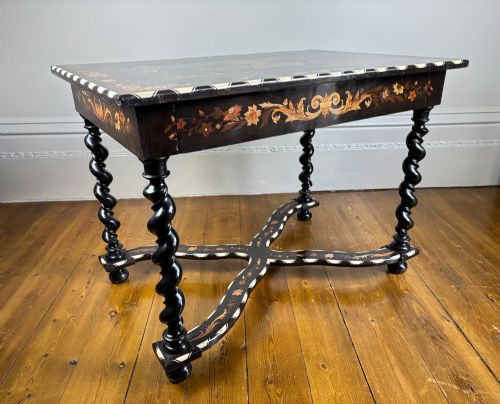
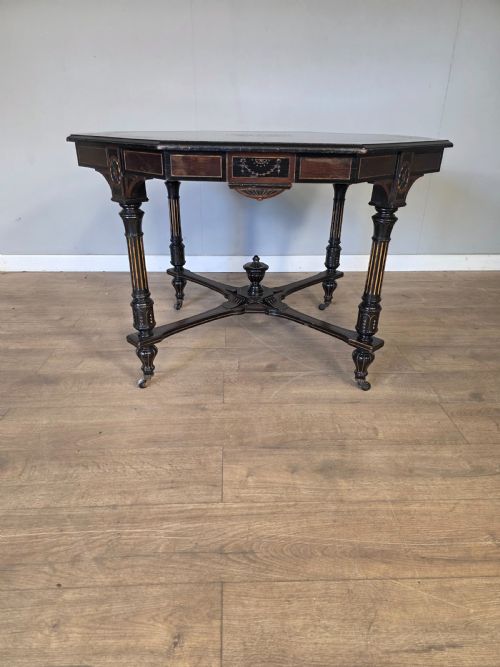
An ebonised wood centre table serves as a dramatic focal point in a room, designed to stand free rather than against a wall. When searching for an ebonised wood centre table, buyers encounter nineteenth-century Victorian and Aesthetic Movement pieces alongside continental revival and low coffee table forms.
The selection ranges from grand pedestal designs with marquetry and bone inlay to smaller occasional and coffee tables. These pieces emerge from diverse regional traditions, including Dutch, Italian, Spanish, and Anglo-Indian workshops.
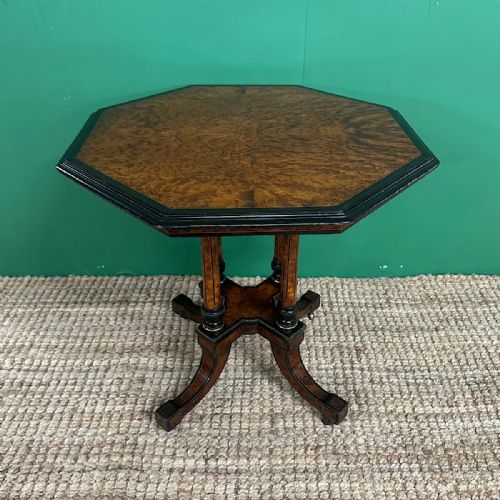
Victorian examples dominate the offerings, often featuring intricate surface decoration or contrasting timber accents. Lower coffee table adaptations cater to modern domestic needs while retaining the dark, polished aesthetic of the original period.
What varies in quality
The standard of an ebonised wood centre table rests on the depth of the finish and the precision of the inlay work. Finer examples display crisp marquetry and carefully fitted bone or brass details that remain flush with the timber.
Proportion and the integration of secondary woods also distinguish superior pieces from simpler utilitarian tables. The quality of the carving and the integrity of the structural frame determine the longevity and visual impact of the piece.
Listings feature ebonised wood alongside rosewood, burr walnut, and brass, spanning the Georgian era through to the 1930s.
The Ebonised Wood Centre Table Glossary
- Ebonised
- Wood treated with stain, dye, or polish to simulate the appearance of natural ebony. This dark finish gained immense popularity during the Victorian and Aesthetic Movement periods.
- Marquetry
- Decorative patterns formed by inserting small pieces of wood, bone, or metal into veneers on a furniture surface. Artisans use this technique to create complex pictorial or geometric designs.
- Sabot
- A protective metal sleeve fitted to the foot of a furniture leg. These fittings are frequently cast in brass to complement the surrounding woodwork.
- Pedestal table
- A table supported by a single central column rather than four distinct corner legs. This construction allows for greater legroom and distinct turning profiles.
- Stretcher
- A horizontal wooden bar connecting the legs of a table to provide structural rigidity. In nineteenth-century furniture, stretchers often feature decorative turnings.
Ebonised Wood Centre Table: Frequently Asked Questions
Where should I place a centre table?
A centre table belongs in the middle of a room where it can be appreciated from all angles, functioning as a display surface or gathering point.
Ensure there is adequate walking space around the piece to accommodate movement and seating in the room.
How do I clean ebonised wood?
Dust the surface regularly with a soft, dry cloth to prevent particulate buildup on the dark polished finish.
Avoid harsh chemical cleaners and excessive moisture, which can degrade the ebonised stain and damage delicate inlay work.
Can I use an antique table daily?
Most nineteenth-century tables are robust enough for everyday domestic use provided they are treated with reasonable care.
Using coasters and mats helps protect the polished wooden top from heat and liquid rings.