





Ebonised Pier Cupboard
An ebonised pier cupboard brings dark, striking polish and restrained French or Victorian elegance to any drawing room.
Ebonised Pier Cupboard
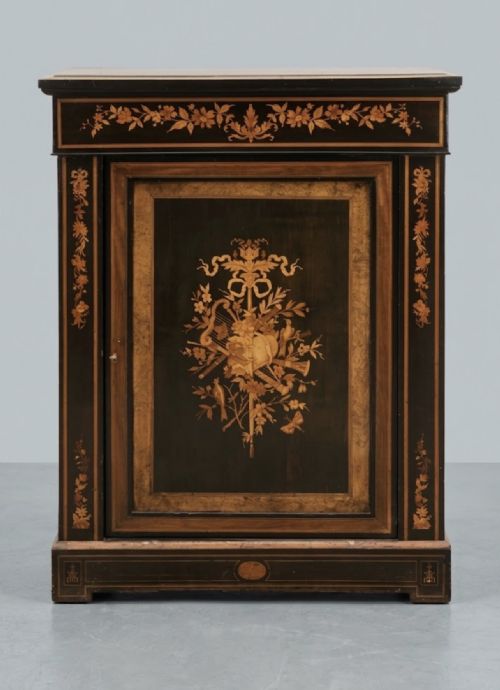
An ebonised pier cupboard is a compact display or storage piece designed to stand against the wall between windows, emerging primarily across the nineteenth century and the Victorian era. The selection centres on pier cabinets, side cabinets, and display cabinets created within Victorian, French Napoleon III, and Louis XVI styles.
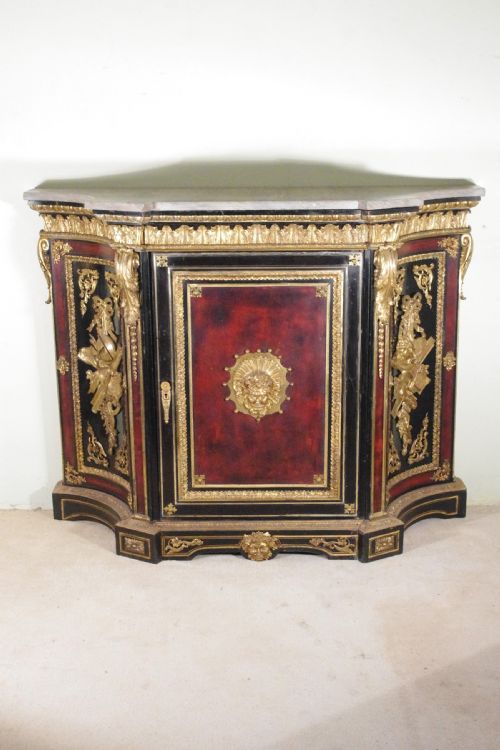
Buyers meet variations featuring glass doors for display, open shelving, and music cabinets alongside serpentine fronted marble topped forms. Many examples incorporate pairs, matching the symmetrical arrangement traditional to nineteenth-century formal interiors.
How they were made
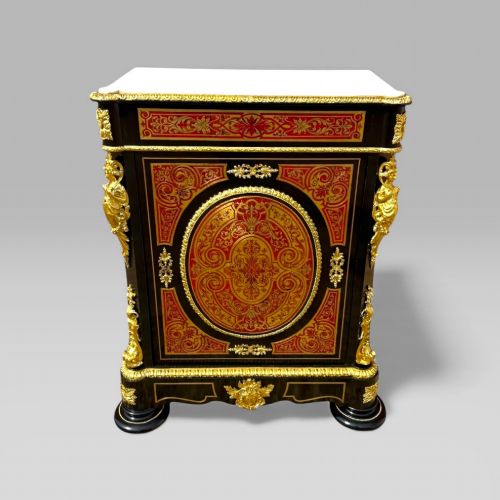
Cabinet makers utilised ebonised wood as a dark base, applying brass inlay, tortoiseshell, and marquetry to achieve high-contrast surface decoration. Ormolu or gilt-metal mounts provide structural definition and decorative accents along the edges and corners.
Interiors and tops incorporate contrasting materials including marble, porcelain plaques in the Sevres style, walnut, and rosewood. Construction methods from the period rely on precise timber joining alongside cast metal mounts fixed securely to the cabinetry.
Ebonised Pier Cupboard Retail Price Guide 2026
Typical asking prices for ebonised pier cupboard among the pieces listed under this phrase on Sellingantiques today, from the lower quarter to the upper quarter. They describe what is for sale here now, not the wider market.
Some nineteenth-century music cabinets include specialised internal shelving designed specifically to keep sheet music flat and tidy.
What varies in quality
The standard of execution in brass inlay and tortoiseshell boullework dictates the visual impact of each piece, distinguishing precise hand-cut enrichment from simpler surface pattern. The weight and crispness of the ormolu mounts further define the grade of the cabinet.
Selection of secondary timbers and the quality of the marble top or porcelain plaques contribute to the overall execution. Matching pairs demand consistent timber grain and identical decorative mounts across both pieces.
The Ebonised Pier Cupboard Glossary
- Ebonised wood
- Timber stained or painted to resemble ebony, creating a dense black surface popular in nineteenth-century furniture. This finish provides a dark backdrop for metallic mounts and inlaid patterns.
- Boulle
- A form of marquetry utilising brass and tortoiseshell inlaid in contrasting patterns, named after the cabinet maker Andre-Charles Boulle. Pieces incorporating this technique frequently appear in French and Victorian cabinetwork.
- Ormolu
- Gilt bronze mounted on furniture as decorative feet, borders, and handles. The technique involves applying a gold amalgam to bronze.
- Pietra dura
- Inlay work using cut and fitted polished coloured stones to create pictorial designs. This technique appears on specific nineteenth-century cabinet panels.
- Sevres style porcelain
- Ceramic plaques painted in the manner of the Sevres factory, often mounted centrally on cabinet doors. These plaques feature decorative scenes or floral motifs.
Ebonised Pier Cupboard: Frequently Asked Questions
What is an ebonised pier cupboard?
An ebonised pier cupboard is a nineteenth-century display or storage cabinet finished in black to imitate ebony and shaped to fit narrow wall spaces between windows.
These pieces frequently feature glass doors, brass inlay, and marble tops, serving both decorative and functional purposes in period interiors.
Where do you place a pier cabinet?
A pier cabinet fits against the architectural wall space between two windows, a placement that originally maximised reflected light from adjacent mirrors.
Today, these cabinets function effectively in living rooms or hallways as display surfaces for porcelain and small objects.
How do I identify a Victorian ebonised cabinet?
Victorian ebonised cabinets display dark wood finishes combined with gilt-metal mounts, brass marquetry, and occasionally porcelain plaques.
They reflect revival styles including French Napoleon III and Boulle work popular during the nineteenth century.