
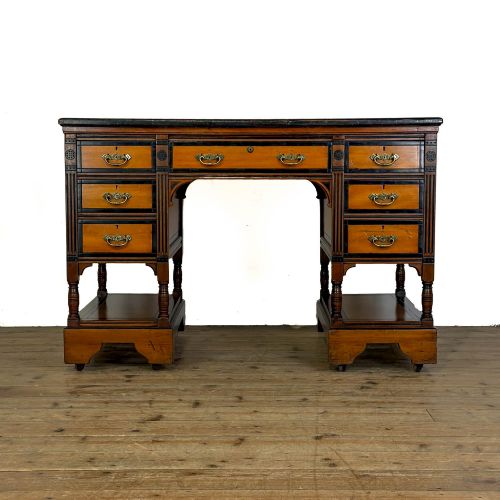
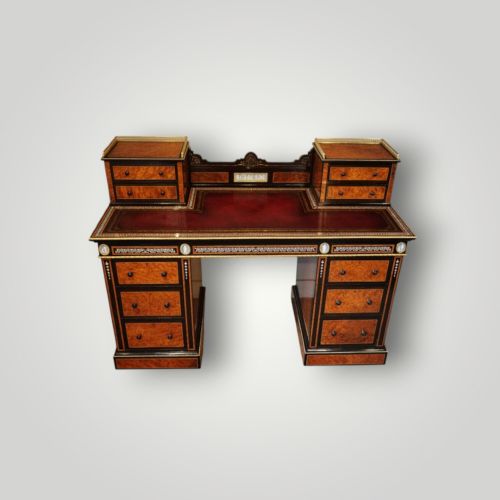
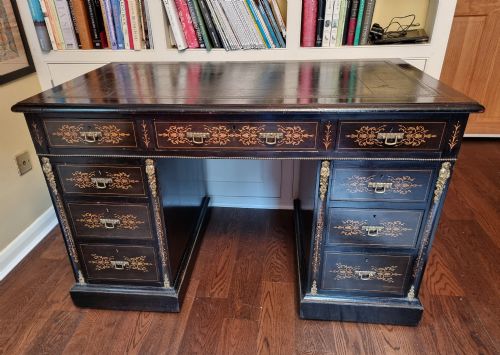
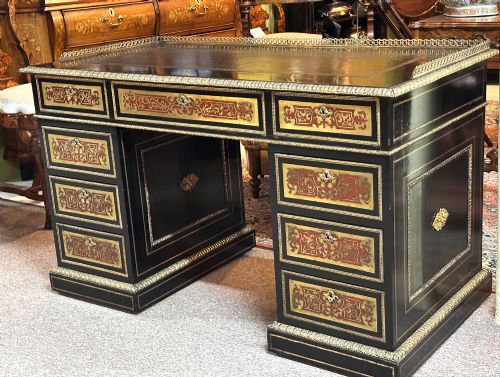




Ebonised Partner Desk
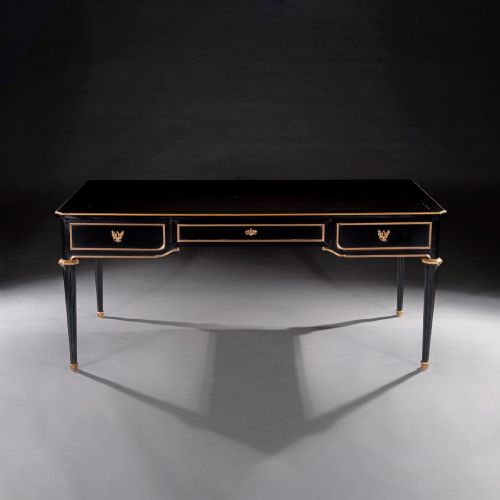
An ebonised partner desk is a striking double-sided workspace designed for two users, finished in a dark, polished wood that mimics ebony.
Ebonised Partner Desk
An ebonised partner desk provides simultaneous access from both sides with drawers and cupboards arranged for two people to work face to face. These substantial tables appear most frequently from the nineteenth century, spanning Victorian, Aesthetic Movement, and Regency revivals.
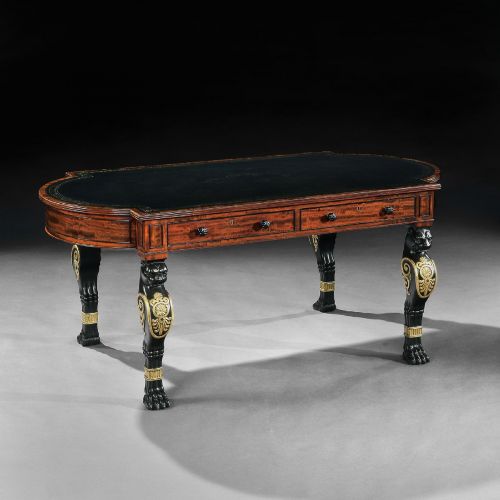
The construction typically incorporates a dark, heavily stained timber finish, often paired with contrasting gilt mounts, brass hardware, or inlaid surfaces. While traditional pedestal forms dominate the selection, variations stretch to bureau plat designs and French revival writing tables.
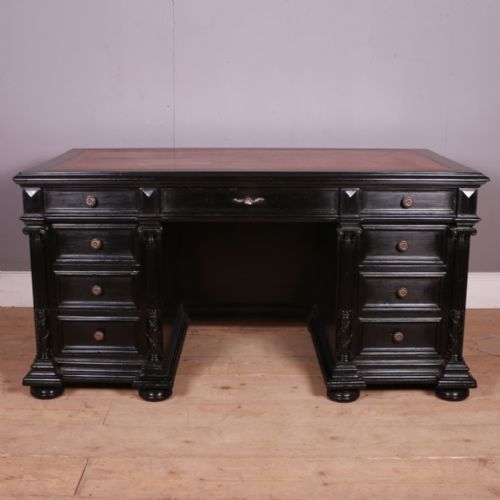
Buyers seeking this configuration will encounter pieces featuring leather writing surfaces inset into the top alongside flanking pedestals of drawers. The scale remains generous, requiring a dedicated central position within a room rather than placement against a wall.
Materials and construction methods
The core structure relies on hardwoods such as mahogany or pine, which undergo a specialised staining and polishing process to achieve the characteristic deep black ebonised finish. Artisans then apply clear coats to build a smooth, reflective surface that highlights the density of the colour.
Decoration frequently involves ormolu mounts, brass details, and intricate inlays using materials like satinwood, ivory, or thuya wood. Leather inserts, often gold-tooled along the perimeter, form the primary writing plane on the top surface.
Listings feature ebonised wood combined with brass, leather, and ormolu across nineteenth-century periods including Victorian and Regency revivals.
Distinguishing quality and craftsmanship
Superior examples demonstrate meticulous attention to the secondary timbers used inside drawer boxes and the crispness of applied ormolu or brass mounts. The depth and durability of the ebonised finish dictate the visual success of the piece, with finer works retaining an even, lustrous sheen across all panels.
The integration of secondary decorative elements, such as Wedgwood plaques or specialised inlay work, separates standard production from exceptional studio output. Construction integrity in the pedestals and smooth operation of opposing drawer sets further define the upper tier of the range.
Jackson and Graham·Edwards and Roberts
The Ebonised Partner Desk Glossary
- Ebonised wood
- Timber treated with stain, paint, or chemical processes to imitate costly ebony wood. This dark finish became particularly popular during the Victorian and Aesthetic periods.
- Partner desk
- A large double-sided writing table featuring drawers and cupboards accessible from both front and back. They were originally created for bankers, partners in trade, or legal associates.
- Ormolu
- Gilded bronze ornamentation applied to furniture mounts and decorative details. The technique involves a mercury amalgam applied to bronze, creating a rich golden surface.
- Bureau plat
- A freestanding French writing table featuring a rectangular top and drawers set into the frieze. These tables lack the heavy pedestals of standard partner desks.
Ebonised Partner Desk: Frequently Asked Questions
Can two people work comfortably at a partner desk?
Yes, the defining characteristic of these desks is the presence of matching drawer configurations and kneeholes on both sides, allowing two users to sit opposite each other.
The generous proportions ensure adequate legroom and surface area for simultaneous use without crowding.
How do I care for the ebonised finish?
The dark polished surface requires dusting with a soft, dry cloth and protection from direct sunlight to prevent fading or drying of the polish. Avoid using harsh chemical cleaners or silicone polishes that can damage the historical sheen.
Applying a quality wax periodically helps maintain the moisture and depth of the dark wood.
Where should a double-sided desk be placed?
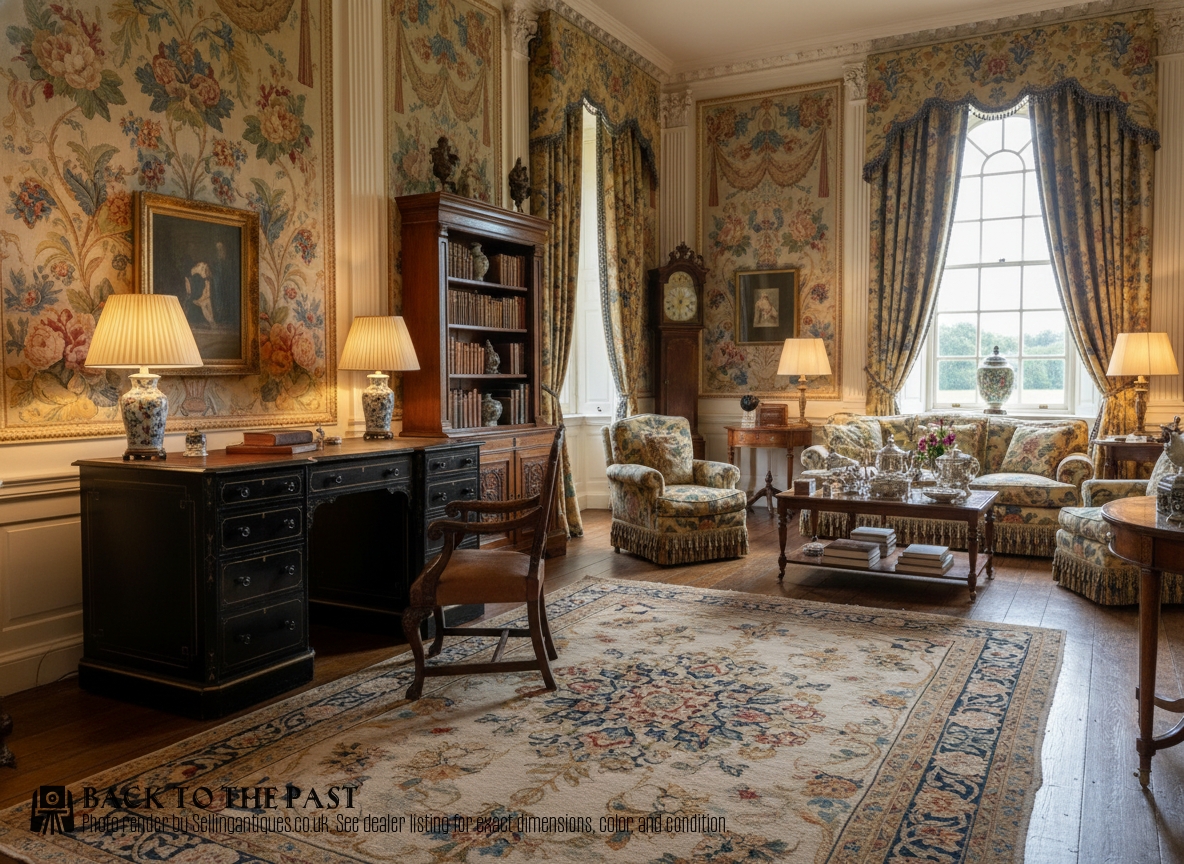
These pieces function best when positioned centrally within a room rather than pushed against a wall. Because both sides feature finished panels and working drawers, floating the furniture allows full access to the design.
Ensure there is sufficient surrounding floor space to pull out chairs from both the front and the back.
What is the difference between an ebonised desk and a black-painted desk?
Ebonised treatment involves penetrating stains, layered polishing, and traditional finishing techniques designed to mimic natural ebony timber rather than applying a simple opaque coat of paint. This method preserves the subtle grain texture of the underlying wood beneath the dark surface.
Painted furniture conceals the grain entirely under a solid pigment layer.