
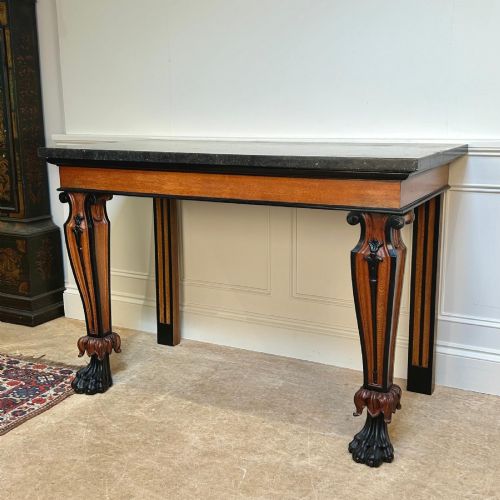
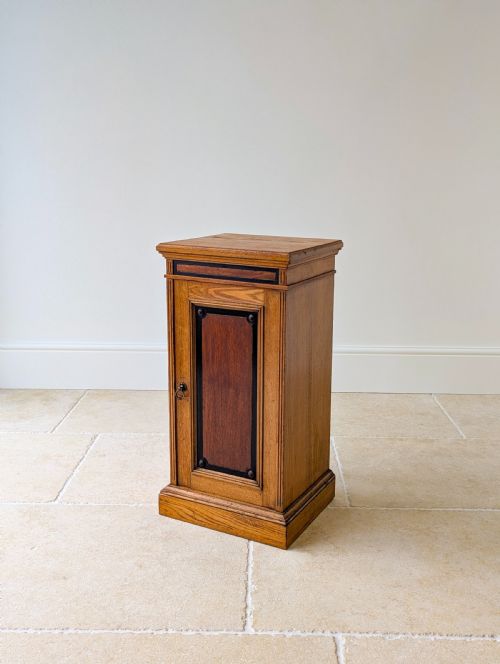
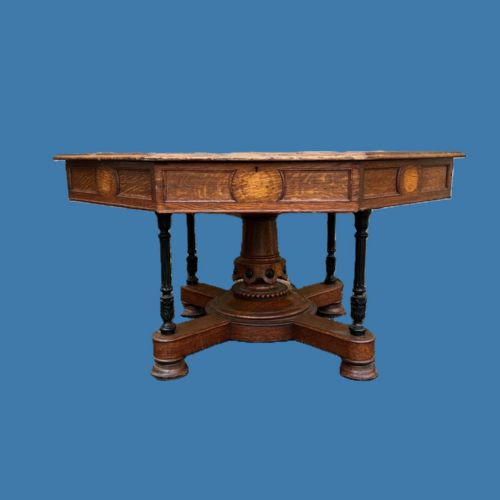


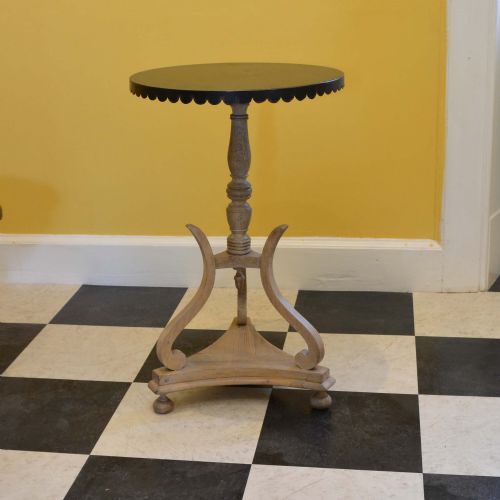


Ebonised Oak Table
An ebonised oak table brings dark, striking contrast to a room through deep blackened finishes applied to strong timber.
Ebonised Oak Table
An ebonised oak table is a functional surface combining the prominent grain of oak with a dramatic black finish, taking forms such as console tables, library tables, desks, and occasional pieces. You will frequently encounter Victorian Aesthetic Movement examples alongside Regency, Arts and Crafts, and Art Deco interpretations on this page.
The objects span centuries from the early nineteenth century through to the 1930s, reflecting shifts in taste from formal Regency proportions to the structured designs of the Arts and Crafts and Manchester School movements. These pieces served diverse domestic functions, operating as partners desks, card tables, dressing tables, and compact bedside cabinets.
Makers and designers of these dark-finished surfaces utilised the natural hardness of oak to create stable frameworks that could support heavy use while maintaining crisp carved details or smooth stencilled decoration. The aesthetic focus centres on the interplay between the pale undertones of timber and the applied dark surface.
When searching for an ebonised oak table, buyers look for pieces that display the characteristic dark finish either overall or as a deliberate contrast against contrasting woods like walnut, burr oak, or ebony. The surviving inventory demonstrates how cabinetmakers adapted the dark surface across varied object types, from French butchers blocks to tripod tables.
How they were made
Makers achieved the distinctive dark appearance of an ebonised oak table by applying chemical treatments, stains, or pigments to the open-pored timber, sometimes combining solid oak with ebonised wood details or ebony stringing. This technique allowed cabinetmakers to emulate more expensive exotic hardwoods while retaining the durable structural qualities inherent to native oak.
Construction methods varied across the periods represented, employing brass mounts, leather inserts, and marble tops to enhance utility and visual interest on desks, card tables, and library tables. Artisans during the Aesthetic Movement and Arts and Crafts periods utilised traditional joinery alongside stencilled decoration to finish surfaces.
Detailing often included trifold drop leaf mechanisms, adjustable components, or turned tripod supports that required precise carpentry to ensure smooth operation alongside the applied dark finishes.
Several tables feature handkerchief folding tops ready for a quiet evening of Victorian card games.
What varies in quality
The standard of an ebonised oak table rests upon the crispness of the timber preparation and the depth of the dark finish, where superior examples retain a rich, uniform appearance without obscuring the natural grain beneath. Lesser pieces often exhibit flat, painted surfaces that flake or mask inferior timber selection.
Construction integrity distinguishes the finest furniture on this page, seen in sturdy pedestal bases, well-fitted drawers, and original brass or leather components that have aged in harmony with the surrounding wood. Pieces retaining authentic period details, such as stencilled decoration or specific workshop stamps, command higher regard among collectors.
Proportion and decorative restraint dictate the visual success of these pieces, particularly within the Aesthetic Movement and Art Deco styles where clean geometric lines or subtle contrasting inlays define the work of skilled makers.
Liberty & Co·Heal s·Trussant & Cie
The Ebonised Oak Table Glossary
- Ebonised
- Wood treated to resemble ebony through staining, chemical darkening, or painting. This finish was widely adopted during the nineteenth century to achieve a sleek, dramatic contrast in domestic furniture.
- Aesthetic Movement
- A late nineteenth-century design style emphasising visual beauty over narrative subject matter. Pieces from this period frequently feature ebonised surfaces, Japanese-inspired motifs, and geometric forms.
- Partners Desk
- A large double-sided desk designed for two people to work opposite one another. These substantial pieces often incorporate pedestals with banks of drawers and leather-lined writing surfaces.
- Kneehole Pedestal
- A desk or dressing table configuration featuring a central recess for the legs flanked by pedestals of drawers. This layout provides stability and storage while maintaining a compact footprint.
- Trifold Drop Leaf
- A table mechanism featuring hinged flaps that fold out to expand the usable surface area. It requires precise joinery to ensure stability when fully extended.
Ebonised Oak Table: Frequently Asked Questions
How do I care for an ebonised oak table?
Maintain the dark finish by dusting with a soft, dry cloth and avoiding direct sunlight or excessive moisture which can damage the treated surface.
Apply a neutral beeswax sparingly only when the wood appears dry, buffing gently to preserve the subtle sheen characteristic of period pieces.
What periods do these tables come from?
The listings span the nineteenth and twentieth centuries, encompassing Regency, Victorian, Arts and Crafts, and Art Deco eras.
Each period brought distinct stylistic interpretations to the dark-finished timber, moving from formal neoclassical proportions to clean modernist lines.
Were these tables purely decorative?
These pieces served practical daily functions as desks, library tables, card tables, bedside cabinets, and dressing tables in period homes.
Cabinetmakers designed them to withstand active use while contributing to the sophisticated dark interiors favoured during the nineteenth and early twentieth centuries.
How do I distinguish between solid ebonised oak and other dark woods?
Examine the surface under a strong light to locate the characteristic open pores and coarse grain texture unique to oak timber.
Look closely at areas where wear has occurred to see the lighter wood beneath the dark surface treatment.