
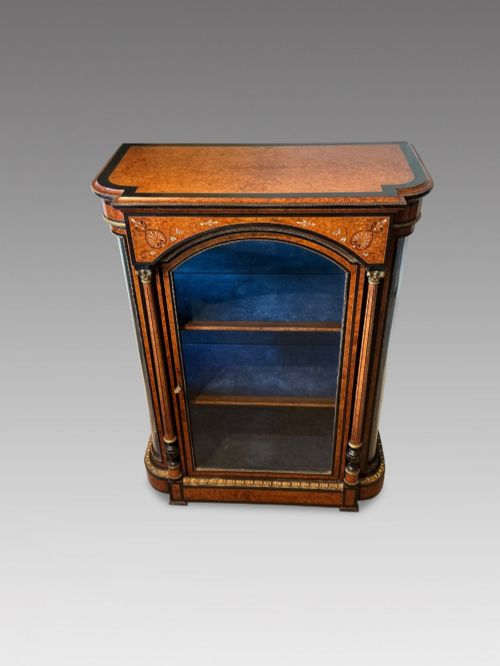
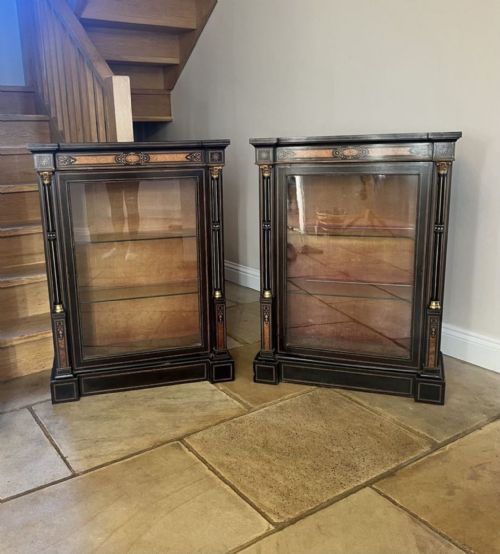
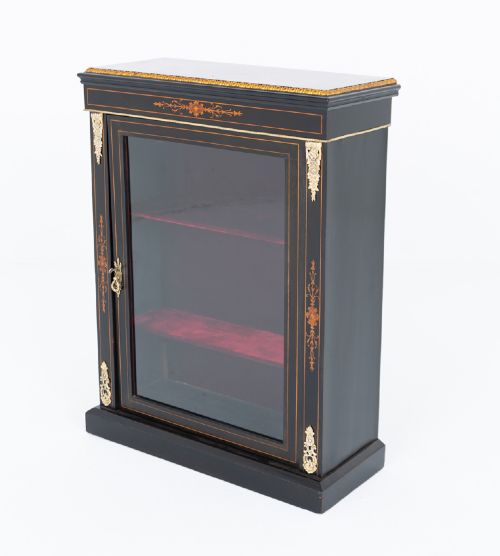


Ebonised Glass Bookcase
An ebonised glass bookcase provides a striking dark framework for displaying cherished volumes behind glazed doors.
Ebonised Glass Bookcase
When you search for an ebonised glass bookcase, you encounter glazed display furniture rendered in blackened wood, spanning periods from the mid nineteenth century through to the early twentieth century. These pieces encompass breakfront bookcases, pier cabinets, and vitrines that combine wooden shelving with glass front panels.
The styles appearing on this page range from Victorian and Aesthetic Movement to Napoleon III and Dutch Baroque Revival. Most examples integrate glazed doors designed to protect books and decorative objects while keeping them visible.
Makers utilised various secondary woods alongside the blackened finish, frequently incorporating amboyna, burr walnut, and ormolu mounts. The resulting forms serve as both practical storage and formal display centerpieces within a room.
Materials and construction
The distinct dark finish relies on ebonisation, a process that stains timber to resemble ebony. Craftsmen combined this blackened wood with contrasting inlay materials including brass stringing, porcelain plaques, and exotic veneers such as amboyna and burr walnut.
Structural embellishments frequently include cast ormolu mounts and gilt detailing applied to cornices and pilasters. Glazed doors feature fitted glass panes held within timber framing, while interiors often incorporate velvet linings and adjustable shelving.
Several Victorian cabinets managed to smuggle Sevres porcelain plaques onto their wooden facades, presumably to confuse future historians.
Assessing quality and execution
Quality shows in the precision of the timber preparation and the depth of the ebonisation. Superior examples maintain a smooth, even blackened surface that reveals the grain underneath rather than relying on a flat, opaque paint layer.
The refinement of the decorative mounts and inlays distinguishes finer pieces. Crisp brass stringing, well-cast ormolu mounts, and carefully fitted glazed doors indicate higher standards of cabinet-making during the Victorian and later periods.
The Ebonised Glass Bookcase Glossary
- Ebonised
- Wood treated to imitate ebony through staining or finishing. This technique creates a dense black surface popular in nineteenth-century furniture.
- Pier cabinet
- A low display cabinet designed to fit against the wall space between windows. These pieces often feature glazed doors and decorative mounts.
- Ormolu
- Gilded bronze mounts applied as decorative ornamentation on furniture. The technique involves mercury gilding on cast bronze.
- Boulle
- Marquetry technique utilising tortoiseshell and brass inlaid in a distinctive pattern. Named after the French cabinet-maker André-Charles Boulle.
- Breakfront
- A piece of furniture with a central section that projects forward from the flanking sections. This configuration adds architectural depth to large bookcases.
Ebonised Glass Bookcase: Frequently Asked Questions
How do I clean ebonised wood?
Dust regularly with a soft, dry cloth to prevent dirt accumulation on the blackened surface. Avoid abrasive cleaners or excess moisture that could damage the finish.
Apply a microcrystalline wax periodically to nourish the timber and maintain the subtle sheen characteristic of nineteenth-century ebonised finishes.
Where should I place a glass bookcase?
Position the piece away from direct sunlight to protect antique glass, internal velvet linings, and book bindings from fading. Ensure stable room temperatures to prevent timber movement.
Allow sufficient floor clearance so doors open fully without catching on carpets or surrounding furniture in the room.
What periods do these bookcases represent?
The pieces span the Victorian era, the nineteenth century generally, and extend into the early twentieth century around nineteen twenty. Styles reflect Victorian, Aesthetic Movement, and Napoleon III influences.
Design characteristics shift from mid nineteenth-century revival forms to later decorative interpretations incorporating brass mounts and varied wood veneers.
Are the shelves adjustable?
Many nineteenth-century display cabinets feature adjustable wooden shelving supported by rack systems. This allows the internal height to accommodate different book sizes.
Some smaller pier cabinets or specialised vitrines contain fixed shelving due to their specific cabinet construction and display purpose.