


Ebonised Fusee Table Clock
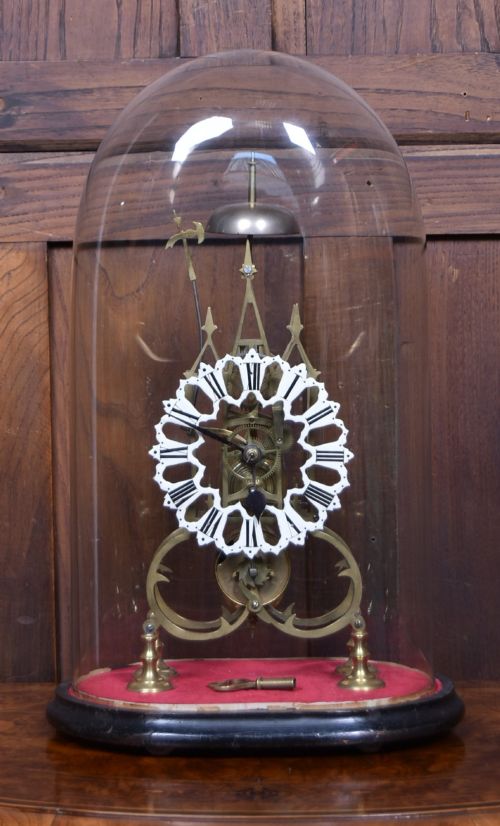
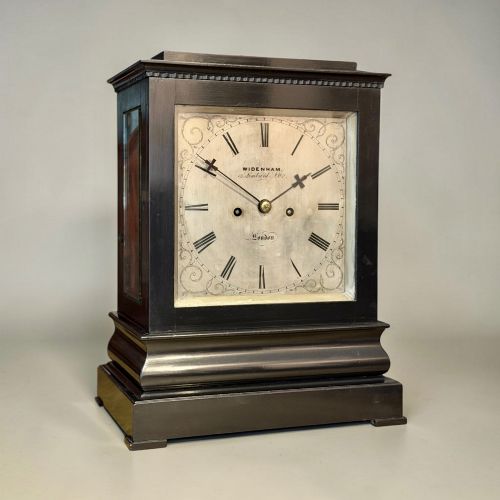
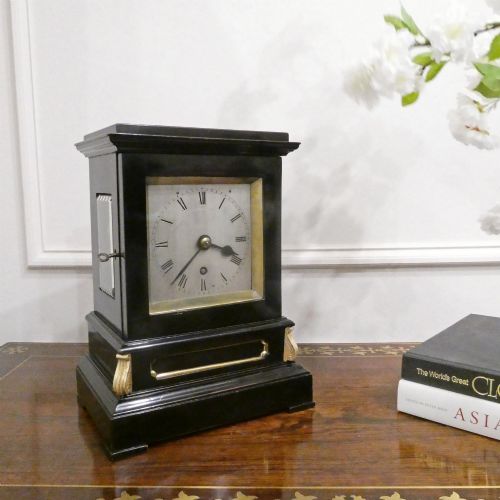
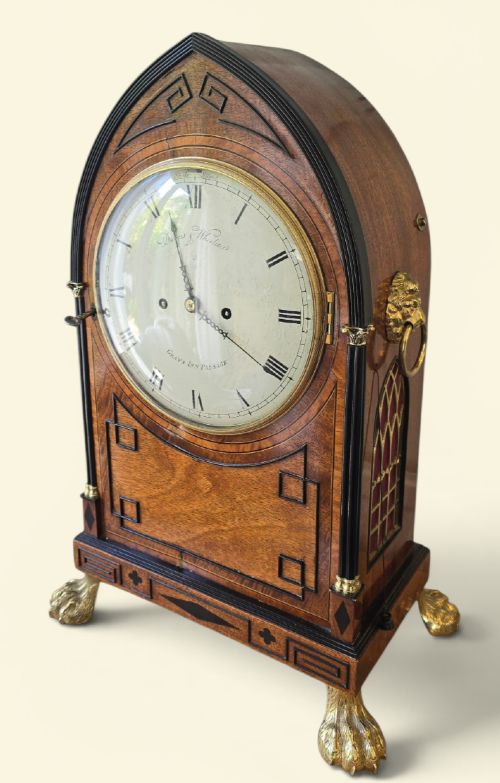
An ebonised fusee table clock brings precision engineering and striking dark timber into a room, offering mechanical mastery housed in a distinguished case.
Ebonised Fusee Table Clock
The ebonised fusee table clock encompasses several traditional forms, including bracket clocks, library clocks, and mantel pieces originating from the eighteenth and nineteenth centuries. These timepieces combine complex mechanical movements with dark, uniform casework, spanning periods from the Georgian era through to the Victorian age.
Most examples found on this page display the characteristic single or twin fusee movements housed within break-arch, bell-top, or balloon-shaped wooden cases. London makers dominate the origins recorded here, producing robust domestic clocks designed for mantels, brackets, and desks.
Materials and construction
Cases are primarily formed from wood finished with ebonisation, sometimes complemented by ormolu, brass mounts, and glass panels protecting the dial. Silvered metal dials provide a clear contrast against the dark timber, while velvet occasionally lines internal or supporting elements.
The internal mechanics rely on fusee movements, which maintain steady power to the gear train as the mainspring unwinds. Makers utilised brass for the intricate wheel trains and plates, often pairing these with verge escapements or musical chiming systems operating on multiple bells.
Listings span multiple centuries, incorporating periods from the early 18th century through the Victorian era alongside Regency and Georgian styles.
Evaluating craftsmanship and execution
The hand of the maker dictates the standing of a piece, with signed dials from notable London workshops commanding attention. The crispness of the ebonised finish, the delicacy of brass mounts, and the preservation of original dial engraving further separate standard production from exceptional examples.
Widenham of London·Desbois & Wheeler·Phillips Brothers·Richard Rooker·Payne & Co London·Somersall London·Frodsham & Baker London·Berguer of the Strand·John Leroux·William Smith London·Percy Webster·James Evans·Isaac Hurley
The Ebonised Fusee Table Clock Glossary
- Fusee
- A conical pulley designed to equalise the torque of the mainspring as it runs down. This ensures the clock maintains consistent timekeeping power throughout its winding cycle.
- Ebonised
- Wood treated to imitate ebony, giving a deep black and uniform appearance. It provides a stark and formal aesthetic popular in period clock cases.
- Verge escapement
- An early type of escapement mechanism that controls the release of the wheel train. It typically works with a pendulum or balance spring to regulate the beat.
- Bracket clock
- A portable domestic clock originally designed to sit on a wall bracket or a table. Many examples include a matching wall bracket for support.
- Break-arch
- A case design feature where the top of the door or dial incorporates a central arched section flanked by corners. This silhouette is common in Georgian and Victorian bracket clocks.
Ebonised Fusee Table Clock: Frequently Asked Questions
What is a fusee movement?
A fusee is a conical drum inside the clock that regulates the pull of the mainspring. As the spring unwinds, the chain moves to a wider part of the cone to keep the power steady.
This clever mechanical device ensures the clock runs with consistent accuracy right up until the moment it needs winding again.
How do I wind an antique clock?
Winding requires using the appropriate key on the winding squares found on the dial face. Care must be taken not to overwind the mechanism, stopping as soon as resistance is felt.
Different models require winding at varied intervals depending on whether they are simple timepieces or feature chiming and striking trains.
Where should I place a bracket clock?
These clocks belong on sturdy surfaces away from direct sunlight, extreme temperature changes, and heavy vibrations. A stable mantel, desk, or dedicated wall bracket provides the necessary foundation for accurate ticking.
Ensuring the surface is level helps the pendulum or escapement maintain an even beat.
How do I distinguish Georgian from Victorian models?
Georgian clocks generally display restrained proportions, classical dial layouts, and traditional bell-top or lancet cases. Maker signatures on these earlier pieces often reflect eighteenth-century London craftsmanship.
Victorian examples frequently introduce bolder architectural elements, heavier cases, and sometimes complex musical or automated movements.