
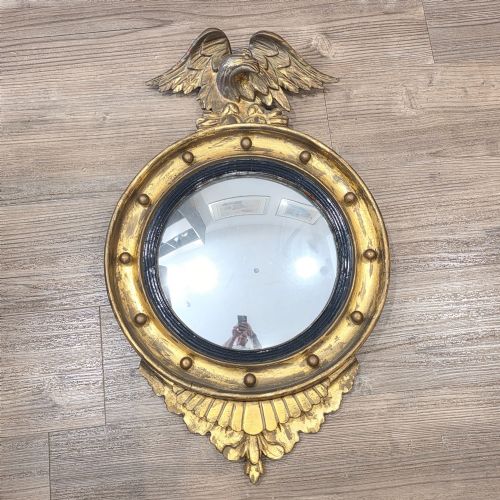
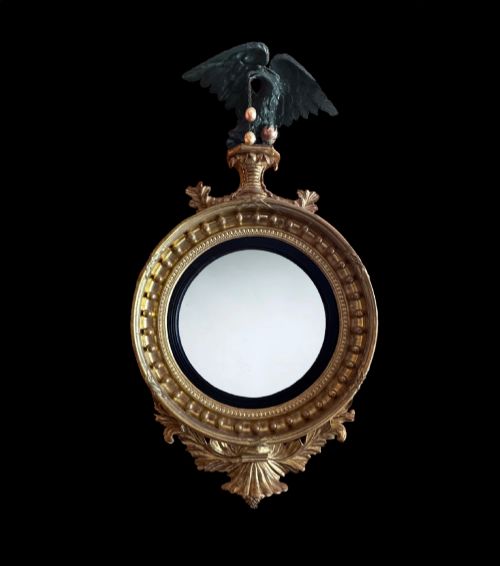
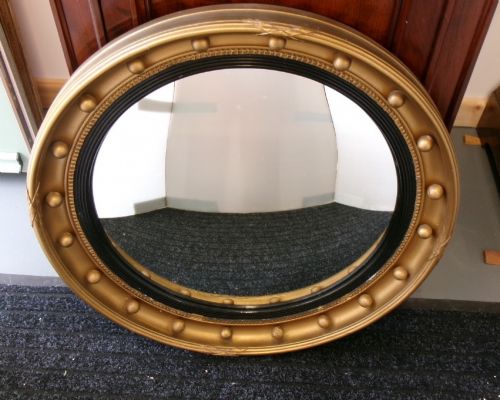
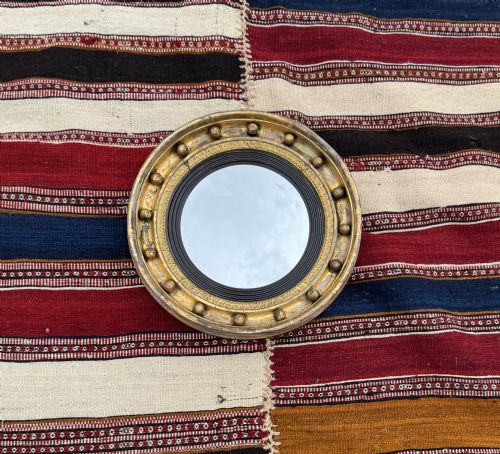


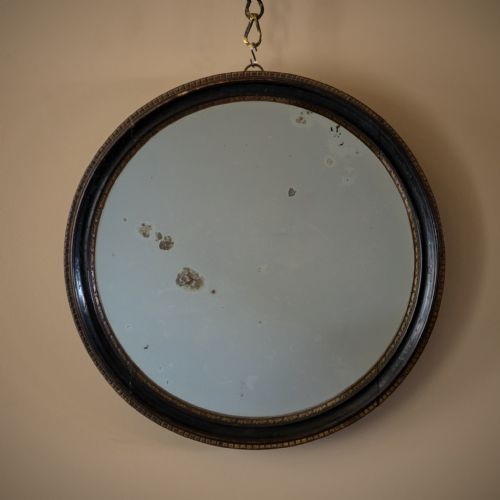
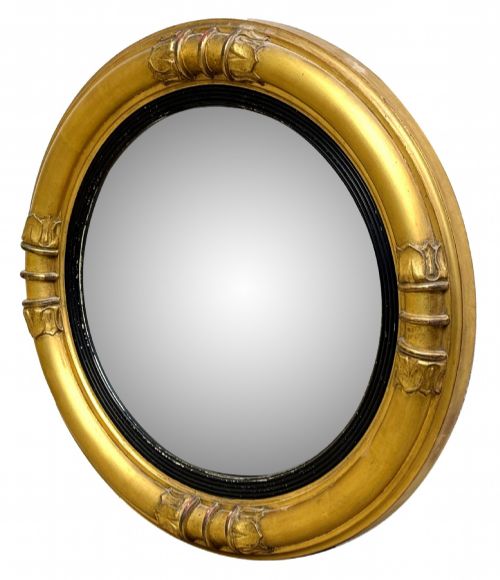
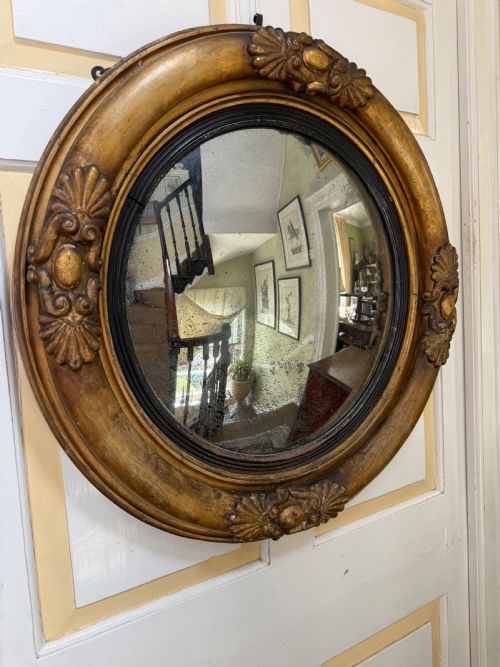


Ebonised Convex Wall Mirror
An ebonised convex wall mirror captures the entire room in a single curved glass plate, drawing the eye instantly.
Ebonised Convex Wall Mirror
When you search for an ebonised convex wall mirror, you encounter round and oval wall-hanging glasses framed in dark or black-finished wood, frequently paired with giltwood elements. The pieces appearing here span the Regency period, the Victorian era, and into the early twentieth century, taking forms such as porthole mirrors, butler's mirrors, and eagle-surmounted designs.
The version most likely to meet you on this page is a nineteenth-century circular wall glass, often showing the influence of Regency style or Regency Revival. These pieces combine deep wooden frames with convex mirror plates that distort perspective to provide a panoramic view of the interior.
How they were made
Maker's workshops built these frames using timber, gesso, and wood, applying ebonisation or dark finishes alongside gilding to achieve strong visual contrast. The ebonised slip sits directly against the glass, serving as a dark border that separates the reflective surface from the outer frame.
The mirror glass itself is blown or cast to a convex curve, mounted within the wooden housing and secured by backing boards. Brass candle sconces or metal fixings occasionally accompany the frame on girandole models, attached firmly to the structure.
Listings feature pieces spanning the Regency, Victorian, and early twentieth-century periods, utilising giltwood, ebonised wood, and brass.
What varies in quality
The standard of carving on the timber and gesso determines the refinement of the frame, particularly on pieces featuring eagles or detailed foliage. Crisp edges and deep relief work separate skilled joinery and moulding from simpler, softer production.
The clarity and depth of the convex glass plate also define the piece, alongside the preservation of the original ebonised finish and gilding. Retaining the undisturbed dark slip around the plate indicates a well-preserved survivor from the nineteenth century.
The Ebonised Convex Wall Mirror Glossary
- Convex glass
- A curved mirror plate that bulges outward to produce a wide-angle, spherical reflection of the surrounding space. This curved form distorts the scale of objects while pulling the whole room into view.
- Ebonised slip
- A dark, blackened inner moulding or ring positioned between the outer frame and the mirror glass. It creates a visual recession that frames the reflective surface.
- Girandole
- A wall mirror fitted with one or more candle branches attached to the frame. The arms multiply the light cast into the room.
- Gesso
- A plaster-like mixture applied to wood frames to provide a smooth base for gilding or painting. Carvers cut intricate details directly into this layered substance.
Ebonised Convex Wall Mirror: Frequently Asked Questions
Where should I hang a convex mirror?
Hang the piece at eye level on a clear wall where it can reflect light from windows or opposite doorways.
Because the curved glass gathers the entire room, placement in a hallway, dining room or drawing room works best to maximise the panoramic effect.
How do I clean the glass?
Dust the frame gently with a soft, dry brush and avoid spraying liquid directly onto the old mirror plate.
Applying a mild glass cleaner to a cloth rather than the surface prevents moisture from seeping behind the antique backing.
What is a butler's mirror?
A butler's mirror is a circular convex wall glass traditionally used by household staff to monitor activity across a large room.
The deep frame and wide-angle reflection allowed servants to keep watch over guests without turning their backs.
Are these mirrors heavy?
Most examples possess substantial weight due to the solid timber frames, thick gesso layers, and heavy convex glass plates.
Securing the piece requires proper wall fixings anchored directly into studs or masonry rather than standard plasterboard hooks.