


Ebonised Chiffonier Cabinet
An ebonised chiffonier cabinet brings dark, dramatic presence and disciplined Victorian craftsmanship straight into a modern interior.

Ebonised Chiffonier Cabinet
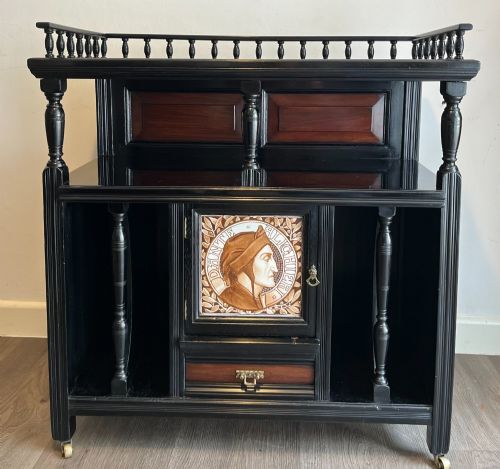
When you search for an ebonised chiffonier cabinet, you are looking at dark, stylish storage furniture that typically emerges from the nineteenth century. These pieces combine the enclosed lower storage characteristic of a chiffonier with the striking, blackened surfaces favoured during the Victorian era and the Aesthetic Movement. Most examples encountered here reflect Victorian tastes, often incorporating glass, brass, or marble elements.
The forms vary across the listings, spanning side cabinets, credenzas, and upright cupboards. You will find pieces finished in ebonised wood alongside variations featuring burr walnut, mahogany, and satinwood. While some show strong ties to the Aesthetic Movement with gilt highlights and painted details, others lean towards French Chateau or Regency styling.
Materials and construction
The primary technique relies on ebonising wood - treating timber such as mahogany or fruitwood to imitate expensive ebony. Makers frequently combined this dark finish with contrasting materials like burr walnut panels, white marble tops, and ceramic or porcelain inserts. Gilt highlights and brass mounts were then applied to catch the light against the sombre dark surfaces.
Structural integrity depended on traditional cabinet-making methods, utilising solid timber frames veneered with decorative grains. Glazed doors often featured fine wooden tracery, while mirrored backs utilised bevelled glass set securely into carved wooden frameworks. The joinery ensured these heavy items, particularly those with stone tops, remained stable.
Listings feature pieces from the eighteenth, nineteenth, and twentieth centuries, spanning Victorian, Regency, and Art Deco styles.
Evaluating craftsmanship and execution
Quality in these dark-finished cabinets rests on the depth of the ebonisation and the crispness of any carved or gilt details. Superior examples display a smooth, even finish that allows the grain of the underlying wood to show subtly rather than hiding beneath flat paint. The integration of decorative elements, such as marquetry panels or brass mounts, separates standard production from finer work.
The choice of secondary materials also defines the tier of the piece. Cabinets featuring thick slabs of marble, intricate brasswork, or high-grade burr walnut veneers demonstrate superior construction. Furthermore, the precision of the door alignment and the weight of the timber indicate the maker's original investment of time and skill.
Garnett & Sons·Lamb of Manchester·Gillows
The Ebonised Chiffonier Cabinet Glossary
- Ebonised
- Wood treated with stain, dye, or polish to simulate solid ebony. This dark finish became particularly fashionable during the nineteenth century for furniture mimicking Asian imports.
- Chiffonier
- A low sideboard or cabinet featuring enclosed shelving below. It typically provides compact storage for dining or living spaces.
- Aesthetic Movement
- A late nineteenth-century design style emphasising visual beauty over narrative subject matter. Furniture from this movement often employs ebonised surfaces with gilt and painted details.
- Marquetry
- Inlays of patterned wood veneers forming decorative motifs. Craftsmen cut contrasting timbers to create floral or geometric designs across the surface.
- Credenza
- A sideboard or display cabinet lacking legs, sitting close to the floor. These pieces frequently incorporate glass doors and decorative mounts.
Ebonised Chiffonier Cabinet: Frequently Asked Questions
What is an ebonised chiffonier cabinet?
An ebonised chiffonier cabinet is a dark, nineteenth-century storage piece finished to resemble ebony wood. These cabinets usually feature enclosed lower cupboards and often include decorative elements like glass doors or marble tops.
They reflect the design priorities of the Victorian era and the Aesthetic Movement, combining sombre dark surfaces with gilt highlights or contrasting timber veneers.
How were these cabinets used historically?
Historically, these cabinets served in dining rooms and parlours to store tableware, linens, or books. The top surface provided space for displaying decorative ceramics, clocks, or lamps.
In some variations, mirrored backs and glass doors allowed owners to showcase fine porcelain and glassware while protecting them from dust.
How do I style one in a modern home?
An ebonised cabinet anchors a room with its dark finish, making it a strong focal point against neutral walls. You can use the top surface to display lamps, art, or curated collections.
Because they come in various forms like sideboards and tall cupboards, they fit easily into living rooms, hallways, or dining spaces needing enclosed storage.
How can I tell the Victorian pieces apart?
Victorian examples often show specific stylistic markers such as Aesthetic Movement gilt highlights, turned wooden galleries, or incised floral carving. The use of ebonised finishes combined with burr walnut or mahogany is a strong indicator of this period.
Examining the construction methods, such as hand-cut dovetails and traditional backboards, helps confirm nineteenth-century production.