
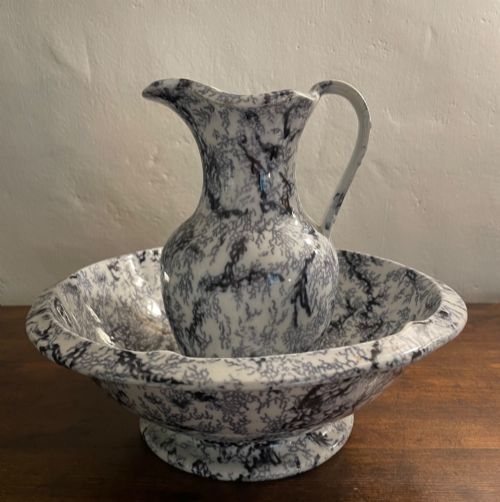
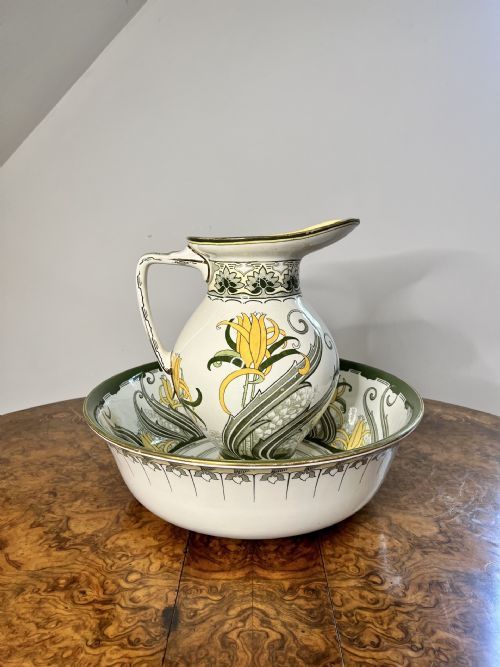
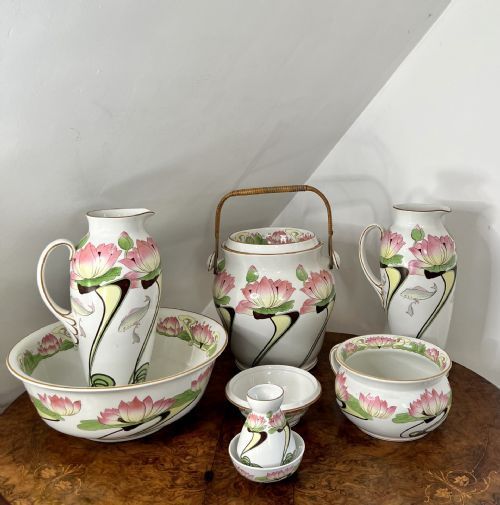


Earthenware Washstand Set
An earthenware washstand set brings practical nineteenth and early twentieth century domestic ceramic utility into the bedroom through matching jugs and basins.
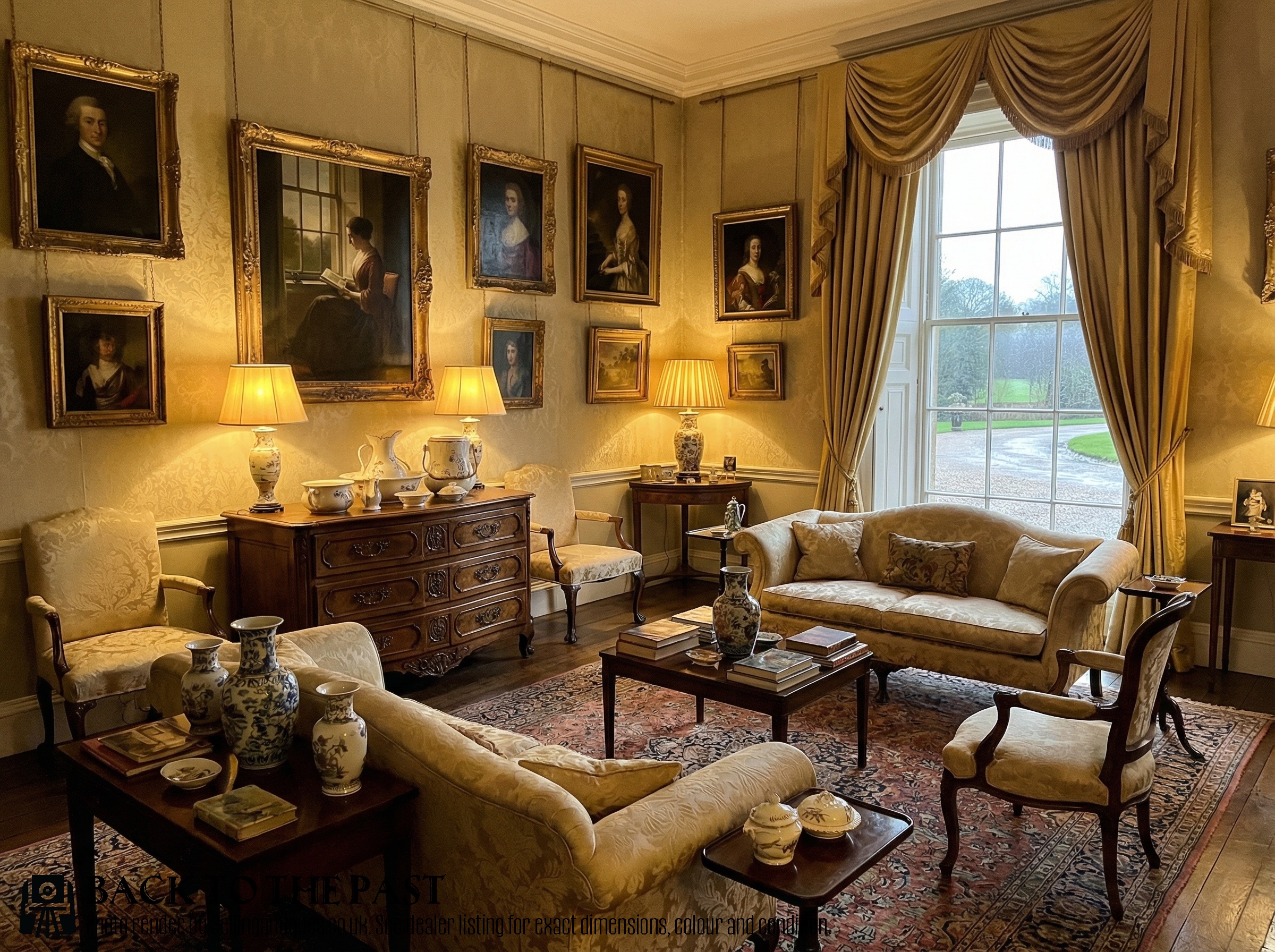
Earthenware Washstand Set
An earthenware washstand set provides a matched jug and basin for personal ablutions before the widespread adoption of plumbed indoor bathrooms in homes. The forms appear primarily across Victorian, Edwardian, and Art Nouveau periods, spanning from the early nineteenth century up to the twentieth century.
Comprising washware items such as pitchers, jugs, basins, and complete wash sets, these pieces served daily washing functions in bedchambers. Surviving examples demonstrate the shift from early Staffordshire flow blue production through to later floral and geometric Edwardian bathroom sets.
How they were made
Potters shaped these earthenware bodies using traditional ceramic techniques before applying protective glaze surfaces to contain water. Workshops utilised Staffordshire flow blue transfer printing alongside hand-applied blue and white pigments to ornament the ceramic bodies.
Certain Edwardian and Art Nouveau pieces incorporated delicate gold leaf highlights over the glazed ceramic surface for decorative effect. The earthenware requires careful kiln firing to mature the clay body and bond the vitreous glaze.
The documented objects comprise jug and basin sets, pitchers, washware, and bathroom sets originating across the nineteenth and early twentieth centuries.
What varies in quality
The sophistication of the ceramic transfer printing and the crispness of the painted blue and white decoration distinguish finer examples from standard utility wares. Earlier Staffordshire pieces often display a characteristic bleeding of the cobalt blue pigment known as flow blue, which requires precise kiln atmosphere control.
Design ambition also separates ordinary sets from exceptional ones, particularly where Art Nouveau organic contours or named maker attribution elevate the piece. The completeness and matching nature of the jug and basin pairing heavily influence the overall character of a set.
Jones and Sons·Doulon Burslem
The Earthenware Washstand Set Glossary
- Flow blue
- A Staffordshire pottery technique where cobalt blue transfer print bleeds slightly into the surrounding white glaze during firing. This creates a soft, hazy effect prized by collectors of nineteenth-century ceramics.
- Earthenware
- A porous type of ceramic fired at relatively low temperatures and rendered waterproof through the application of a vitreous glaze. It forms the primary body material for all pieces in this category.
- Washware
- Collective terminology for the ceramic vessels utilised for personal hygiene before modern indoor plumbing became standard. This category encompasses jugs, basins, soap dishes, and chamber pots.
- Transfer printing
- A mechanical method of applying complex decorative patterns to ceramics by pressing paper tissue inked from a copper plate onto the biscuity clay body. It revolutionised pottery production during the nineteenth century.
Earthenware Washstand Set: Frequently Asked Questions
What is an earthenware washstand set?
An earthenware washstand set is a matching group of ceramic vessels, primarily a large water jug and a deep basin, designed for bedroom washing.
These sets date from the nineteenth and early twentieth centuries, reflecting domestic hygiene habits before plumbed bathrooms.
How were washstand sets used historically?
They stood on wooden washstands in bedrooms, holding water brought up from the kitchen for morning and evening washing.
The jug supplied clean water to the basin, while slops were emptied later into chamber vessels or slop pails.
How do I date an antique wash set?
Dating relies on stylistic clues, ceramic body thickness, and maker marks stamped or printed on the unglazed base.
Victorian pieces often feature deep transfer prints or flow blue, while Edwardian and Art Nouveau sets show lighter palettes and organic motifs.
Can I use an antique wash set daily?
While physically robust, these nineteenth-century earthenware pieces possess delicate glazes and historical value that make modern daily use risky.
Thermal shock from hot water or accidental chipping against modern basins can permanently damage antique ceramics.