


Earthenware Staffordshire Hearth Dogs
These earthenware staffordshire hearth dogs bring nineteenth-century character to a mantelpiece, offering the traditional charm of matched pairs and modelled breeds.
Earthenware Staffordshire Hearth Dogs
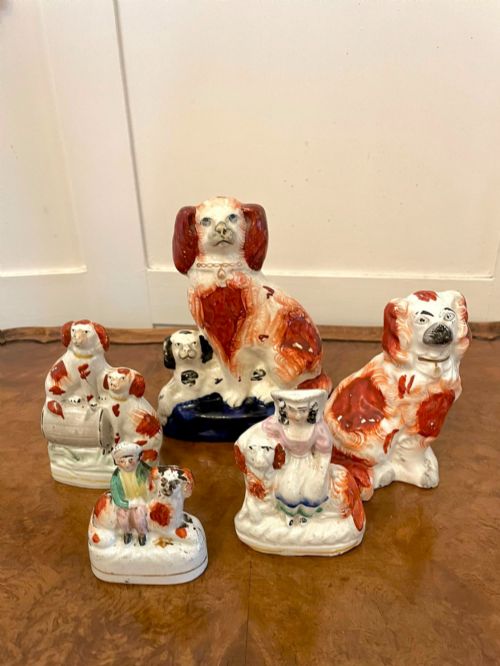
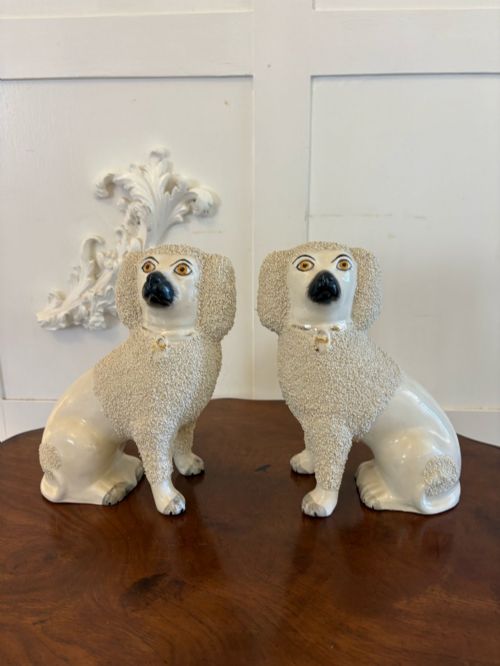
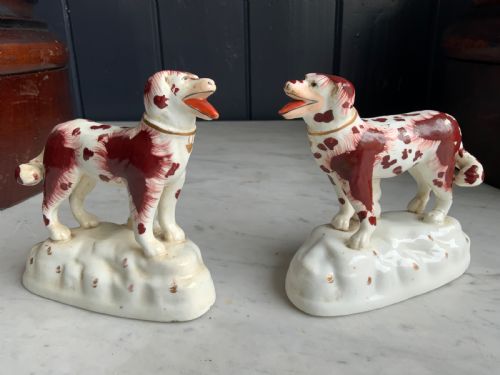
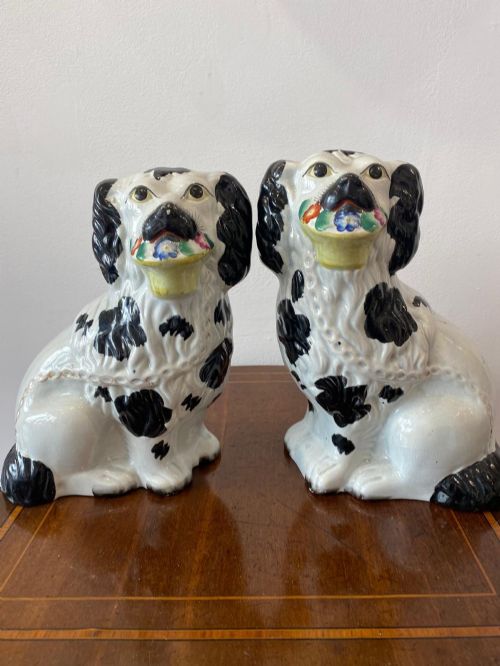
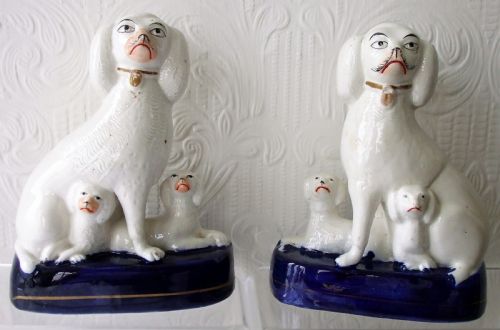
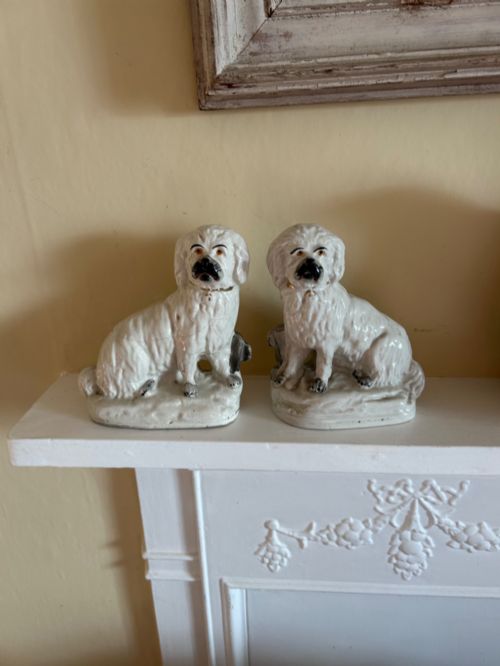
Earthenware staffordshire hearth dogs represent ceramic figures modelled as spaniels, poodles, maltese terriers, and poodles with pups, typically arranged as symmetrical pairs for display. Most examples seen here date from the nineteenth century, including specific decades such as the eighteen-sixties, eighteen-eighties, and the victorian period.
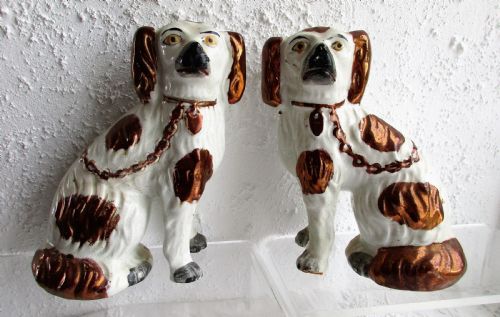
The form developed as a mantelpiece ornament, often referred to as comforter spaniels or seated spaniels. Buyers encounter pairs seated on blue cushions with encrusting, alongside white variants and red and white colourings.
How they were made
Certain models incorporate copper lustre finishes or textured encrusting on cushions to create visual depth. The construction aligns with nineteenth-century pottery traditions of moulded earthenware production.
Some poodles arrive accompanied by tiny ceramic pups tucked firmly beside them on the hearth.
What varies in quality
Quality in earthenware staffordshire hearth dogs rests upon the crispness of the modelling and the precision of the hand painting. Finer pieces display carefully articulated facial expressions and clean application of enamel and gilt details.
Pairs showing consistent size, matching poses, and refined glazing stand apart from simpler utilitarian pottery figures. The presence of secondary elements like pups or detailed cushion bases also distinguishes the range.
Beswick
The Earthenware Staffordshire Hearth Dogs Glossary
- Earthenware
- Porous pottery fired at lower temperatures than stoneware or porcelain. It forms the primary ceramic body for these nineteenth-century figures.
- Lead glaze
- A shiny coating applied to pottery before firing to give a glossy finish. This technique protects the underlying earthenware body.
- Copper lustre
- A metallic glaze that produces a reflective, coppery sheen on the ceramic surface. It appears on specific decorative pairs from the period.
- Enamel
- Opaque glass-based paint applied over the glaze and fired again to fix the colour. It provides the red, black, and gold details on the dogs.
- Comforter spaniels
- A traditional term for Staffordshire dog figures modelled after the King Charles spaniel. Victorians placed them on hearths as decorative mantel ornaments.
Earthenware Staffordshire Hearth Dogs: Frequently Asked Questions
How were these dogs displayed?
These figures were traditionally placed as matched pairs on either end of a fireplace mantelpiece. Their symmetrical design framed the hearth.
Owners often positioned them facing inward toward each other. This arrangement became a standard feature in Victorian domestic interiors.
What breeds do the figures represent?
The listings feature several distinct breeds modelled by nineteenth-century potters. Spaniels dominate the selection, particularly seated spaniels and comforter spaniels.
Other examples include poodles, poodles with pups, and maltese terriers. Each breed reflects popular household pets of the Victorian era.
How do I identify a pair?
Genuine pairs comprise two mirror-image figures designed to sit facing one another. They share matching dimensions, glazing, and decorative motifs.
Colours such as red and white or plain white correspond across both figures. Variations in posture indicate the left and right components of a matched set.
What materials are used in the decoration?
Makers utilised enamel paints to render the eyes, noses, and patches of fur on the ceramic body. Lead glaze provides the overall glossy surface finish.
Selected pieces incorporate gilt, gold leaf, or copper lustre for metallic ornamentation. Some examples feature textured encrusting on modelled cushions.