
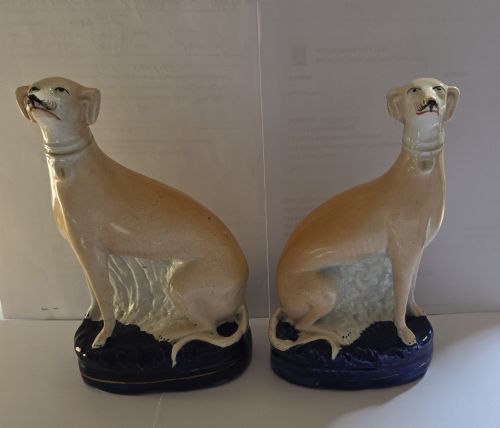


Earthenware Seated Figurines
These earthenware seated figurines bring personality to a mantelpiece, ranging from Victorian spaniels and whippets to ancient figures and glazed apes.
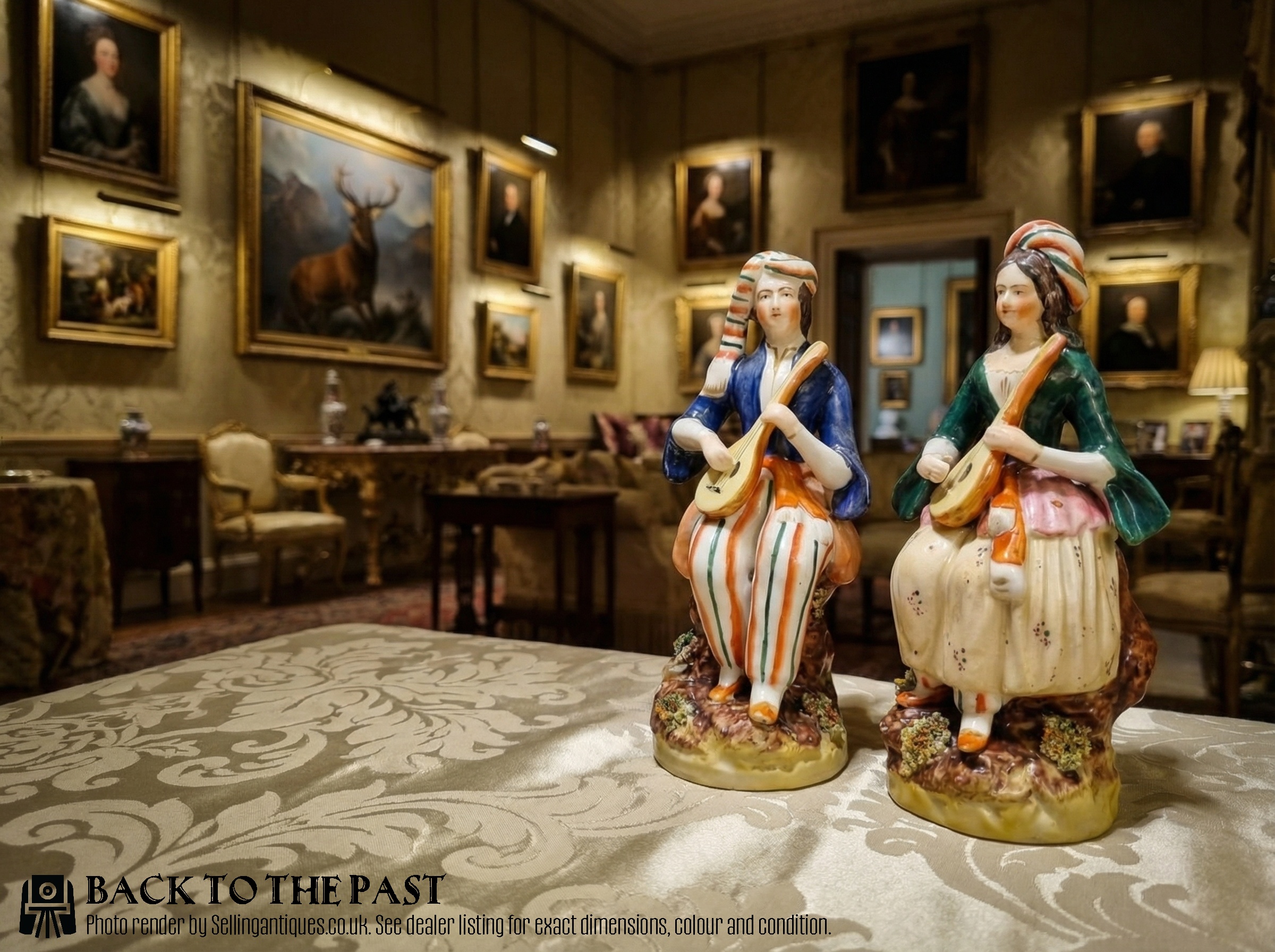
Earthenware Seated Figurines
Earthenware seated figurines encompass a broad sweep of history and form, taking the shape of animals and humans cast in clay. Buyers searching for earthenware seated figurines encounter domestic Victorian subjects alongside older works.
The Victorian period dominates the selection, particularly Staffordshire pairs of spaniels and whippets, as well as royal portrait figures like Queen Victoria and seated Turks. Earlier and foreign examples include pre-Columbian female figures and Chinese turquoise-glazed apes.
These ceramic pieces function primarily as decorative ornaments, often modelled as matched pairs intended for a fireplace mantle or sideboard. Their presence reflects both nineteenth-century parlour taste and ancient sculptural traditions.
How they were made
Makers shaped these earthenware and terracotta pieces using local clays or terracotta bodies, often finishing the surface with a glaze. The ceramic body is fired before receiving its final decorative layer.
Colour is applied through enamel paint and glaze, occasionally heightened with gilt details. Victorian Staffordshire pieces often feature cobalt blue or naturalistic markings, while Chinese and pre-Columbian works rely on distinct single-colour glazes or terracotta finishes.
Listings feature earthenware, terracotta, and ceramic bodies decorated with glaze, enamel, and gilt.
What varies in quality
Completeness as a matched pair elevates certain domestic figures, especially when both dogs or figures survive together in a uniform state. The precision of hand-painted enamel and gilt details also distinguishes finer studio or factory work from standard commercial output.
The Earthenware Seated Figurines Glossary
- Earthenware
- A porous pottery type fired at lower temperatures than stoneware or porcelain. It requires a glaze to become waterproof and forms the base body for Victorian Staffordshire and many ancient ceramics.
- Flatback
- A style of figure moulded with a flat unglazed or minimally finished back. This construction allowed Victorian mantelpiece ornaments to sit flush against a wall.
- Enamel
- Opaque glass-like paint applied over the fired glaze and fixed with a low-temperature second firing. It provides the bright surface colours seen on Victorian dog figurines.
- Terracotta
- Unglazed or fired brown-red earthenware clay used in ancient sculpture. It shows the natural colour of the baked earth.
- Gilt
- A thin layer of gold application used to highlight details such as collars or crowns. It adds ornamental richness to ceramic figures.
Earthenware Seated Figurines: Frequently Asked Questions
Where should I display these figures?
These figures sit naturally on mantelpieces, bookshelves, or sideboards where their forms can be appreciated at eye level. Paired animals work particularly well balanced at either end of a shelf.
Because they are made of earthenware, keep them away from damp areas and direct, prolonged sunlight to protect the painted enamels and glazes.
How do I care for antique earthenware?
Dust the surface gently with a soft, dry brush to prevent dirt accumulation. Avoid using water or chemical cleaners, as these can damage old enamel and gilt highlights.
Handle the pieces by their main body rather than protruding parts like ears or heads to prevent accidental breakage.
What periods do these figurines cover?
The selection spans from ancient pre-Columbian figures dating back centuries BC to nineteenth-century Victorian Staffordshire pottery. Early twentieth-century Chinese glazed pieces also appear among the selections.
Victorian examples from the mid to late nineteenth century form the largest group available to buyers.
Are Victorian spaniel figures always sold in pairs?
Many Victorian Staffordshire spaniels and whippets were modelled and sold as matched pairs to sit facing one another on either side of a fireplace. Single figures do occur, but pairs remain a defining characteristic of the dog figurine tradition.
Checking the proportions and facial markings helps determine if a pair was produced together.