




Earthenware Jug Vases
These earthenware jug vases bring together centuries of global ceramic history, offering tactile surfaces and sculptural forms that suit any room.
Earthenware Jug Vases
Earthenware jug vases span multiple centuries and design traditions, ranging from early Pre-Columbian terracotta vessels to European majolica and studio pottery. When you search for earthenware jug vases, you encounter diverse forms including ewers, pilgrim flasks, and traditional pitchers that double as flower holders.
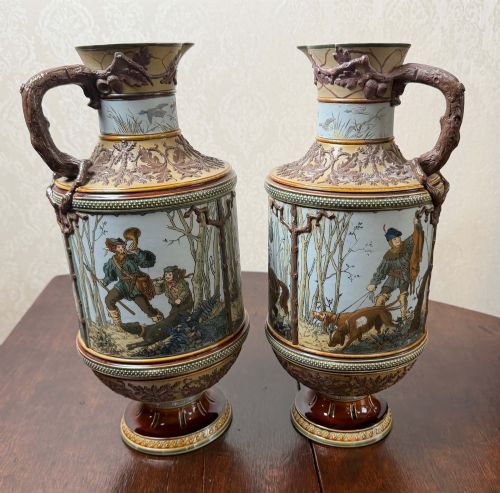
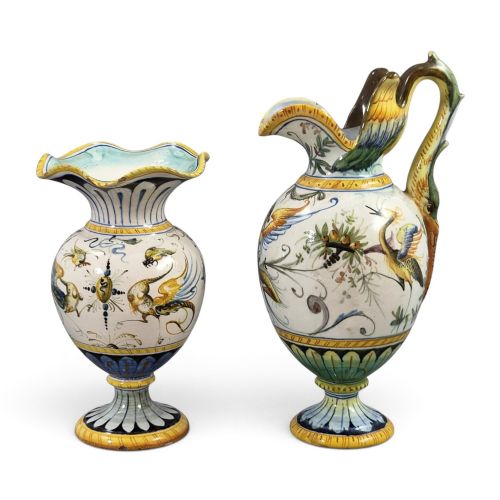
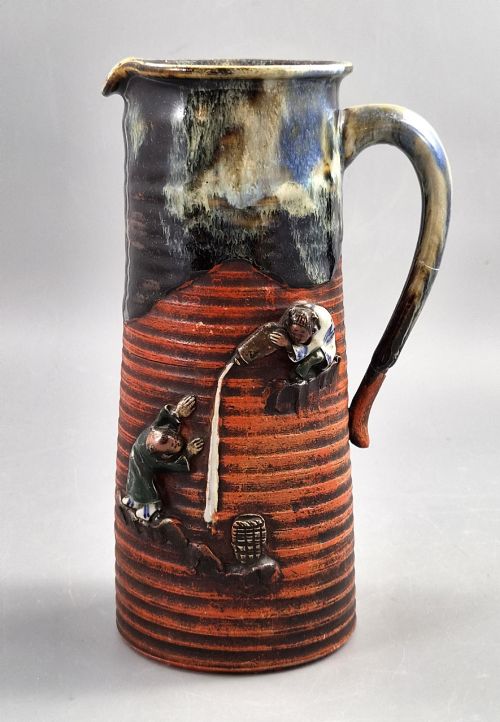
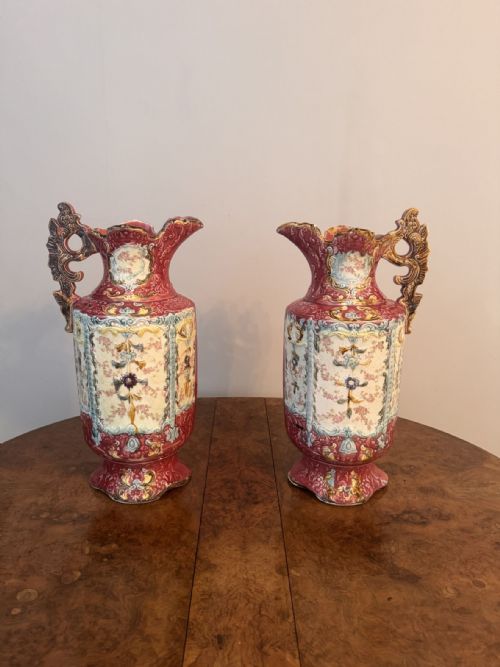
The pieces on this page draw from distinct historical movements such as the Arts and Crafts era, Renaissance Revival, and Dutch Delftware. Formats vary from large Victorian decorative pairs to detailed Japanese Sumida Gawa pitchers and English studio works by notable makers.
Whether you prefer the crisp tin-glazed surfaces of eighteenth-century Delftware or the textured relief of nineteenth-century German and Italian output, these vessels serve primarily as decorative focal points. Their dual nature as both jugs and vases reflects historical utility adapted entirely for display.
Materials and Making
Construction relies heavily on basic earthenware bodies and terracotta, shaped by hand or on the wheel before receiving decorative treatment. Potters often applied glazes and enamel directly to the porous clay base to seal the vessel and add colour.
Surface decoration frequently involves tin glaze or specialised ceramic glaze to create smooth, colourful finishes as seen in Majolica and Delftware pieces. Many items employ relief moulding, hand-painted scenes, or applied motifs such as the characteristic slip designs of studio pottery.
Earthenware Jug Vases Retail Price Guide 2026
Typical asking prices for earthenware jug vases among the pieces listed under this phrase on Sellingantiques today, from the lower quarter to the upper quarter. They describe what is for sale here now, not the wider market.
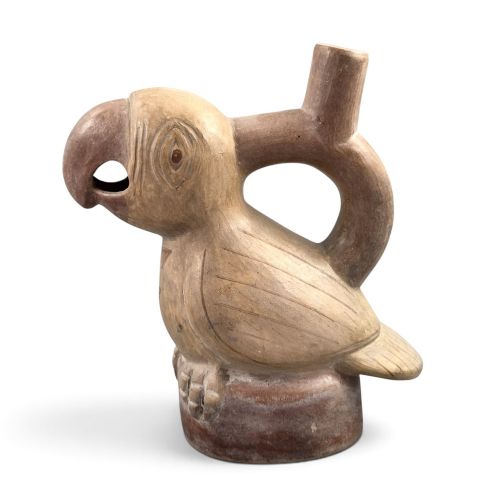
Some vessels take the form of birds or pilgrim flasks, proving that historic potters rarely settled for a simple round pot.
Judging Quality
Quality in these vessels rests upon the crispness of the modelling, the stability of the glaze, and the ambition of the hand-painted or moulded decoration. Superior examples display confident execution in their surface patterns and well-balanced forms that maintain structural integrity.
Artisanal intent also dictates value, distinguishing standard production pieces from signed studio works or sophisticated revival items. The depth of the enamel work and the preservation of the glaze without excessive crazing reveal the original maker's skill.
Mettlach·Cantagalli Florence·Sir Edmund Elton·Charlotte Rhead
The Earthenware Jug Vases Glossary
- Earthenware
- Porous pottery fired at relatively low temperatures that requires a protective glaze to hold liquids. It represents one of the oldest and most widespread ceramic mediums.
- Majolica
- Tin-glazed earthenware decorated with brightly coloured metal oxide paints on an opaque white background. This technique gained prominence during the Italian Renaissance and later revivals.
- Ewer
- A large pitcher or jug featuring a wide spout and a looped handle, traditionally used for pouring water. In decorative contexts, it functions primarily as an ornamental vessel.
- Tin Glaze
- A lead glaze rendered opaque by the addition of tin oxide, providing a smooth white surface for painting. It forms the basis of traditional Delftware and majolica.
- Ornithomorphic
- Shaped or decorated in the form of a bird. This descriptor frequently appears in descriptions of ancient and Pre-Columbian pottery vessels.
Earthenware Jug Vases: Frequently Asked Questions
Can I use these vases for holding fresh flowers?
Many of these vessels were originally made to hold liquids or flowers, but older pieces with porous earthenware bodies or historic glazes require caution.
It is generally safer to place a small glass or plastic liner inside fragile or antique examples to protect the interior from moisture.
How do I clean an antique earthenware jug?
Dusting with a dry, soft cloth is sufficient for the exterior surfaces of most glazed and painted ceramic pieces.
Avoid submerging older items in water or using harsh chemical cleaners, as this can damage delicate enamels and historic glazes.
How can I tell the period of a ceramic piece?
Dating relies on examining the clay body, the composition of the glaze, and the stylistic markers associated with specific movements like Arts and Crafts or Renaissance Revival.
Maker's marks, stamps, and signatures on the base provide the most reliable evidence for narrowing down the date of creation.