





Early Seventeenth Century Chest
An early seventeenth century chest is a heavy timber repository built to endure, offering robust storage anchored in centuries of domestic history.

Early Seventeenth Century Chest
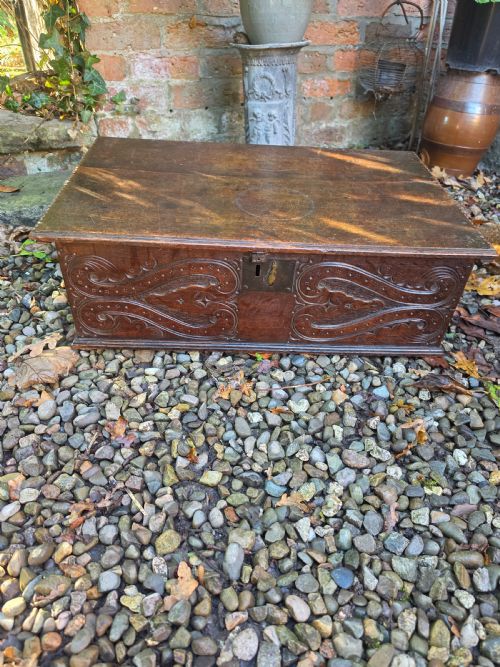
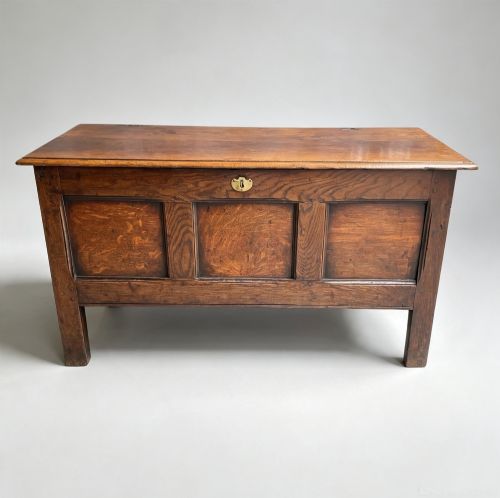
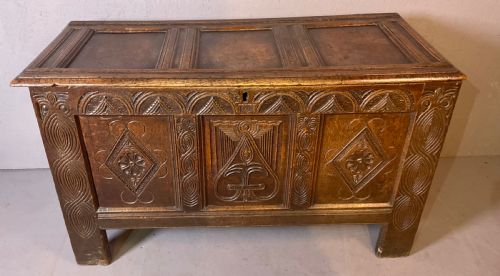
The early seventeenth century chest category encompasses sturdy oak coffers, blanket boxes, and early chests of drawers designed for domestic storage. These pieces originate primarily from the seventeenth century, with occasional pieces spanning into the eighteenth century, reflecting utilitarian origins.
Most examples encountered here take the form of the traditional oak coffer, sometimes featuring panelled construction or simpler six-plank assemblies. Regional variations appear too, including Welsh examples and West Country pieces, which bring distinct local joinery traditions to light.
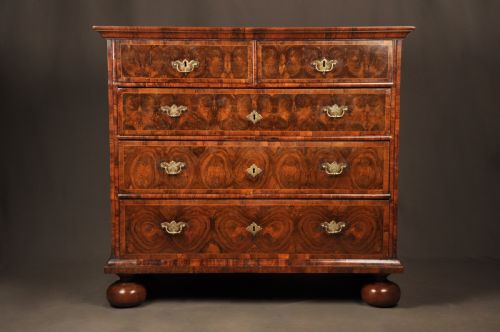
Beyond basic coffers, the selection includes geometric chests of drawers and small safe boxes fitted with complex steel locks. These variations demonstrate the evolution of domestic storage from simple blanket containment to more compartmentalised furniture.
Materials and construction methods
Oak serves as the primary structural timber across almost all pieces, chosen for its strength and local availability. Selected items incorporate contrasting veneers such as olive oyster, adding visual depth to the surface.
Joinery relies heavily on traditional panelled construction and sturdy plank assembly rather than modern mechanical fastenings. Metal components such as iron, brass, and wrought iron are integrated to create functional hinges and complex steel locks.
Early Seventeenth Century Chest Retail Price Guide 2026
Typical asking prices for early seventeenth century chest among the pieces listed under this phrase on Sellingantiques today, from the lower quarter to the upper quarter. They describe what is for sale here now, not the wider market.
Listings feature oak predominantly, supplemented by iron, brass, and olive timber across various coffer and chest formats.
Assessing quality and character
Quality rests upon the integrity of the timber and the complexity of the original construction, whether in carved panels or geometric drawer fronts. Survival of original hardware, such as complex steel locks and hinges, elevates the historical standing of a piece.
Proportion and regional carpentry traits also distinguish individual items, from simple six-plank coffers to refined chests of drawers. The presence of undamaged surface timber without extensive modern intervention preserves the integrity of the object.
The Early Seventeenth Century Chest Glossary
- Jacobean
- A design style spanning the late sixteenth and seventeenth centuries, characterised by solid proportions and geometric ornamentation. It frequently employs moulded panels and heavy timber framing.
- Oyster veneer
- Slices cut across small branches or roots of timber to produce circular patterns resembling oyster shells. This technique gained popularity in the latter part of the seventeenth century.
- Six plank coffer
- A primitive form of chest constructed from six simple boards pinned together at the corners. It represents an early and straightforward method of box-making.
- Arcaded
- A decorative motif carved into woodwork to resemble a sequence of arches supported by columns. This style appears frequently on seventeenth-century panels.
Early Seventeenth Century Chest: Frequently Asked Questions
What were early seventeenth century chests used for?
These chests served primarily as secure storage for household textiles, valuable documents, and personal belongings in domestic settings.
Because houses lacked built-in closets, large coffers and blanket boxes were essential portable furniture for organising household goods.
How do I place an oak chest in a modern room?
An oak coffer functions effectively as a coffee table, hallway bench, or end-of-bed blanket storage unit.
The neutral tones of aged timber and iron hardware allow these pieces to integrate smoothly into contemporary living spaces.
How do I tell a coffer from a chest of drawers?
A coffer opens from a single hinged lid at the top and usually contains a single deep compartment inside.
By contrast, a chest of drawers provides side-access pull-out compartments, representing a later development in domestic storage.
What distinguishes Welsh coffers from other regional pieces?
Welsh examples, sometimes referred to as coffor bach, often exhibit specific local timber choices and regional joinery traits.
These smaller chests reflect the distinct domestic traditions found in West Country and Welsh workshops during the seventeenth century.