


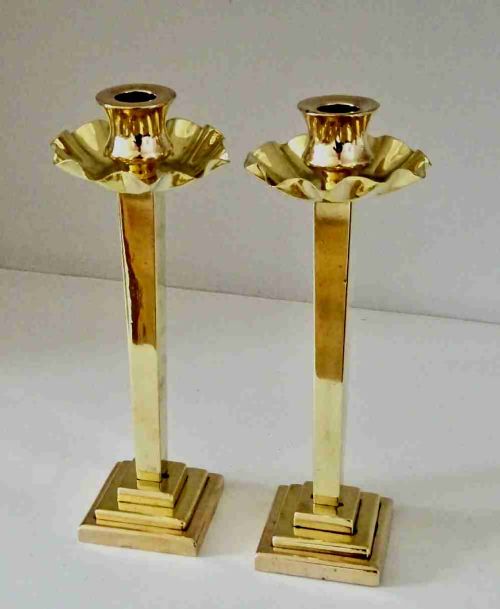
Early Art Deco Lighting
Early art deco lighting brings distinct transitional forms of the early twentieth century into a room, combining architectural metals with characterful glass shades.
Early Art Deco Lighting
When you search for early art deco lighting, you encounter domestic fixtures spanning the turn of the twentieth century up through the nineteen-twenties, encompassing both transitional Edwardian designs and the emergence of Amsterdam School and Jugendstil aesthetics. These pieces include table lamps, desk lamps, floor lamps, ceiling lights, and chandeliers intended for focused task illumination or ambient room lighting.
The selections on this page rely heavily on adjustable brass desk lamps, bankers lamps, and patinated metal or copper table lamps that bridge late-nineteenth-century utility with modern geometric styling. You also find specialised forms such as pullman lamps, candle lamps, and hall lights fitted with glass or opaline shades.
What varies in quality
Quality rests in the substantive weight of the cast metals, the crispness of the articulation in adjustable arms, and the preservation of original patination on copper and brass surfaces.
The integrity of specialised components, such as original glass shades, frosted Baccarat figurines, and structural fretwork, distinguishes standard utility items from more ambitious decorative examples.
Selected inventory includes a tiny celluloid table lamp that proves small ambitions sometimes outlive grand chandeliers.
The Early Art Deco Lighting Glossary
- Amsterdam School
- A stylistic movement originating in the Netherlands characterised by brickwork, expressive forms, and detailed metalwork seen in early twentieth-century design. It heavily influences the architectural silhouettes found in select table lamps and candlesticks.
- Opaline Glass
- A milky, semi-translucent glass type used extensively for shades to diffuse light evenly. It softens harsh glare in period ceiling fixtures and desk lamps.
- Jugendstil
- The continental European counterpart to Art Nouveau, emphasising flowing organic lines before transitioning into geometric modernism. Pieces from this origin often display floral or sinuous motifs.
- Pullman Lamp
- A compact, specialised light fixture originally designed for train carriages or maritime use where space was strictly limited. Their robust construction makes them durable additions to domestic desk spaces.
- Patinated Metal
- Metal surfaces altered naturally over time or through chemical treatment to display aged tones such as dark brown, verdigris, or warm bronze. This finish offers visual depth distinct from polished new metal.
Early Art Deco Lighting: Frequently Asked Questions
How do I date early art deco lighting?
Dating relies on stylistic clues that sit between Edwardian ornamentation and fully realised modernist geometry. Look for transitional markers such as Amsterdam School fretwork or heavy brass bases combined with clean lines.
Material choices also offer guidance, as nickel plating, patinated copper, and early opaline glass point directly to manufacturing practices spanning from nineteen hundred to nineteen thirty.
Are these lamps suitable for modern desks?
Many examples, including adjustable brass desk lamps and articulated bankers lamps, were engineered for focused task work. Their flexible arms and directional shades translate well to contemporary workspaces.
Buyers should inspect the internal wiring and bulb fittings to ensure compatibility with current safety standards while retaining the original exterior housing.
How should I clean patinated brass?
Preserving the aged surface requires avoiding harsh chemical polishes that strip away historical character and valuable patination. Dust gently with a soft, dry cloth to maintain the stable metal finish.
Allowing the natural oxidation to remain intact protects the underlying alloy and ensures the piece retains its period appearance.