



Early 19th Century Textile
An early 19th century textile brings domestic needlework and tribal weaving into a room, offering tactile connection to the past through wool, linen, and silk.
Early 19th Century Textile
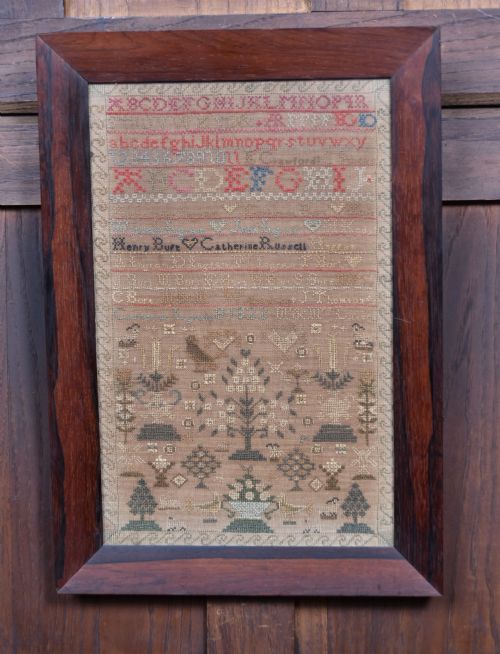
When you search for an early 19th century textile, you encounter a varied group of objects ranging from framed British needlework pictures and samplers to tribal rugs and French tapestries. These pieces reflect both the formal education of young women in domestic embroidery and the utilitarian or decorative weaving traditions of tribal makers.
The domestic works frequently record names and dates, serving as personal documents of the period, while the floor coverings and fragments demonstrate regional dyeing and knotting methods. Samplers and silkwork pictures dominate the British examples, whereas wool and cotton feature strongly in the tribal bag faces and rug fragments.
The geographical origins span Britain, France, and Central Asia, incorporating Georgian and Regency aesthetics alongside Turkmen and Persian tribal designs. This mix ensures that a buyer searching this category encounters both refined wall art and robust nomadic floor textiles.
How they were made
Makers utilised natural fibres including wool, linen, cotton, and silk, often working them onto plain woven linen grounds or mounting them as framed pictures. Crewel work, silk embroidery, and felt application form the primary surface techniques for the pictorial pieces, while the rugs and bag faces rely on flat-woven details and pile knots.
Wooden frames and giltwood surrounds frequently house the needlework pictures and samplers, protecting the delicate threadwork behind glass. The Turkmen and tribal pieces employ durable wool foundations to support intricate geometric motifs created with saturated natural dyes.
Early 19th Century Textile Retail Price Guide 2026
Typical asking prices for early 19th century textile among the pieces listed under this phrase on Sellingantiques today, from the lower quarter to the upper quarter. They describe what is for sale here now, not the wider market.
Listings in this category span multiple materials including linen, silk, wool, cotton, wood, and glass.
What varies in quality
The distinction between standard and superior pieces rests upon the precision of the stitchwork, the complexity of the narrative or geometric design, and the retention of original materials. Samplers with well-executed lettering and pictorial scenes by named makers command greater interest than plain or heavily damaged examples.
For the tribal rugs and bag faces, quality is visible in the density of the weave, the clarity of the secondary motifs, and the presence of complete plain weave backs or original borders. Condition remains paramount, with complete textile fragments and stable wool surfaces marking the upper tier of the range.
The Early 19th Century Textile Glossary
- Sampler
- A piece of needlework produced to demonstrate proficiency in various stitches and lettering. They often include alphabets, numbers, and the maker's name alongside a date.
- Chuval
- A large Turkmen tent bag used for storage. These pieces feature distinctive guls and are frequently collected as small rugs or wall hangings.
- Khorjin
- A traditional saddle bag face woven by tribal makers. They display expressive geometric patterns executed in wool.
- Crewel work
- Embroidery executed with wool yarn on a linen or cotton ground. It produces textured surface designs with a raised appearance.
- Aubusson
- A style of woven tapestry originating from France. These works depict pastoral scenes or architectural motifs in muted tones.
Early 19th Century Textile: Frequently Asked Questions
How do I clean an old textile?
Historic textiles require professional conservation rather than standard domestic cleaning methods. Surface dust can be removed gently with low suction through a mesh screen.
Water and chemical detergents will damage fragile silk, wool, and natural dye grounds. Consult a specialist textile conservator before attempting any intervention.
Can I hang these textiles on the wall?
Framed samplers and embroidered pictures are designed for wall display behind protective glass. Unframed rugs and fragments require proper mounting support to distribute weight evenly across the fibres.
Direct sunlight causes fading in natural dyes, so placement away from bright windows is essential.
What is a needlework sampler?
A needlework sampler is a practice piece created by young makers to demonstrate competence in stitches. They typically record alphabets, numerical sequences, and decorative borders.
Many examples include the maker's name and a specific year, providing a clear historical record.
How do I identify tribal rugs?
Tribal rugs and bag faces display characteristic geometric motifs, repeating guls, and saturated colour palettes associated with specific nomadic groups. The presence of wool foundations and flat-woven backs helps distinguish them from European pieces.
Structure and knotting techniques offer further clues to their regional origin.