




Early 19th Century Candlestick
An early 19th century candlestick brings period illumination and sculptural weight to a room, offering enduring metalwork and classical proportion.
Early 19th Century Candlestick
An early 19th century candlestick encompasses domestic lighting accessories from the Georgian, Regency, and French Empire periods. These items range from simple brass desk pieces to grand ormolu and bronze table ornaments.
Brass examples appear most frequently, alongside silver plate, bronze, and occasional turned wood or giltwood creations. Pairs predominate in the selections, often designed for mantelpieces or dining tables.
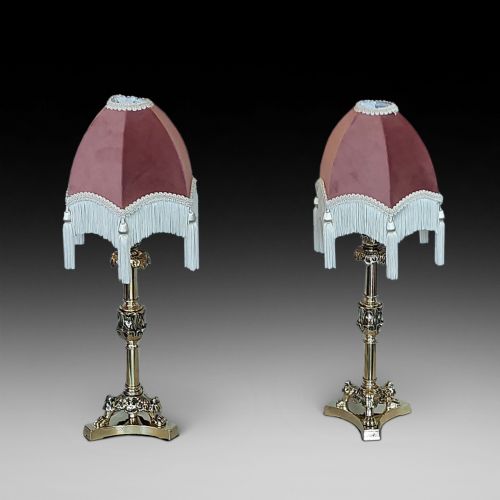
Many survivors from this era adapt to modern interiors through conversion into electric lamps using silk shades or fabric fittings. Chamber sticks with low pans and handles also feature regularly among the available forms.
How they were made
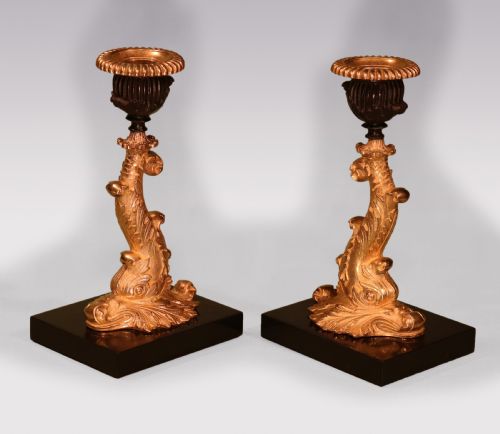
Foundry work in brass, bronze, and ormolu involved casting metal in sections before turning on a lathe and joining the components. Ormolu pieces received a fine application of gold amalgamation over bronze, creating a rich contrast with dark patinated surfaces.
Silversmiths utilised Old Sheffield plating techniques, fusing a thin sheet of silver to a copper base before hand-shaping and soldering the parts. Turned wood examples relied on precision lathe work to achieve spiral and columnar profiles.
Chamber sticks and column candlesticks often integrated thumbpieces, nozzle trays, and detachable drip pans to catch melting wax. Details like dolphin mounts or cast floral motifs required skilled chasing and chiselling after the initial casting.
Materials recorded across the inventory include brass, bronze, ormolu, silver plate, oak, walnut, and giltwood.
What varies in quality
The crispness of the cast ornamentation dictates the standard of metalwork, distinguishing sharp, hand-chased foliage from soft, worn production. Heavy gauge brass and substantial bronze additions indicate superior material substance compared to lighter alternatives.
Original gilding retention on ormolu and gilt bronze elevates a piece, whereas aggressive cleaning or over-polishing diminishes the original surface texture. Matching pairs with identical proportions and uniform casting marks command higher regard than assembled sets.
William Tonks·Thomas Hope
The Early 19th Century Candlestick Glossary
- Ormolu
- Gilded bronze, produced by applying a mercury-gold amalgam to a bronze base and heating it. This technique creates a distinctive matte and burnished golden finish seen on French Empire pieces.
- Chamber stick
- A low portable candlestick fitted with a pan to catch wax and a loop handle for carrying around a house. These served bedrooms and hallways before fixed domestic lighting.
- Sheffield plate
- An early form of composite metal made by fusing a sheet of sterling silver onto a heavier copper ingot. This method preceded electroplating and leaves characteristic thin silver edges where copper shows through.
- Candelabra
- A branched lighting fixture holding multiple candles from a single stem. These larger decorative items frequently incorporate classical motifs such as dolphins or foliate scrolls.
Early 19th Century Candlestick: Frequently Asked Questions
How do I clean antique brass safely?
Wash brass pieces gently in warm soapy water using a soft cloth to remove surface dust and old wax residues.
Avoid harsh commercial metal polishes that strip away the natural historic patina and leave an overly bright, unnatural shine.
Were these candlesticks originally electrified?
Electric conversions are later adaptations added to transform antique candlesticks into functional table lamps for modern homes.
Original pieces held only wax or tallow candles in a standard nozzle fitted with a drip pan.
How can I tell Regency from Georgian style?
Regency items lean heavily into classical antiquity, drawing inspiration from Greek, Roman, and French Empire designs with motifs like bronze mounts and dolphins.
Georgian pieces often display earlier restraint, favouring simple column forms, straightforward brass casting, or early Sheffield plating.
What is the difference between a candlestick and a chamber stick?
Standard candlesticks stand upright on dining tables and mantelpieces to provide fixed ambient room illumination.
Chamber sticks incorporate a saucer base and finger ring specifically for carrying through dark hallways at night.