
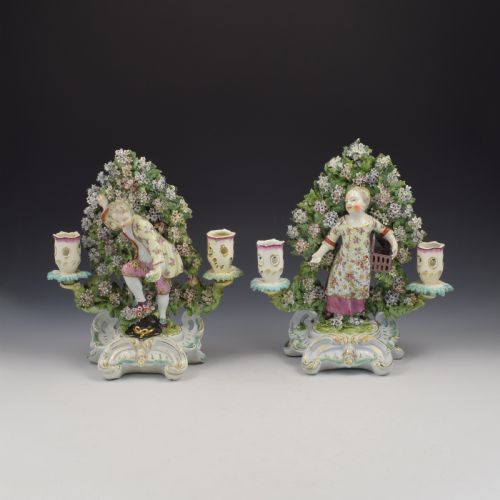


Floral Porcelain Candleholder
These floral porcelain candleholder examples bring 18th Century and 19th Century craftsmanship to a room through painted details and sculptural forms.
Floral Porcelain Candleholder
A floral porcelain candleholder combines functional lighting with sculpted ceramics, often taking the form of candlesticks and candelabra. When searching for a floral porcelain candleholder, buyers encounter pieces decorated with applied flowers, botanical motifs, and figural scenes.
The selection here spans from Georgian and Regency eras through to the late 19th Century. Many pieces feature Rococo and Rococo Revival styling, showing scrolling forms and elaborate painted decoration.
Makers such as Derby, Spode, Minton, Meissen, and Sitzendorf dominate the offerings, working in hard-paste porcelain, bone china, and enamel. Pieces range from single chambersticks to large four-arm figural candelabra with ormolu mounts.
Materials and construction
Makers utilised porcelain and bone china as the primary base materials, shaping them into figures, bocage backgrounds, and floral bases. Enamel paints were applied by hand to decorate the botanical elements and figures.
Gold leaf, gilt, and gilding highlight the raised scrolls and edges of the pieces, particularly on Regency and Rococo Revival designs. Certain candelabra incorporate ormolu mounts to support the porcelain components and branches.
Gardener figures and children holding baskets populate the floral bases, bringing miniature horticulture to the mantelpiece.
Assessing quality and execution
The crispness of the modelled porcelain flowers and the detail in figural modelling separate standard production from superior work. Finer examples show delicate petals and careful hand-painting that remains distinct across complex bocage forms.
The application of gilding and enamel work indicates the skill level of the factory. Integrated ormolu mounts and multi-arm configurations require precise metalwork to complement the porcelain sections.
Derby Porcelain·Spode·Minton·Meissen·Sitzendorf
The Floral Porcelain Candleholder Glossary
- Bocage
- A background of applied porcelain leaves and flowers surrounding figures on a candlestick. This leafy screen is typical of 18th Century and Regency ceramic design.
- Chamberstick
- A low candlestick fitted with a pan and a side handle for carrying through a house. These portable items often feature floral decoration.
- Candelabra
- A branched candlestick holding multiple lights. The examples here often incorporate figural groups and gilt accents.
- Ormolu
- Gilt bronze mounts used to frame or support porcelain components. This technique appears on mixed-media pieces from the 19th Century.
- Hard-paste porcelain
- A durable ceramic composition fired at high temperatures. It provides a smooth base for enamel colours and gilding.
Floral Porcelain Candleholder: Frequently Asked Questions
How do I distinguish between candlesticks and candelabra?
Candlesticks hold a single candle in a fixed socket, whereas candelabra feature branched arms designed to hold multiple candles simultaneously.
The examples on this page include both single candlesticks and large multi-arm candelabra with figural supports.
Where were these pieces made?
The pieces originate from major European ceramic centres in England and Germany. Factories in Derby, Stoke-on-Trent, Meissen, and Thuringia produced these works.
English makers like Spode and Minton worked alongside continental manufacturers such as Meissen and Sitzendorf.
What styles are common among these candleholders?
Rococo and Rococo Revival styles dominate the selection, alongside Regency designs. These styles feature asymmetrical scrolls, shell motifs, and abundant floral elements.
Such ornamentation reflects the 18th Century aesthetic revived during the 19th Century by European factories.