


Early 18th Century Candlesticks
These early 18th century candlesticks offer substantial brass, iron and carved wood forms that bring historic domestic lighting into modern rooms.
Early 18th Century Candlesticks
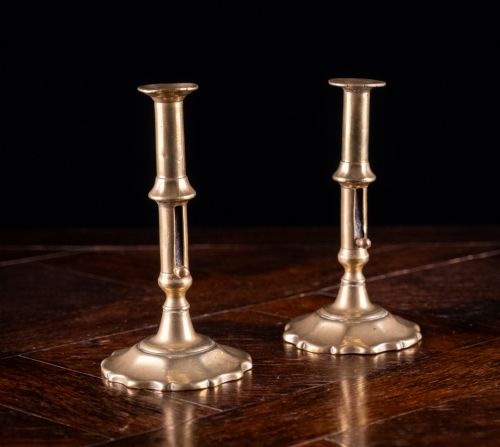
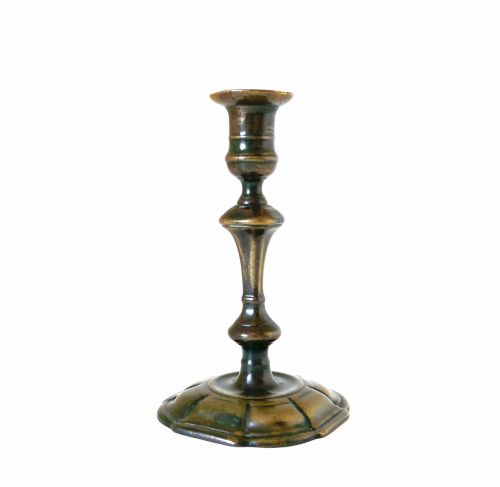
When you search for early 18th century candlesticks, you encounter a selection spanning the late 17th century through the Georgian and George II eras, alongside continental and Italian examples. The version you are most likely to meet on this page is the brass pair featuring hexagonal, octagonal, or petal bases, often with multi-knopped stems.
Origin styles stretch across English Queen Anne and George II designs to Dutch Baroque and Italian Venetian aesthetics. Whether cast in solid metal or carved from wood, each survivor carries the distinct proportions of its period.
Materials and Construction
Makers utilised cast brass, bell metal, and wrought iron, employing techniques such as multi-part casting and seaming to build rigid stems and heavy bases. Metal pieces frequently incorporate side ejector mechanisms to push out remaining candle stubs.
Wooden alternatives rely on carved timber substrates treated with gesso, silver leaf, and giltwood finishes for altar-style or Venetian presentation. These varied material choices dictate both the weight of the piece and the texture of its surface patina.
The listed inventory combines solid brass, bell metal, wrought iron, and carved wood forms spanning the 17th, 18th, and early 19th centuries.
Judging Quality and Execution
The distinction between standard examples and superior ones rests on the crispness of casting detail in the knops and the preservation of original patination. Metal candlesticks that retain clean lines on hexagonal and octagonal bases demonstrate higher grade workshop output.
Completeness of original mechanical elements, such as side ejector slides, elevates certain brass specimens above simpler designs. For carved wooden versions, the intact survival of silvered and giltwood surfaces determines the caliber of the piece.
The Early 18th Century Candlesticks Glossary
- Bell metal
- An alloy of copper and tin traditionally used for bells, noted here in seamed candlesticks for its resonant density and dark tone.
- Ejector
- A mechanical slide fitted into the socket of a candlestick to push out the remaining wax stub without damaging the metal.
- Heemskerk
- A distinct style of heavy brass candlestick originating in the 17th century, characterised by multiple drip pans and a central bell-shaped base.
- Mecca
- A transparent golden varnish applied over silver leaf or silvered wood to imitate true giltwork on Italian altar-type candlesticks.
- Rushlight
- A simple wrought iron holder designed to grip a dried rush dipped in animal fat, representing early domestic lighting before wax candles became common.
Early 18th Century Candlesticks: Frequently Asked Questions
How do I clean antique brass candlesticks?
Wipe surfaces gently with a soft, dry cloth to remove accumulated dust without disturbing the historic patination. Avoid modern chemical polishes that strip away age and diminish the character of the metal.
For stubborn residue, consult a specialist rather than attempting aggressive cleaning methods at home. Preserving the surface skin remains paramount for maintaining historical integrity.
What is a side ejector?
A side ejector is a small sliding lever integrated into the socket of the candlestick. Pushing this internal mechanism upward forces the remaining wax candle end out of the holder.
This practical addition helps date metal pieces securely to the late 17th and early 18th centuries. Collectors prize examples where the original sliding mechanism still functions smoothly.
Were these candlesticks made in pairs?
Many surviving examples were produced as matched pairs to flank the mantelpiece, mirror, or dining table in historic homes. Single pieces also occur frequently, reflecting the dispersed nature of surviving antique lighting.
Pairs command higher interest among collectors who wish to display them symmetrically. Even within a matched pair, minor casting variations often confirm their hand-wrought origins.