
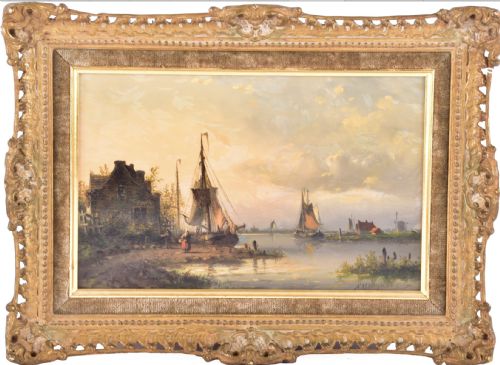
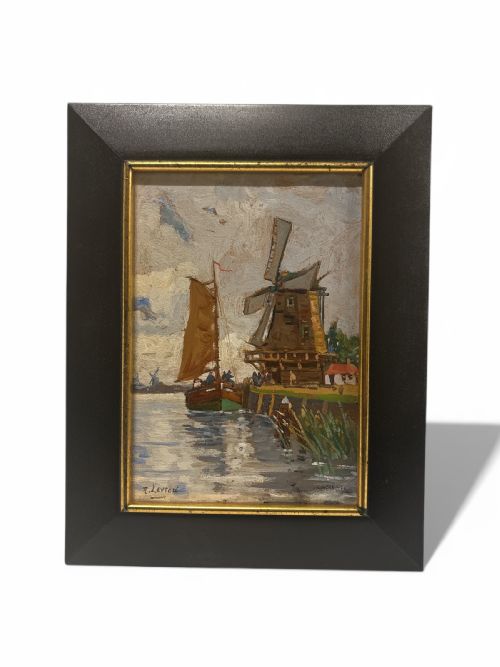
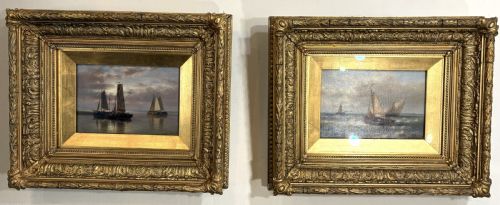


Dutch Coastal Scene
A dutch coastal scene brings home the vast light, heavy skies, and maritime life of the Netherlands through enduring brushwork.
Dutch Coastal Scene
A dutch coastal scene represents maritime views, harbours, and shores captured primarily in oil on canvas or board. These works frequently feature traditional elements such as windmills, sailing boats, and fishing vessels along the North Sea coast.
The pieces available span from the nineteenth century into the twentieth century, encompassing Victorian marine works, Impressionist interpretations, and the atmospheric approach of the Hague School. Painters range from listed historical artists to members of the broader European School.
Subjects often focus on everyday maritime activity, including figures mending nets or carrying water by the shore. Buyers encounter both intimate watercolours and substantial oil paintings framed in giltwood.
Materials and methods
Artists relied primarily on oil paint applied to stretched canvas or wooden panels, utilising rich layers to capture the shifting movement of water and clouds. Watercolour on paper appears in specific marine works, offering a lighter tonal range.
Frames of giltwood and gold leaf frequently accompany these paintings, providing a traditional decorative border that complements the maritime subject matter. Support materials vary from robust nineteenth-century wooden panels to mid-twentieth-century canvases.
The selection spans from nineteenth-century maritime traditions through to mid-twentieth-century revivals.
Distinguishing quality
Quality rests in the handling of light and atmospheric perspective, where skilled brushwork conveys the damp air and open skies characteristic of the coast. Weaker works rely on formulaic repetition, whereas superior examples demonstrate confident draughtsmanship in the rendering of rigging, hulls, and figures.
The depth of the palette and the preservation of the original canvas or board surface dictate the visual impact of the piece. Period frames finished in genuine gold leaf also distinguish the more substantial works from later or simpler mountings.
Abraham Hulk I·Thomas Bush Hardy·Adrian Van Porten·Owen Bowen·Gudrun Sibbons·Madeline Hughes·Frank Myers Boggs·Charles Martin Powell·Pieter Cornelis Dommersen
The Dutch Coastal Scene Glossary
- Hague School
- A group of artists working in the Netherlands during the late nineteenth century who were influenced by the realism of the French Barbizon school. They are noted for sombre palettes and atmospheric depictions of landscapes and seascapes.
- Giltwood
- Wood that has been treated with gold leaf or a metallic gilding finish to create a decorative frame. This technique was standard for framing nineteenth-century oil paintings.
- Marine painting
- Artwork that depicts ships, seascapes, and coastal views as the primary subject. It forms a major category within European painting traditions.
- Watercolour
- A painting method in which the paints are made of pigments suspended in a water-based solution. Works on paper utilising this medium require protective glass framing.
Dutch Coastal Scene: Frequently Asked Questions
How do I identify a nineteenth-century work?
Nineteenth-century paintings typically show canvas preparation, pigment ageing, and framing styles characteristic of the period. Signatures and biographical dates of the artist provide definitive chronological markers.
Examinations of the reverse side often reveal historical stamps, canvas stretchers, and dealer labels that confirm the era of production.
Where should I hang an oil painting?
Oil paintings on canvas or board require placement away from direct sunlight and excessive humidity. Stable indoor environments prevent warping of wooden supports and cracking of the paint layer.
Consider hanging the piece at eye level on a wall capable of supporting both the artwork and its traditional gilt frame.
What is the difference between oil and watercolour?
Oil paint utilises a drying oil binder, allowing for rich texture, blending, and deep colour saturation on canvas or board. Watercolour uses water-soluble binders on paper, creating translucent washes.
Watercolours require glazing to protect the delicate paper surface from atmospheric moisture and dust.
How do I clean an antique frame?
Giltwood and gold leaf frames collect dust within their decorative moulding recesses over time. Gentle removal using a soft, dry brush preserves the delicate metallic finish.
Avoid liquid cleaners and damp cloths, as moisture can strip historical gilding from the underlying wood.