


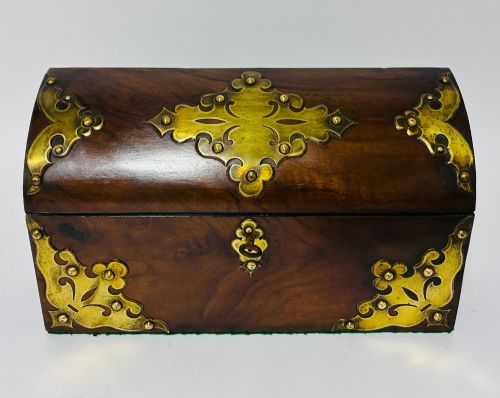
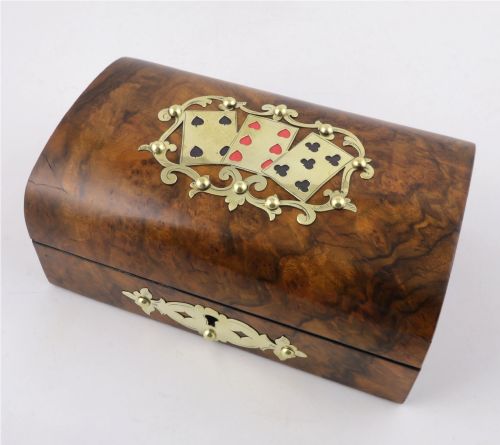


Domed Walnut Chest
A domed walnut chest brings warm timber and curved lid lines into a room, serving as a handsome container for personal treasures.
Domed Walnut Chest
When you search for a domed walnut chest, you encounter a variety of lidded containers and cabinets ranging from table boxes to large bureau bookcases. The selection spans the Georgian and Victorian eras, alongside Dutch Baroque and Gothic Revival styles.
You are most likely to meet smaller lidded boxes such as tea caddies and games caskets, alongside larger coffers and bureau bookcases featuring distinctive curved tops. These pieces utilise walnut and burr walnut timbers, often enriched with fruitwood marquetry or brass mountings.
How they were made
Cabinet makers constructed these pieces using solid walnut and decorative burr walnut veneers applied to carcases of secondary woods. The characteristic curved lids required skilled timber bending or multi-plate construction to achieve the smooth domed profile.
Surface decoration frequently involved fruitwood marquetry, geometric wood inlay, and Tunbridge work, complemented by fitted brass locks, hinges, and escutcheons.
Domed Walnut Chest Retail Price Guide 2026
Typical asking prices for domed walnut chest among the pieces listed under this phrase on Sellingantiques today, from the lower quarter to the upper quarter. They describe what is for sale here now, not the wider market.
Listings feature walnut, burr walnut, and fruitwood timbers across Georgian, Victorian, and 19th Century periods.
What varies in quality
Quality rests upon the selection of the timber figures, where richly patterned burr walnut veneer elevates a piece far above plain grained boards. The precision of the inlay work and the integration of fine marquetry scenes further define the upper tier of craftsmanship.
Structural harmony also dictates value, seen in how cleanly the domed lid meets the box rim and whether interior compartments remain intact and well proportioned.
The Domed Walnut Chest Glossary
- Burr walnut
- A prized timber harvested from walnut tree growths, yielding intricate swirling patterns and knot formations.
- Marquetry
- The art of applying decorative veneer pieces in wood to form pictorial designs or geometric patterns.
- Caddy
- A small lidded box historically used for storing tea leaves, often fitted with internal compartments.
- Escutcheon
- A protective brass plate surrounding a keyhole, adding both decorative detail and structural reinforcement to the timber.
- Tunbridge inlay
- A meticulous form of woodworking creating mosaic pictures from thousands of tiny tinted wood blocks.
Domed Walnut Chest: Frequently Asked Questions
What were domed walnut chests used for?
These pieces served practical storage roles for valuable commodities and personal items. Smaller caddies and boxes held tea leaves, playing cards, or poker dice.
Larger coffers and bureau bookcases protected precious documents, books, and household valuables while displaying the owner's taste through rich timber figures.
How do I care for burr walnut?
Burr walnut requires stable indoor humidity and protection from direct sunlight to prevent the decorative veneers from drying and lifting. Regular dusting with a soft, dry cloth preserves the polished surface.
Avoid placing these items near radiators or heat sources which can cause the timber to warp and split over time.
How can I tell Georgian pieces from Victorian ones?
Georgian examples often display restraint in their proportions and cleaner lines, reflecting earlier eighteenth century tastes. Burr walnut veneers on these earlier pieces have mellowed to a softer golden brown tone.
Victorian pieces frequently embrace revival styles like Gothic taste or Dutch Baroque, often featuring more exuberant marquetry inlay and heavier brass hardware.
What is Dutch marquetry?
Dutch marquetry involves elaborate floral and pictorial wood inlays applied across furniture surfaces. Craftsmen utilised various fruitwoods to create contrasting light and dark shades within the design.
This technique appears on bureau bookcases and coffers, adding intense visual texture to the walnut ground.
Are all domed tops constructed the same way?
No, lid construction varies according to the scale of the object. Smaller table boxes might feature solid curved timber lids or framed veneer panels.
Larger bureau bookcases and cabinets often employ double domed cornices built up from shaped timber mouldings over internal framing.