


Domed Burr Walnut Box
A domed burr walnut box is a tactile Victorian or Georgian tabletop container that brings rich figuring and curved form to a room.
Domed Burr Walnut Box
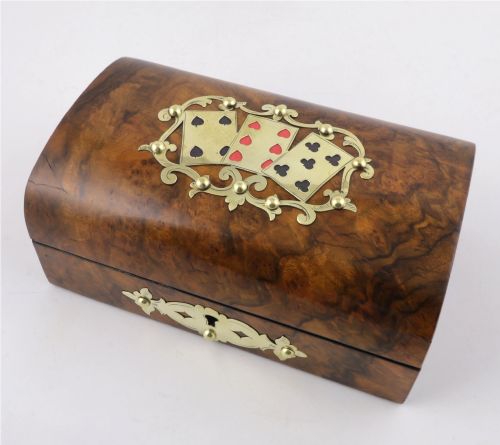
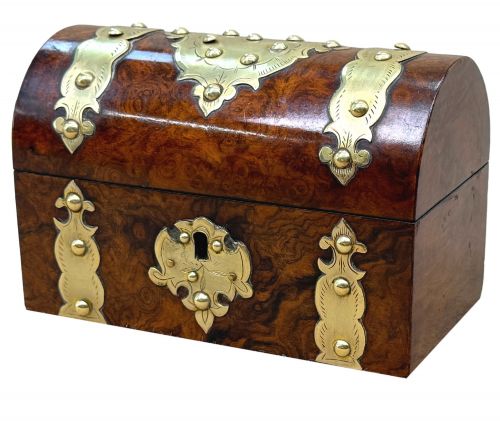
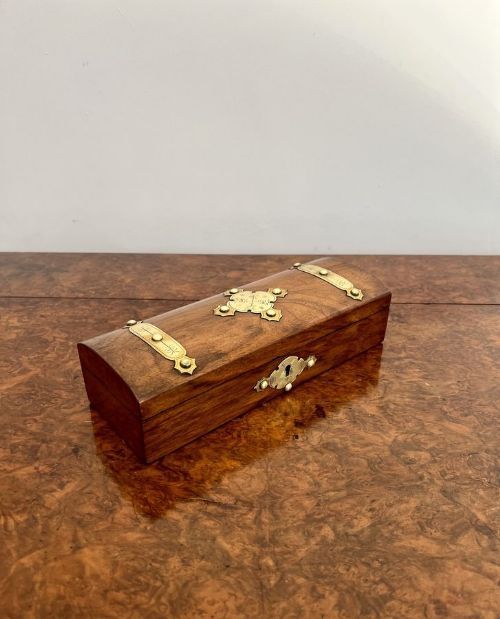
A domed burr walnut box brings together curved lids and heavily figured wood, serving as a striking tabletop piece for storage or display. When you search for a domed burr walnut box, you encounter items designed for specific domestic uses, such as stationery boxes, tea caddies, glove boxes, writing slopes, and jewellery caskets.
The pieces on this page stem predominantly from the Victorian period, with occasional Georgian examples. You are most likely to meet Victorian stationery boxes and tea caddies featuring distinct curved or domed lids and brass mounts.
These items range from small table boxes to spacious caskets intended to hold correspondence, cards, or valuables. Their distinctive domed profiles distinguish them from flat-topped caskets of the same eras.
How they were made
Makers utilised burr walnut and mixed wood veneers applied over a solid secondary wood core to achieve rich, swirling grain patterns across the curved lids and sides. Brass mounts, corner braces, and escutcheons were frequently fitted to reinforce corners and accentuate the woodwork.
Interiors often lined with felt, velvet, or fitted with ivorine details and porcelain accents to accommodate specific contents such as tea, stationery, or games. Marquetry inlay was occasionally incorporated into the exterior design alongside plain burr veneers.
Listings feature items spanning from the Georgian period through to the late Victorian era, constructed in burr walnut with brass and felt.
What varies in quality
Quality rests in the intensity and symmetry of the burr walnut figuring across the curved surfaces, where master craftsmen carefully matched veneer panels. The weight and integration of the brass mounts also separate standard pieces from finer productions.
Internal fitting and the precision of the domed lid closure distinguish exceptional boxes from simpler utility pieces. Retained original linings and functioning locks with keys elevate the standing of a casket.
The Domed Burr Walnut Box Glossary
- Burr walnut
- A wood veneer taken from the growth growths or burls of a walnut tree, yielding dense, swirling grain patterns. It forms the defining visual characteristic of these boxes.
- Stationery box
- A desk accessory structured to hold envelopes, writing paper, and pens, often featuring tiered interior compartments beneath a domed lid.
- Tea caddy
- A container originally built to store loose tea leaves, frequently fitted with internal lids or foil-lined compartments to preserve aroma.
- Writing slope
- A portable slant-topped box that opens to reveal a writing surface and storage for inkwells and stationery.
- Glove box
- A long, narrow container manufactured specifically for the neat storage of leather or fabric gloves.
Domed Burr Walnut Box: Frequently Asked Questions
What fits inside a domed burr walnut box?
These containers served various domestic purposes depending on their internal fittings, holding stationery, letters, playing cards, tea, or jewellery.
Stationery boxes typically feature tiered wooden partitions for envelopes, while tea caddies and jewellery caskets offer open compartments or divided interiors.
How do I date a burr walnut box?
Dating relies on stylistic clues, construction methods, and materials such as brass mounts, felt linings, and ivorine details.
Victorian examples dominate the selection, showing Gothic Revival influences or mid-nineteenth-century decorative trends, while earlier Georgian items display simpler lines.
Are keys usually included with these boxes?
Many surviving boxes retain their original working locks, and some include period keys for the brass escutcheon.
However, due to their age, locks may occasionally be unkeyed or non-functioning while the exterior brass hardware remains intact.
How should I care for burr walnut veneer?
Burr walnut requires stable indoor humidity away from direct sunlight and heat sources to prevent the fine veneers from drying out or lifting.
Gentle dusting with a dry, soft cloth preserves the polished surface and highlights the natural grain of the wood.