
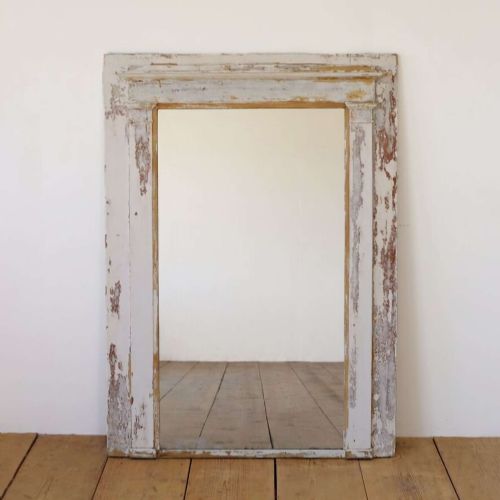


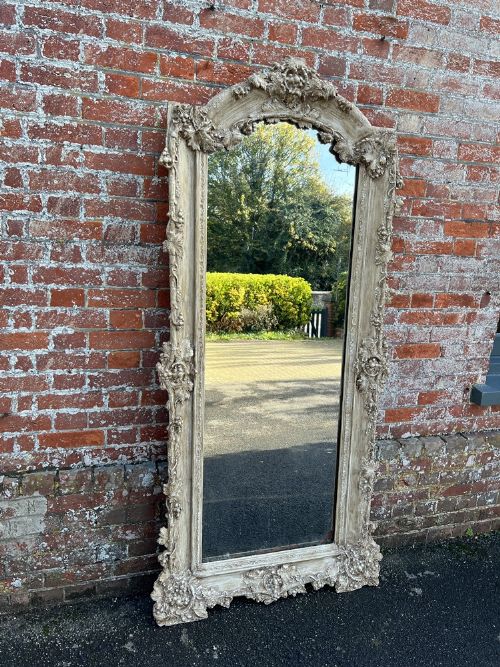


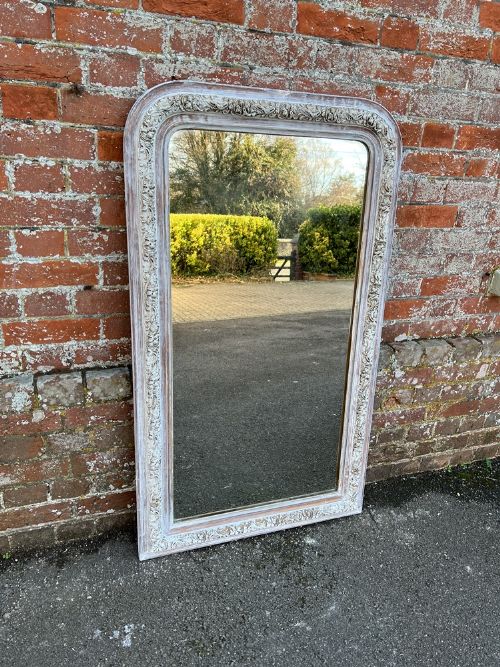

Distressed Painted Floor Mirror
These distressed painted floor mirrors bring aged character and reflection into a room, spanning French and English origins.
Distressed Painted Floor Mirror
A distressed painted floor mirror offers large reflective glass framed by weathered surfaces, bringing immediate presence and depth to a room. When searching for a distressed painted floor mirror, buyers encounter substantial wall mirrors, overmantles, and bistro mirrors originating from the nineteenth and early twentieth centuries. These pieces predominantly reflect French chateau, provincial, and Victorian styles, often featuring arched, shaped, or plain tops.
The selection on this page demonstrates origins rooted firmly in English country houses and French workshops. Most examples date from the mid-nineteenth century up to the early twentieth century, showing decades of natural wear on their painted and gessoed surfaces. Buyers find that these large mirrors serve functional and decorative roles alike, leaning against walls to bounce light around a space.
Materials and Construction
Makers built these frames using carved wood as a sturdy foundation, applying layers of gesso to build up decorative mouldings and smooth contours before painting. The wood and gesso layers take on the marks of time, creating the distinct weathered texture that defines these objects.
Surfaces receive paint and sometimes giltwood accents, applied by hand in workshops producing French Rococo revival, Louis Philippe, and English country pieces. Original mirror glass is set within these carved frames, often secured by historic backing boards that complete the piece.
Materials recorded on this page include carved wood, gesso, paint, giltwood, and mirror glass.
Evaluating Quality
Quality rests in the harmony between the hand-carved wooden frame and the integrity of the applied gesso ornamentation. Better examples display crisp carving beneath the paint layers, where floral motifs or ribbed frames remain distinct despite decades of surface ageing.
The depth and execution of the original paint layer distinguish finer pieces from simpler utilitarian items. Artisans who formed the French provincial and English country frames achieved proportions that balance the heavy weight of large mirror glass with delicate architectural lines.
The Distressed Painted Floor Mirror Glossary
- Gesso
- A plaster-like mixture applied to wood frames to create a smooth surface for painting or gilding. This material allows for intricate relief decoration around the mirror border.
- Overmantle Mirror
- A wide mirror specifically designed to hang or stand above a fireplace mantelpiece. These often feature arched tops to fit architectural chimney breasts.
- Louis Philippe
- A mid-nineteenth century French style characterised by simple, graceful lines and often an arched top with restrained decorative moulding.
- Bistro Mirror
- A functional commercial mirror originating from French establishments, valued for straightforward frames and practical proportions.
- Giltwood
- Wood that has been coated with a thin layer of gold leaf or gold paint. It frequently appears beneath or alongside distressed painted finishes.
Distressed Painted Floor Mirror: Frequently Asked Questions
How do I secure a heavy floor mirror?
Large mirrors benefit from sturdy wall tethers or brackets attached to the rear frame, preventing any risk of tipping while allowing the piece to rest safely against the skirting board.
Professional installation ensures that the substantial weight of carved wood and thick glass is properly supported without straining the historic joints.
Are these mirrors truly antique?
The pieces listed originate from the nineteenth and early twentieth centuries, constructed using period timber, gesso, and hand-applied paint finishes.
Construction techniques, wear patterns on the glass, and historical framing methods confirm their age and period origin.
How should I clean the painted frame?
Painted and gessoed surfaces require gentle dusting with a dry microfibre cloth to preserve the fragile, distressed finish accumulated over generations.
Liquid cleaners and abrasive agents should be kept away from the painted wood to prevent stripping the historic patination.
Can these mirrors stand directly on the floor?
Many large wall and overmantle mirrors are routinely used as floor mirrors by resting them firmly against a wall.
Their substantial height and heavy wooden construction provide the physical presence needed for floor placement.