
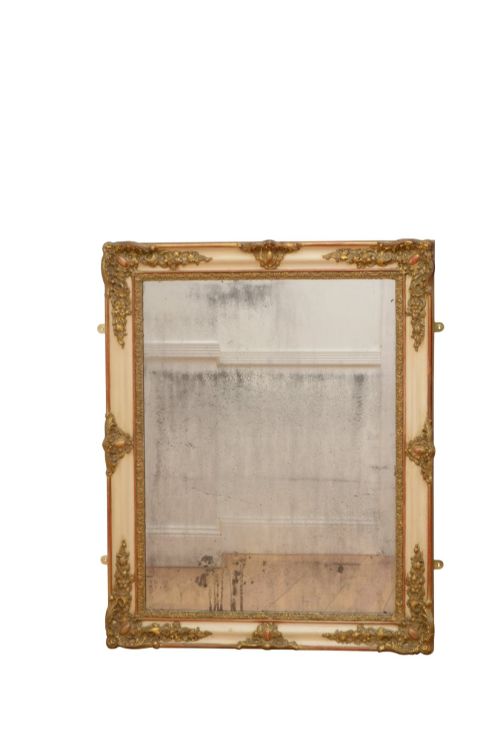


Distressed Gesso Wall Mirror
A distressed gesso wall mirror brings depth to a room through layered textures and aged reflective surfaces built to last centuries.
Distressed Gesso Wall Mirror
A distressed gesso wall mirror serves as a prominent interior focal point, originating primarily from nineteenth-century English and French workshops. These pieces combine substantial scale with decorative framing designed to reflect light and expand spatial perception.
The most common examples on this page are nineteenth-century overmantle and wall mirrors displaying painted or gilt surfaces over carved wooden frames. Buyers encounter arched tops, shaped profiles, and column-framed variants reflecting French Chateau and Victorian aesthetics.
Pieces span from the eighteenth century through to the early twentieth century, incorporating styles such as Louis Philippe, Rococo Revival, and Neoclassical design. Each object provides historical character through weathered finishes and authentic patination.
Construction and Materials
Makers built these frames using carved wood as a foundation, applying multiple layers of gesso to create smooth or ornate sculptural details. Artisans then finished the surfaces with paint, gold leaf, or silver leaf before introducing deliberate or natural distress.
Mirrors utilise traditional mirror glass or original mercury plates set within the prepared wooden housings. The combination of dense gesso, wood, and layered paint yields a durable structure that acquires visible wear over generations.
Several mirrors retain nineteenth-century dust trapped behind the glass by old backing boards.
Assessing Quality and Execution
Quality rests in the crispness of the original wood carving beneath the gesso layers and the proportion of the frame. Finer examples retain harmonious dimensions, balanced architectural elements like columns or arched tops, and intentional decorative detailing.
The integrity of the surface finish dictates visual success, separating uniform modern interventions from authentic aged patination. Depth in the gilding, natural craquelure in the paint, and the preservation of early glass plates elevate the standing of a piece.
Charles Nosotti
The Distressed Gesso Wall Mirror Glossary
- Gesso
- A plaster-like mixture applied to wood frames to create a smooth surface for painting or gilding. It allows for intricate relief ornamentation.
- Overmantle Mirror
- A large mirror specifically designed to hang above a fireplace mantelpiece. These frames often feature horizontal or arched proportions to fit architectural spaces.
- Cushion Mirror
- A frame style with a convex, sloping profile that directs the eye inward toward the glass plate. This form gained popularity during the nineteenth century.
- Louis Philippe
- A mid-nineteenth-century French style characterised by understated elegance, often featuring rounded upper corners and simple moulding. It balances neoclassical restraint with domestic comfort.
- Mercury Plate
- An older type of mirror glass created using a tin and mercury amalgam behind the glass. This technique produces a characteristic mottled, dark reflection.
Distressed Gesso Wall Mirror: Frequently Asked Questions
What is an overmantle mirror?
An overmantle mirror is a large wall mirror traditionally hung above a fireplace opening. Its proportions are tailored to anchor the space above a mantel.
These pieces frequently feature arched or shaped tops designed to draw the eye upward and reflect ambient room light.
How do I date a gesso mirror?
Dating relies on examining the wood construction, the formulation of the gesso, and the style of the frame moulding. Nineteenth-century pieces often show specific regional traits like French Louis Philippe curves or English column details.
Secondary indicators include the backboards, fixings, and the chemical composition of the mirror glass itself.
What is original mercury plate glass?
Original mercury plate refers to glass silvered using a traditional tin and mercury technique rather than modern chemical silvering. This method yields a softer, uneven reflection with dark speckling.
Collectors prize original plates for the distinct historical atmosphere they bring to antique mirrors.
How do I hang a heavy gesso mirror?
Hanging requires securing the mirror directly into wall studs or using heavy-duty wall anchors rated for the combined weight of wood and gesso. Professional mirror brackets distribute the load safely.
Given the substantial weight of nineteenth-century frames, stable wall fixing is essential for secure placement.