


Diamond Star Brooch
A diamond star brooch brings together celestial form and old-cut sparkle, offering a versatile piece that doubles as a pendant or tiara.
Diamond Star Brooch
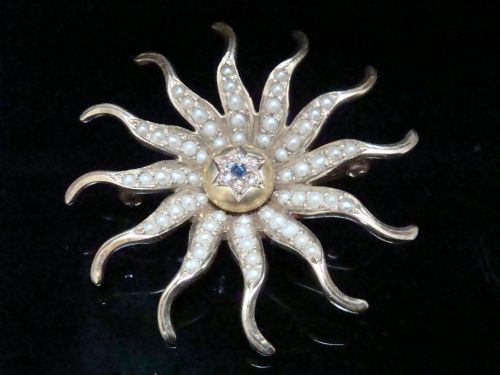
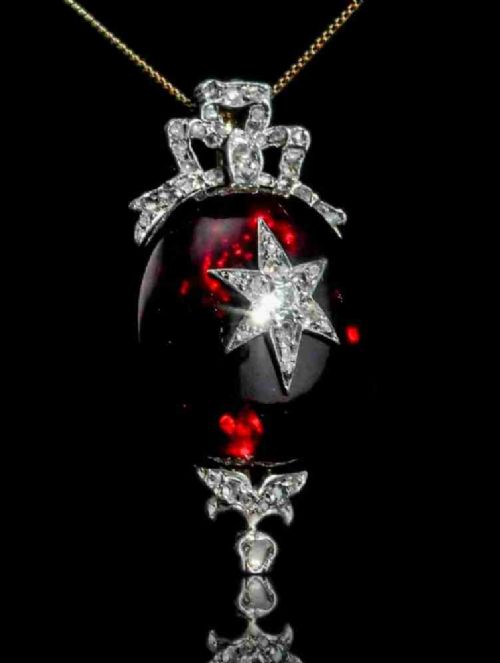
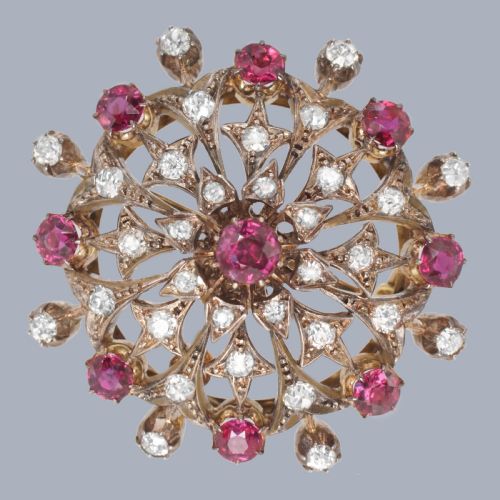
A diamond star brooch is a celestial-themed jewel designed to catch the light from every angle. When you search for a diamond star brooch, you encounter pieces primarily from the Victorian and Edwardian eras, spanning the late nineteenth century through to nineteen ten.
The forms vary from simple rayed starbursts to complex convertible designs that transform from brooches into pendants or tiaras. Most examples rely on old European cut or rose cut diamonds arranged symmetrically around a central stone or cluster.
Many incorporate coloured gems alongside the diamonds, including garnets, rubies, pearls, turquoise, emeralds, opals, and sapphires. These pieces often feature combined gold and silver mounts, pairing a yellow or white gold backing with silver settings that enhance the stones.
Materials and mounting techniques
Jewellers of the nineteenth and early twentieth centuries set diamonds in silver to maximise the brilliance of the stones against a dark background. This silver work is routinely backed with gold, ranging from fourteen carat and eighteen carat to nine carat and yellow gold, to prevent tarnish from touching clothing.
Stones are typically foil-backed or collet-set by hand, utilising old cut diamonds that exhibit distinct hand-faceted proportions. Convertible mechanisms incorporate screw fittings or removable loops, allowing a single starburst to shift function between hair ornament, neck chain, and lapel pin.
Some stars double as tiaras, proving that Victorian engineers understood the practical necessity of transforming headwear into evening jewellery.
Distinctions in construction and stone selection
Quality rests heavily on the uniformity and cut of the diamonds, where matched old European cuts command greater presence than mixed rose cuts. The crispness of the ray construction and the structural integrity of the convertible fittings dictate the durability of the piece.
The inclusion of accompanying gems like natural pearls, untreated rubies, or clean sapphires alters the character and desirability of the star. Superior pieces maintain original settings without modern intervention, preserving the precise alignment of each individual ray.
The Diamond Star Brooch Glossary
- Old European cut
- An early form of brilliant cut diamond featuring a small table, heavy crown, and large culet. This cut predates modern round brilliants and produces distinctive patterned light.
- Rose cut
- A diamond cut with a flat base and a domed crown covered in triangular facets. It resembles an opening rosebud and gives a soft, watery reflection.
- Convertible brooch
- A jewel engineered with detachable elements, such as screw-in frames or hidden loops. This allows the primary star motif to function as a pendant or a tiara.
- Collet setting
- A metal collar that wraps around the girdle of a gemstone to hold it in place. It represents a traditional method common in nineteenth-century mounting.
- Celestial starburst
- A design motif replicating a radiating star or comet. It dominated Victorian and Edwardian fine jewellery production.
Diamond Star Brooch: Frequently Asked Questions
How do I wear a convertible star brooch?
A convertible star brooch typically includes a detachable pin stem or a hidden loop on the reverse. You can thread a chain through the loop to wear it as a pendant or mount it onto a frame to use as a tiara.
Most conversion systems rely on secure threaded screws or hinges that tuck away neatly behind the rays when worn flat against fabric.
Are these brooches made of silver and gold?
Victorian jewellers frequently combined silver and gold in a single piece. Silver was placed on the face because it took a dark patina that made old-cut diamonds appear brighter.
Gold was used for the reverse and pin stems to provide structural strength and prevent the silver from staining garments.
What is the difference between old cut and modern diamonds?
Old cut diamonds were shaped entirely by hand under candlelight or gaslight, resulting in smaller tables and deeper pavilions. They produce a broader, softer flash of light compared to the precise brilliance of modern cut stones.
Each old cut stone possesses unique proportions dictated by the original crystal shape rather than standardised factory measurements.
Did these pieces always include pearls or coloured stones?
While many star brooches feature pure diamonds, a significant number incorporate pearls, rubies, garnets, or sapphires at the centre. These coloured stones often denote specific stylistic periods or regional preferences within the nineteenth century.
Seed pearls and turquoise clusters were particularly popular choices for Victorian makers seeking contrast against white diamonds.