


Celestial Diamond Brooch
A celestial diamond brooch captures the infinite draw of the night sky in precious metal and cut stones.
Celestial Diamond Brooch
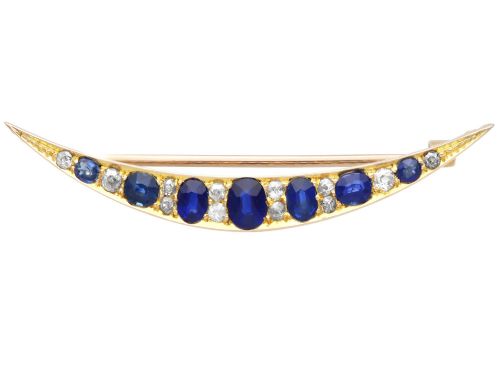
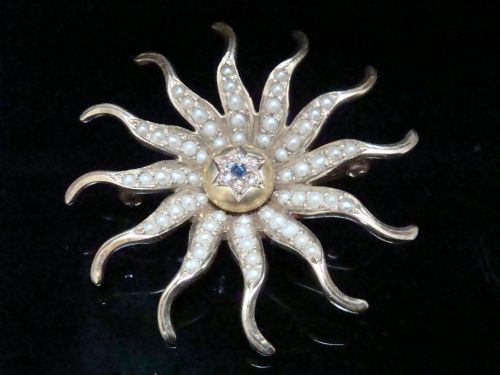
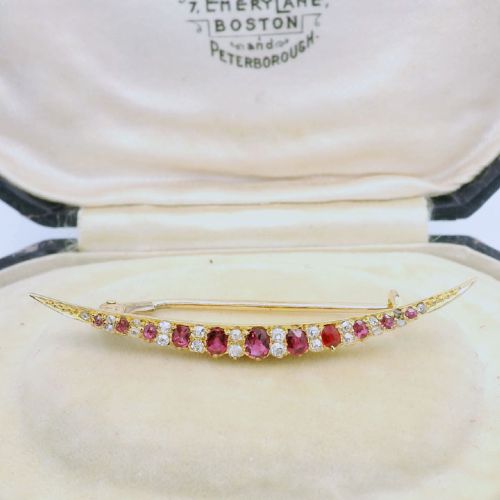
A celestial diamond brooch takes the form of stars, crescents, and starbursts, bringing the cosmos down to the lapel or bodice. These jewels span the Victorian era, the nineteenth century, and the early twentieth century into the Art Deco period.
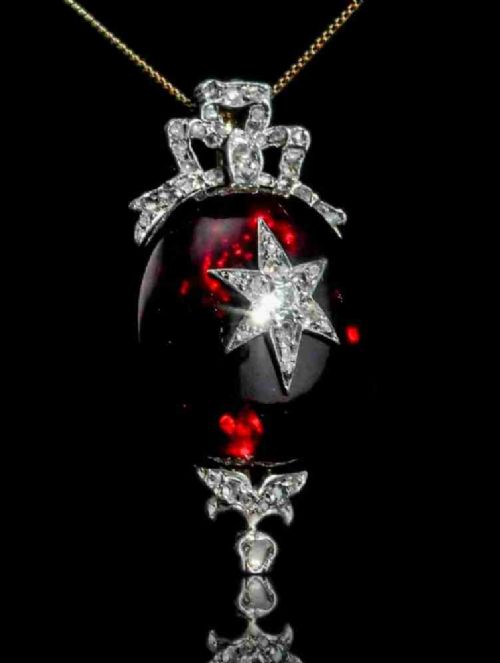
The most common versions met on this page are starbursts and crescent moons, frequently designed to convert into pendants or tiaras. They combine diamonds with rubies, sapphires, garnets, turquoise, and seed pearls.
Makers of these celestial diamond brooch pieces utilise silver-on-gold settings alongside solid yellow gold and platinum to mount old cut and old rose cut diamonds. The resulting jewels reflect the profound nineteenth-century fascination with astronomy and the night sky.
How they were made
Silversmiths and jewellers set diamonds into silver fused over gold, a technique that maximised the brilliance of old European and rose cut stones by keeping the metal colour bright against the gems. Yellow gold in fifteen-carat, fourteen-carat, and nine-carat weights provides the warm structural backing for these starry forms.
Prong settings and closed foil backs secure rubies, sapphires, garnets, and seed pearls alongside the central diamonds. Convertible fittings incorporate screw-in loops and detachable frames, allowing a single starburst to serve as both brooch and pendant or mount upon a tiara frame.
Materials appearing across the inventory include rubies, sapphires, garnets, turquoise, seed pearls, and old cut diamonds.
What varies in quality
The precision of stone setting and the matching of cut stones define the upper tier of these jewels, where old cut diamonds possess uniform sparkle and coloured gems show deep, saturated hues. Lower tiers rely on more modest seed pearls or simpler silver-topped mounts with less fluid articulation in the rays.
Ingenuity of conversion mechanisms also separates standard work from master craftsmanship, particularly in tiaras and pendant brooches where tiny hinges and threaded posts operate smoothly without compromising the silhouette of the star or crescent.
The Celestial Diamond Brooch Glossary
- Old European cut
- An early brilliant diamond cut featuring a small table, high crown, and a large culet, designed to catch candlelight and gaslight.
- Old rose cut
- A hemispherical diamond cut with a flat base and a domed crown faceted in triangles, producing a soft, glowing shimmer rather than sharp fire.
- Crescent brooch
- A curved jewellery form representing the waxing moon, frequently paired with stars or set with alternating gems.
- Convertible pendant
- A jewel engineered with hidden loops, screw attachments, or detachable mounts to transform between a brooch, a pendant, and a tiara.
- Silver-on-gold
- A historical mounting method where a thin layer of silver fronts a gold backing, combining the bright white surface favoured for diamonds with the strength of gold.
Celestial Diamond Brooch: Frequently Asked Questions
How do I wear a convertible brooch?
Many starburst and crescent jewels feature detachable fittings, screw-in bales, or frame slots that let you slide the piece onto a chain or mount it to a tiara band.
Inspect the reverse of the setting for small hinges or threaded posts before attempting any transformation.
What periods do these brooches come from?
The pieces span the Victorian era and the nineteenth century, extending into nineteen-twenty and the Art Deco period.
Astronomical motifs gained immense popularity during the late nineteenth century, reflecting a broader cultural fascination with the cosmos.
How do I care for silver-topped gold?
Keep these jewels away from moisture and harsh cleaning dips, as the silver layer can tarnish and the gold backing requires gentle handling.
Store them in a dry jewellery box and use a soft, dry cloth to remove surface dust from the old cut stones.
Are coloured stones common in star brooches?
Rubies, sapphires, garnets, turquoise, and seed pearls frequently accompany diamonds in these celestial designs, adding contrasting flashes of red, blue, and green.
They often represent night skies, planets, or symbolic sentiments popular among Victorian makers.