


Diamond Cut Glassware
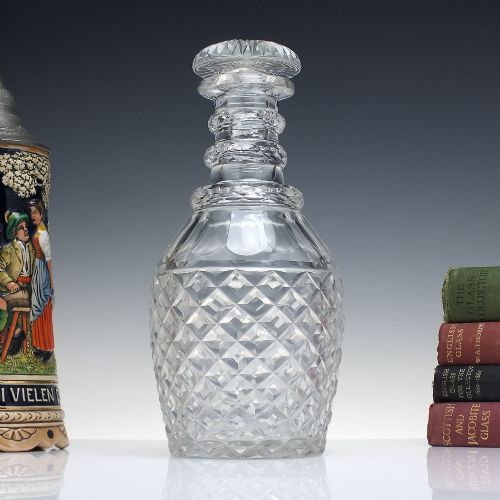
Diamond cut glassware brings brilliant refractivity to the table, offering tactile weight and deep geometric facets that catch candle and daylight alike.
Diamond Cut Glassware
Diamond cut glassware encompasses functional and decorative vessels defined by criss-crossing geometric incisions that produce sharp prisms across the surface. When collectors search for diamond cut glassware, they encounter utilitarian drinking vessels and serving pieces produced across several centuries of British and Irish manufacture.
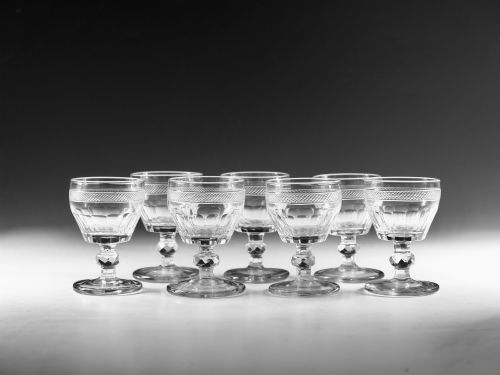
The selections available span multiple eras, most frequently meeting buyers in Victorian and Edwardian iterations alongside earlier Georgian examples. Common forms include heavy decanters, port glasses, rummers, spirit jugs, and large fruit or pedestal bowls designed for formal dining and entertaining.
Earlier Georgian and Anglo-Irish specimens often display thicker walls and darker metal, while later Victorian and Edwardian pieces show crisper, more linear wheel-cutting. The enduring appeal lies in the way these faceted surfaces interact with ambient light during use.
How they were made
Makers utilised lead crystal, lead glass, and clear glass blown into initial shapes before undergoing intensive cold-working by hand. Artisans applied designs using rotating iron and stone wheels fed with abrasive grit and water to cut deep troughs into the metal.
Following the initial coarse cutting, workers smoothed the facets with finer wheels and polished the surfaces with cork or felt using putty powder to restore brilliance. This labour-intensive process resulted in the characteristic sharp ridges and brilliant clarity observed in period pieces.
Materials appearing across current stock include heavy lead crystal, clear glass, and traditional lead glass.
What varies in quality
Quality rests primarily on the depth and crispness of the wheel-cutting, where sharper, more precisely aligned geometric incisions separate superior examples from softer, shallower work. The weight and purity of the underlying lead crystal or lead glass also determine how brilliantly the piece refracts light.
Proportion and form dictate the upper tier of the range, visible in balanced pedestals, well-fitted original stoppers, and heavy, stable bases. Pieces that retain clean, unblemished rims and sharp diamond points without excessive polishing wear represent the best of their respective periods.
The Diamond Cut Glassware Glossary
- Lead crystal
- Glass containing a high proportion of lead oxide, which increases weight, refractive index, and softness for easier cutting. This material allows for deeper facets and greater brilliance than standard soda-lime glass.
- Facet stem
- A stem on a drinking glass shaped with multiple flat polished planes instead of a smooth cylindrical or knopped profile. These flat planes catch the light effectively during use.
- Comport
- A raised bowl or dish on a pedestal foot, used historically for serving fruit or sweetmeats at the table. These vessels often feature extensive cutting across the body and foot.
- Rummer
- A large, sturdy drinking glass popular in the eighteenth and nineteenth centuries, typically featuring a short stem and a capacious bowl. They were frequently used for ale, wine, or punch.
- Hobnail
- A specific raised pattern of square-topped facets resembling the hobnails used in heavy boots. This dense texture provides exceptional grip and light reflection.
Diamond Cut Glassware: Frequently Asked Questions
How do I clean antique cut glass?
Wash pieces by hand in warm, soapy water using a soft brush to reach into deep geometric incisions. Avoid sudden temperature changes to protect the heavy metal from thermal shock.
Dry immediately with a lint-free cloth to restore the bright refractive sparkle characteristic of lead crystal and clear glass.
Are old decanters safe for modern wine?
Period decanters function well for serving wine provided they are thoroughly cleaned and inspected for any residual cloudiness or old sediment. The heavy lead crystal or lead glass houses liquids securely for the duration of a meal.
Ensure stoppers are matched correctly to their specific necks if you intend to store liquids for longer periods.
How can I tell Georgian glass from Victorian pieces?
Georgian and Anglo-Irish items often display darker metal with occasional bubbles or striations, alongside heavier walled construction and broader cutting. Pontil marks on the base tend to be rougher and more pronounced on earlier examples.
Victorian and Edwardian pieces frequently utilise clearer metal with crisper, more uniform mechanical cutting and lighter overall proportions depending on the specific decade.
Why do some decanters have matching stoppers?
Original stoppers were ground by hand to fit the exact neck of an individual decanter during production, ensuring a tight closure. Finding a matched pair or set preserves the integrity and utility of the vessel.
Examine the ground portion of both stopper and neck for matching number marks or identical wear patterns to confirm their original pairing.
Can I use these bowls for daily dining?
Large fruit bowls and comports serve well for presenting fruit or dry items on a dining table or sideboard. Their substantial weight provides good stability during everyday use.
Exercise care around hard surfaces to prevent chipping the sharp diamond points that define the decorative exterior.