




Desktop Stationery Cabinet
A desktop stationery cabinet organises correspondence with fitted compartments and drop fronts, bringing period craftsmanship directly to the writing desk.
Desktop Stationery Cabinet
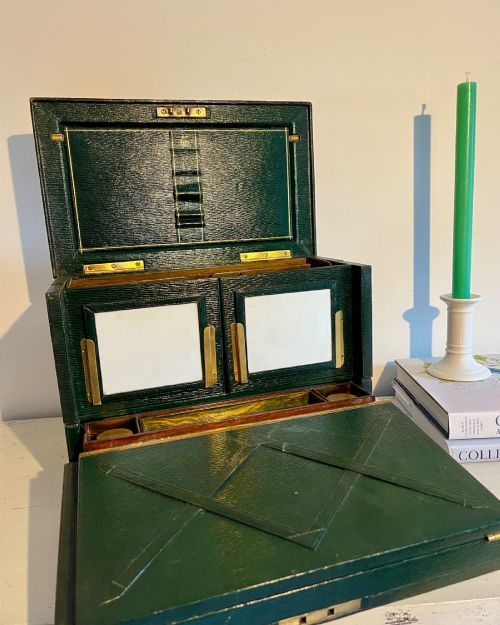
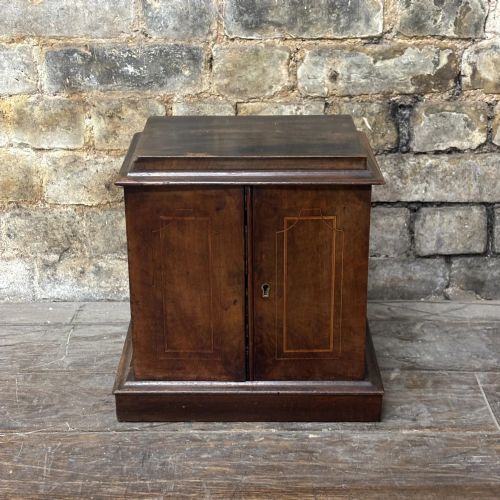
A desktop stationery cabinet appears in forms ranging from simple lidded boxes and letter racks to drop-front chests, cartonnieres, and table cabinets designed to hold writing paper, envelopes, and incoming mail. These pieces serve the desk by keeping correspondence ordered and accessible within a compact footprint.
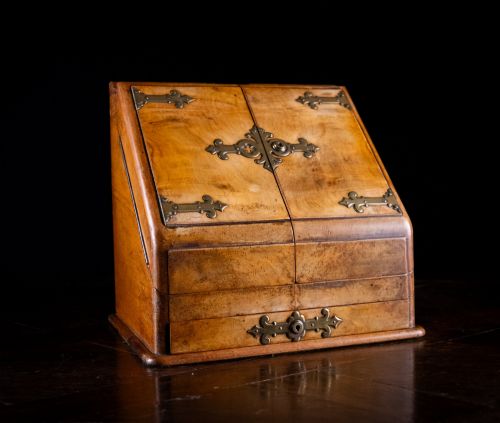
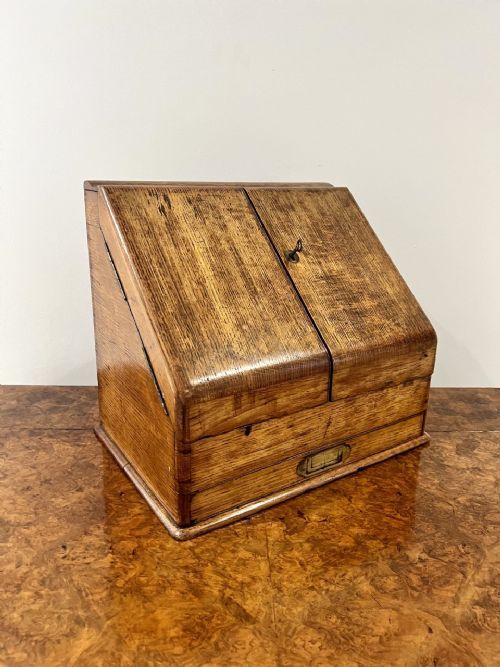
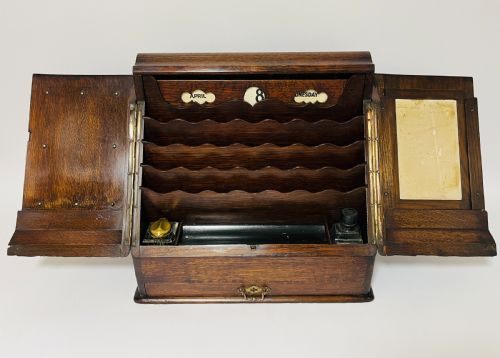
The version most commonly met on this page is the Victorian or Edwardian oak or walnut tabletop cabinet, often fitted with internal partitions, calendars, or ink bottles. Such pieces reflect the heavy correspondence of nineteenth-century households and offices.
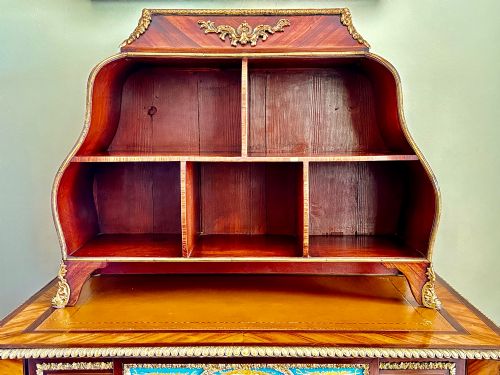
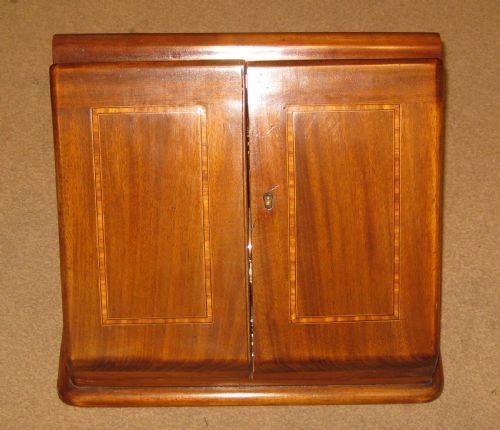
Makers also utilised mahogany, rosewood, coromandel, and satinwood, applying marquetry, brass mounts, or leather trims to suit formal libraries and country house studies. Styles span from plain utilitarian boxes to Louis XV Revival pieces with ormolu mounts and Arts and Crafts designs.
Materials and construction
Cabinetmakers built these pieces primarily from solid hardwoods such as oak, mahogany, and walnut, frequently selecting burr walnut, rosewood, or satinwood for decorative veneering. Interiors often feature fitted letter slots, pen trays, and small drawers constructed with traditional joinery.
Metal hardware plays a functional and decorative role, with brass hinges, carrying handles, lock escutcheons, and gilt mounts securing the structure. Leather, tooled panels, and glass ink bottles complete the desktop ensemble.
Surface ornamentation ranges from subtle marquetry inlay and painted details to heavy brass binding and ormolu mounts, depending on the stylistic period.
Period styles span from Georgian beginnings through Victorian Gothic Revival to Edwardian Arts and Crafts.
Distinctions in quality
The standard of a desktop stationery cabinet depends on the selection of timber and the ambition of its interior fittings, such as adjustable calendars, matching ink bottles, and secret drawers. Pieces featuring figured burr walnut, coromandel, or intricate marquetry stand apart from plain utility boxes.
Construction methods dictate longevity; tightly fitted joints, original brass hardware, and working locks with keys distinguish superior examples. The execution of decorative mounts, such as ormolu or gilt-brass details, signals the original cost and care put into the cabinet.
F Waller·Houghton & Gunn
The Desktop Stationery Cabinet Glossary
- Cartonnier
- A desktop cabinet or tiered filing chest designed specifically for holding papers, documents, and correspondence in vertical compartments.
- Drop front
- A hinged panel that folds downwards to reveal an inner arrangement of letter slots, pigeonholes, and small drawers.
- Ormolu
- Gilded bronze mounts applied for decorative effect on revival furniture styles.
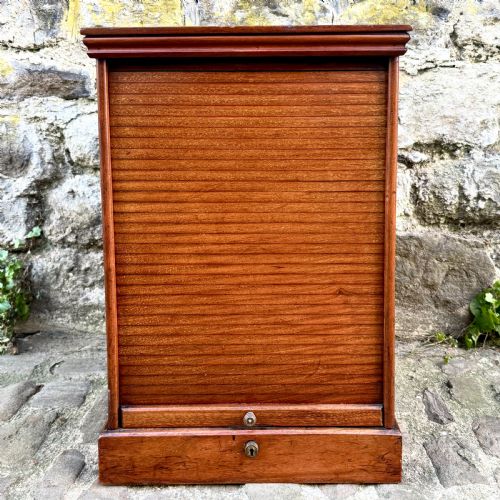
- Tambour front
- A sliding shutter formed of narrow strips of wood glued to canvas, allowing it to curve around tracks to enclose a cabinet.
- Marquetry
- Decorative veneer work formed by fitting together contrasting pieces of wood or other materials to create pictorial patterns.
Desktop Stationery Cabinet: Frequently Asked Questions
What did people store inside a desktop stationery cabinet?
These cabinets held writing paper, envelopes, stamps, and unanswered correspondence to keep desks tidy.
They also accommodated ink bottles, pen nibs, and occasionally small account books or calendars.
How do I tell a Victorian cabinet from an Edwardian one?
Victorian cabinets often display heavier timbers like solid oak or burr walnut with brass binding and Gothic or Revival influences.
Edwardian pieces frequently incorporate lighter satinwood inlay, marquetry, or simpler Arts and Crafts designs.
Were these cabinets meant for home or office use?
They served in both domestic country house studies and professional offices to manage the heavy flow of daily letter writing.
Portable boxes were also used by travellers or moved between rooms in large residences.