
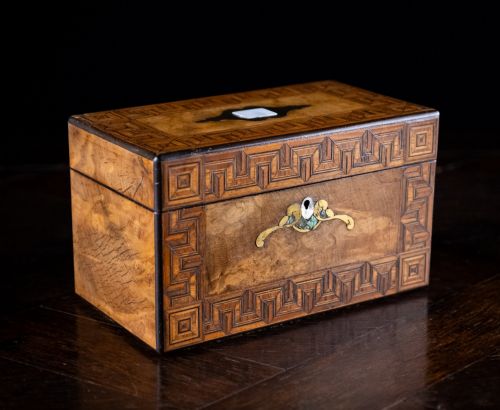
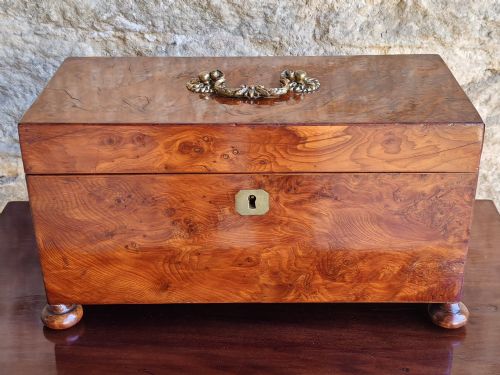


Decorative Brass Tea Chest
These decorative brass tea chest examples combine timber construction with metal inlay, offering practical storage and period presence.
Decorative Brass Tea Chest
A decorative brass tea chest serves as a receptacle for storing loose leaf tea safely away from moisture and light. Such containers emerge across the Georgian, Regency, and Victorian eras in various timber forms.
The objects on this page span the eighteenth and nineteenth centuries, utilising woods like rosewood, mahogany, walnut, and coromandel alongside brass ornamentation.
Makers shaped these vessels as caddies and boxes, incorporating interior compartments and canisters for distinct tea varieties.
Materials and construction methods
Craftsmen built these containers from dense timbers including mahogany, rosewood, and walnut, often applying veneers to stable underlying woods. Surface decoration relied heavily on brass inlay, banding, and boulle work.
Interiors frequently feature fitted compartments, sometimes retaining metal canisters or glass mixing bowls alongside bone details. Wood inlay, mother-of-pearl, and tortoiseshell further embellished the exterior surfaces of these chests.
Listings feature items from the eighteenth and nineteenth centuries, spanning Georgian, Regency, and Victorian periods in rosewood, mahogany, and walnut.
Judging quality in antique tea chests
Quality rests upon the precision of the brass inlay and the selection of figured timber grain. Superior examples display tight joinery and intact interior fittings rather than replacement components.
The sophistication of decorative techniques, from penwork to boulle work, separates standard production from finer workshop output.
The Decorative Brass Tea Chest Glossary
- Tea Caddy
- A box or chest designed specifically for storing tea leaves. These containers often featured lockable lids to protect expensive contents.
- Boulle
- A form of marquetry utilising brass and tortoiseshell inlaid in intricate patterns. It appears on nineteenth-century luxury boxes.
- Padouk
- A dense exotic hardwood used in eighteenth-century cabinet making. Its distinct reddish tone suited refined furniture and caddies.
- Marquetry
- The art of applying decorative pieces of veneer to a structure to form geometric or pictorial designs. Craftsmen utilised various woods for contrast.
- Penwork
- A surface decoration technique using ink drawn onto wood before varnishing. Regency makers applied this method to create intricate motifs.
Decorative Brass Tea Chest: Frequently Asked Questions
What were tea chests used for?
These chests stored valuable tea leaves securely under lock and key in period homes.
Servants or masters dispensed the leaves from internal canisters to regulate consumption.
How do I date a tea caddy?
Dating relies on timber choice, construction methods, and the style of brass inlay.
Georgian examples tend to use mahogany, whilst Regency and Victorian pieces frequently feature rosewood and coromandel.
Are interior canisters usually original?
Many surviving chests retain their original metal canisters or glass mixing bowls within.
Replacements do occur due to the fragile nature of these internal components over centuries of use.
How should I care for timber and brass?
Keep the wood away from direct sunlight and sudden humidity changes to prevent veneer lifting.
Gentle dusting preserves the polished brass surfaces without harsh chemical cleaners.