
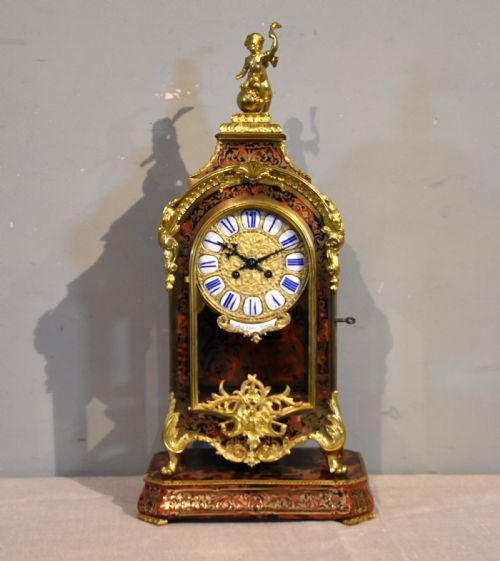


Decorative Brass Horology
Decorative brass horology brings together precision movement and gleaming metalwork, offering striking timepieces that anchor a room.
Decorative Brass Horology
Decorative brass horology comprises clocks driven by mechanical movements housed in brass, ormolu, and gilt bronze cases. The selection centres on French carriage clocks, mantel clocks, and bracket clocks spanning the nineteenth and early twentieth centuries.
Carriage clocks dominate the offerings, appearing alongside heavier mantel clocks and architectural bracket clocks. Materials extend beyond brass to include glass, enamel dials, mahogany, and ebonised wood.
The periods represented stretch from the mid-nineteenth century through the Victorian and Edwardian eras up to mid-century skeleton clocks. Buyers encounter French regional styles alongside English bracket designs.
How they were made
Cases utilise cast and chased brass, gilt bronze, and ormolu, often paired with bevelled glass panels to reveal the internal mechanism. Timber housings employ mahogany and ebonised wood for bracket and mantel clocks.
Dials frequently feature white enamel with Roman or Arabic numerals, protected beneath glass or framed by ornate metal bezels. Movements incorporate intricate gear trains, fusee mechanisms, and striking complications.
Paul Garnier tucked signatures into hidden spots on his carriage clocks, turning a simple time check into a treasure hunt.
What varies in quality
Quality rests in the crispness of the cast brass or ormolu ornament and the fidelity of the period revival style. Maker attribution adds distinction, as seen in signed French works and English bracket clocks.
The sophistication of the movement dictates standard, distinguishing simple timepieces from repeating carriage clocks and fusee skeleton clocks with passing strikes. The integration of materials like tortoiseshell or fine enamel further elevates a piece.
Le Roy Paris·Paul Garnier·Winterhalder and Hofmeier·John Bennett Cheapside London
The Decorative Brass Horology Glossary
- Carriage clock
- A portable spring-driven timepiece designed for travel, typically featuring a brass case with glass panels and a swing handle. They originated in France and often include alarm or repeating complications.
- Fusee
- A conical pulley used in mechanical clocks to maintain even power from the mainspring as it unwinds. This mechanism improves timekeeping accuracy across the power reserve.
- Ormolu
- Finely ground high-carat gold mercury-gilded onto a bronze or brass base. The technique creates a rich, lasting metallic lustre seen on French mantel clocks.
- Bracket clock
- A portable table clock historically placed upon a wall bracket or furniture surface. English examples often utilise mahogany cases and fusee movements.
- Skeleton clock
- A timepiece with an open framework that exposes the gear train and movement to view. These are typically protected beneath a glass dome.
Decorative Brass Horology: Frequently Asked Questions
What is a carriage clock?
A carriage clock is a portable spring-driven timepiece housed in a brass case with glass sides. They were originally built for travel by coach.
Most examples feature a carrying handle on top and an enamel dial displaying Roman numerals.
How do fusee movements work?
A fusee movement uses a conical pulley connected to the mainspring via a chain or cord. This equalises the pulling force as the spring winds down.
This clever mechanical device ensures consistent energy delivery to the escapement for better accuracy.
What is ormolu?
Ormolu describes a metallic coating of gold amalgam applied to a bronze or brass foundation. Artisans used this method to decorate French mantel clock cases.
The technique yields a deep golden finish that resists tarnish and catches candlelight.
How do I care for a brass clock?
Keep mechanical clocks away from direct sunlight, dampness, and rapid temperature changes. Professional servicing every few years keeps the gear train running smoothly.
Dust glass panels gently and avoid using harsh chemical polishes on the brass or ormolu surfaces.