




Decorative Brass Desk Stand
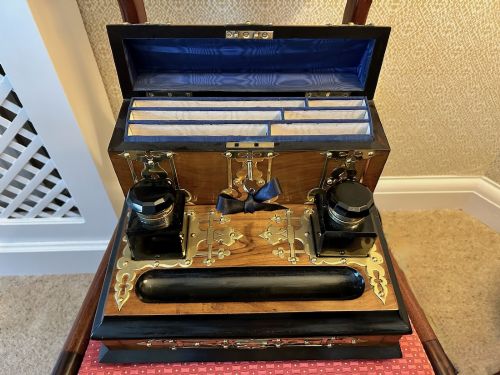
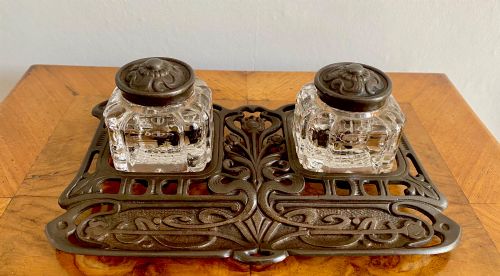
These decorative brass desk stand pieces bring writing furniture to life with cast metal work and fitted inkwells.
Decorative Brass Desk Stand
A decorative brass desk stand provides a structured home for writing implements, ink bottles and correspondence on a writing table. Buyers examine these desk accessories to find functional metalwork that brings period character to a study.
The pieces listed on this page span the Victorian and Edwardian eras, incorporating materials like walnut, coromandel-wood and porcelain. They appear alongside related items such as book slides, candlesticks and inkstands.
Continental and domestic examples display styles ranging from Egyptian Revival and Aesthetic Movement to Art Nouveau. Walnut and coromandel bases frequently anchor fitted glass inkwells and pen trays.
How they were made
Maker workshops utilised brass casting alongside turned wooden bases in walnut and coromandel-wood. Ormolu and gilt bronze applications provide metallic contrast on nineteenth-century surfaces.
Fitted glass ink bottles sit within metal mounts, sometimes accompanied by champleve enamel or porcelain inserts. Woodworking joinery secures the timber trays and book slides that hold paper and desk accessories.
Listings feature brass combined with walnut, coromandel-wood, glass, porcelain and champleve enamel across the Victorian and Edwardian periods.
What varies in quality
Quality depends upon the crispness of the brass casting and the retention of original components such as glass ink bottles and stoppers. Pieces with intact gilding and well-figured wood bases stand apart from plain replacements.
The integration of decorative elements like champleve enamel, paste stones or porcelain inserts dictates the refinement of each desk stand. Heavier gauge metalwork and precise joinery distinguish finer workshop production.
The Decorative Brass Desk Stand Glossary
- Ormolu
- Gilded bronze applied to metalware and furniture mounts. This technique provides a bright golden finish on nineteenth-century desk accessories.
- Coromandel-wood
- A dense, dark timber with contrasting light stripes used for luxury cabinet work. It forms durable and decorative desk stand bases.
- Champleve enamel
- A technique where troughs are dug into a metal surface and filled with vitreous enamel before firing. It decorates luxury desk clocks and inkwells.
- Aesthetic Movement
- A late nineteenth-century style emphasising visual beauty over narrative content. It influences the linear brass decoration found on Victorian pieces.
Decorative Brass Desk Stand: Frequently Asked Questions
What periods do these pieces date from?
The selection spans the nineteenth century through to the Edwardian era and the 1920s. Victorian and Edwardian pieces form a significant portion of the available desk accessories.
Craftsmen produced these works across various European and British workshops, reflecting shifting design movements over several decades.
Are original ink bottles usually present?
Some pieces retain their original glass ink bottles and stoppers, while others have been matched with later replacements over time. Surviving original glassware adds considerable interest for collectors of desk furniture.
Inspect the fit between the glass and the brass collar to determine whether the components belong together from the start.
What wood types support the brass work?
Walnut and coromandel-wood frequently serve as the primary timber bases for these desk accessories. These dense woods provide a stable, heavy foundation for cast metal inkstands and pen trays.
Cabinet makers selected them for their rich grain patterns and durability in daily desk use.
How do I care for brass desk stands?
Dust the brass and timber surfaces gently with a dry, soft cloth to prevent the accumulation of grime. Avoid aggressive metal polishes that can strip patination or damage adjacent wooden and ceramic elements.
Keep the items away from direct sunlight and damp environments to protect both the metal finish and the underlying wood.