


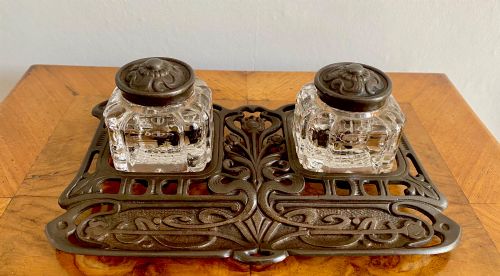


Vintage Glass Ink Pots
These vintage glass ink pots are desktop companions of clear glass and precious metal, prized for their weight and brilliance.
Vintage Glass Ink Pots
Vintage glass ink pots bring heavy functional vessels to the modern desk, originating primarily from the Victorian and Edwardian eras through to the Art Deco and 1930s periods. You will regularly encounter robust cut crystal bodies paired with silver, brass or enamel mounts, alongside novelty forms.
The objects listed on this page encompass individual inkwells, desktop stands with original bottles, and comprehensive inkstands designed for correspondence. These items combine utilitarian glass reservoirs with decorative metals, reflecting the writing habits of the nineteenth and twentieth centuries.
How they were made
Makers utilised heavy glass and crystal, often employing facet cutting to catch the light on the desktop. This glass body was typically combined with brass frames, sterling silver mounts, or guilloche enamel.
Artistic movements influenced the metalwork and glass form, producing organic lines in Art Nouveau pieces and geometric symmetry in Art Deco examples. Novelty pieces integrated glass eyes and detailed metal casting to mimic animals.
A bulldog stares back from the desktop with glass eyes, guarding your ink since 1880.
What varies in quality
The distinction between standard examples and superior pieces rests upon the crispness of the glass cutting and the quality of the metal mounts, such as hallmarked sterling silver or vermeil. Heavier cut crystal and intricate enamel work elevate a piece significantly.
Originality of components also dictates the standing of an ink pot, particularly when original glass bottles remain with their stands or when novelty elements like glass eyes are fully intact.
Tiffany & Co·Kralik or Loetz
The Vintage Glass Ink Pots Glossary
- Guilloche enamel
- A decorative mechanical technique whereby an intricate repeating pattern is engraved beneath translucent enamel. It appears on the metal lids of select Victorian examples.
- Grand Tour
- A cultural journey undertaken by wealthy Europeans that inspired souvenir objects such as brass and cut-glass inkwells. These pieces often incorporate classical motifs.
- Vermeil
- Sterling silver plated with gold. This material adds a warm metallic lustre to the interior or exterior mounts of the ink pot.
- Facet cut
- A method of cutting flat polished surfaces onto glass or crystal to create sharp angles that reflect light. It defines the heavier desktop pieces from the Victorian and Edwardian periods.
- Novelty inkwell
- An ink pot fashioned into a figurative shape, such as an animal. These whimsical items were popular desk accessories in the late nineteenth century.
Vintage Glass Ink Pots: Frequently Asked Questions
What periods do these ink pots cover?
The selection spans from the late Victorian and Edwardian eras into the 1930s Art Deco period. You will find pieces dated from the 1880s through to the early twentieth century.
Each period brings distinct stylistic traits, moving from ornate novelty animal designs to geometric Art Deco inkstands.
Are original bottles usually included?
Some listings provide the original glass bottles housed within a larger stand, while others comprise a single standalone inkwell with its attached lid.
Checking the specific title or description clarifies whether the ink pot comes as an individual desk piece or part of a fitted stand.
How do I identify Art Nouveau pieces?
Art Nouveau ink pots exhibit organic, flowing lines inspired by natural forms, often created around 1900. Makers during this time utilised iridescent glass or distinctive metal stands.
These designs contrast sharply with the later, more rigid geometric lines found in 1930s Art Deco examples.
What materials make up the lids?
The lids and mounts commonly feature sterling silver, brass, or guilloche enamel. Hallmarked silver dates the piece precisely according to assay office marks.
Glass forms themselves range from simple clear reservoirs to heavy facet-cut crystal and iridescent art glass.
How were these ink pots used?
They sat upon nineteenth and twentieth-century desks to hold liquid ink for dip pens. A hinged lid kept the ink from drying out too quickly.
Beyond simple utility, they served as decorative desk accessories reflecting the personal taste and wealth of the owner.