



Dark Wood Sutherland Table
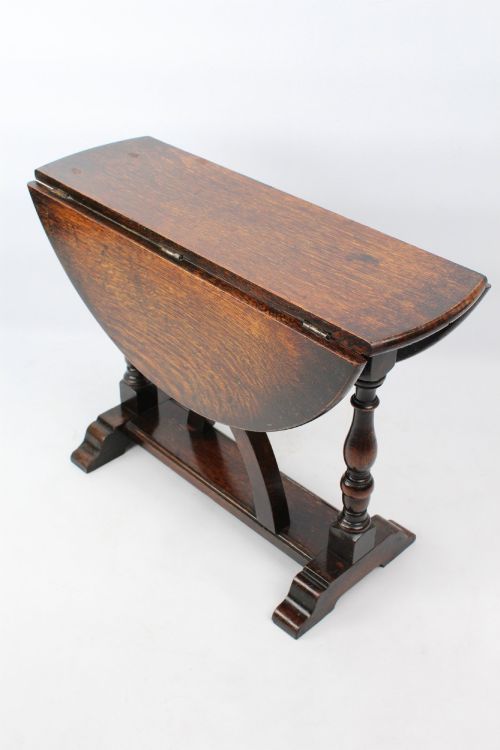
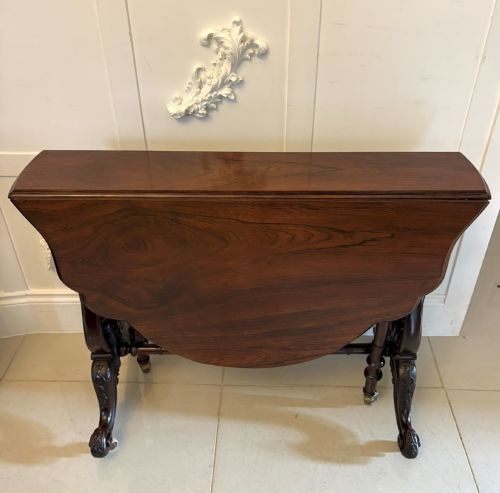
These dark wood sutherland tables fold flat against a wall when not in use, offering a clever space-saving design that suits both compact rooms and larger living spaces.
Dark Wood Sutherland Table
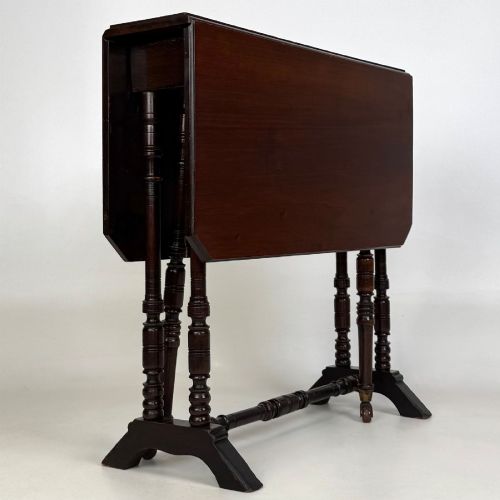
A dark wood sutherland table is a narrow drop-leaf folding table supported by swinging gate legs that pull out to prop up the leaves. When someone searches for this phrase, they are looking at practical nineteenth-century and early twentieth-century furniture designed to expand quickly for tea or writing.
The versions most commonly met on this page date from the Victorian and Edwardian eras, executed in rich timbers such as mahogany, rosewood, and walnut. These examples range from compact occasional pieces to larger folding tables fitted with slender turned legs.
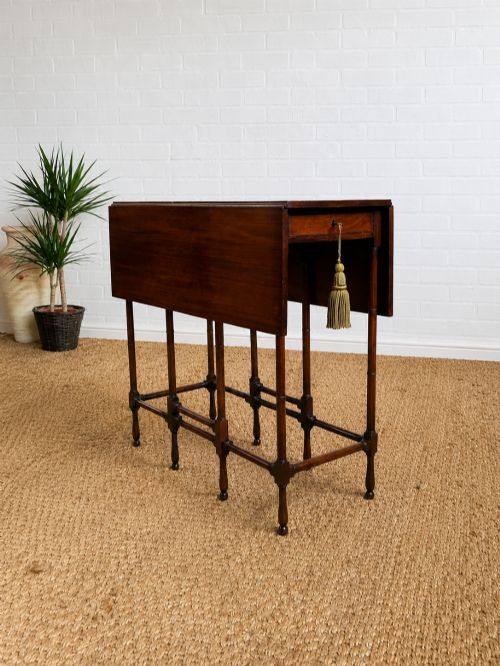
Makers often incorporated subtle decorative elements, including boxwood and satinwood inlay, bamboo-turned supports, or small fitted drawers. The folding mechanism remains the defining characteristic across all of them, allowing the leaves to drop almost vertically on either side of a very narrow central frame.
How they were made
Cabinetmakers utilised dense timbers like mahogany, rosewood, and walnut to construct these folding frames, ensuring the narrow central pivot and swinging gate legs could bear weight when extended. Boxwood and satinwood frequently appear as fine stringing or marquetry inlay across the table surfaces.
Joiners relied on precision hinges and clever pivoting leg structures so the leaves dropped cleanly without jamming against the frame. Turning lathes shaped the legs into standard vase profiles, faux bamboo, or bamboo-turned designs, often finished with small brass castors.
Dark Wood Sutherland Table Retail Price Guide 2026
Typical asking prices for dark wood sutherland table among the pieces listed under this phrase on Sellingantiques today, from the lower quarter to the upper quarter. They describe what is for sale here now, not the wider market.
Some tables feature fake bamboo legs, proving that Victorians loved a convincing botanical illusion indoors.
What varies in quality
The choice of timber underpins the distinction between standard production and finer workshops, with rich figured rosewood or dense solid mahogany sitting at the upper end of the scale. Subtleties in the joinery, such as the snugness of the drop leaves when folded and the smoothness of the gate-leg pivot, separate everyday items from superior examples.
Decorative restraint and refinement in the leg turnings dictate visual success. Finely executed boxwood inlay or crisp bamboo-turned members elevate an occasional piece above plain utilitarian versions.
The Dark Wood Sutherland Table Glossary
- Drop-leaf table
- A table with a fixed central section and hinged leaves that fold down at the sides. These leaves are supported by swing-out legs when raised.
- Gateleg table
- A table featuring legs hinged to swing outward like a gate, providing direct support underneath the folding leaves. This mechanism gives sutherland tables their characteristic stability.
- Inlay
- A technique where pieces of contrasting wood, such as boxwood or satinwood, are set into recesses flush with the surface to create decorative patterns.
- Castor
- A small wheel attached to the bottom of a table leg to ease movement across the floor. They are frequently made of brass on nineteenth-century pieces.
- Faux bamboo
- Wood turned and carved to imitate the segmented stalks of natural bamboo. This decorative treatment became popular during the Victorian Aesthetic Movement.
Dark Wood Sutherland Table: Frequently Asked Questions
What is a sutherland table?
A sutherland table is a narrow drop-leaf table featuring exceptionally slender folding leaves and swinging gate legs. When folded down, it occupies minimal floor space.
Cabinetmakers designed them to serve as occasional tables that could expand rapidly when needed for tea, sewing, or writing.
How do you fold a sutherland table?
To open the table, pull the hinged gate legs outward from the central underframe until they lock into a vertical position. Then lift the drop leaf and rest it securely on top of the extended leg.
To close it, lift the leaf slightly to release pressure, swing the gate leg back inward beneath the centre, and let the leaf hang straight down.
What woods were used for these tables?
Victorian and Edwardian makers primarily worked with dark timbers such as mahogany, rosewood, and walnut. These woods provided the necessary structural strength for such narrow folding frames.
Lighter contrasting woods like boxwood and satinwood were frequently employed for decorative stringing and geometric inlay.
How do I tell Victorian from Edwardian tables?
Victorian tables generally display heavier timbers, deeper polished finishes, and traditional turned or carved legs. Pieces from the later nineteenth century often incorporate Aesthetic Movement details like faux bamboo turnings.
Edwardian examples tend to feature lighter frames, delicate satinwood or boxwood inlay, and a more slender overall silhouette suited to refined drawing rooms.