



Dark Wood Corner Etagere
A dark wood corner etagere brings vertical display space to neglected room angles using rich nineteenth-century timbers.
Dark Wood Corner Etagere
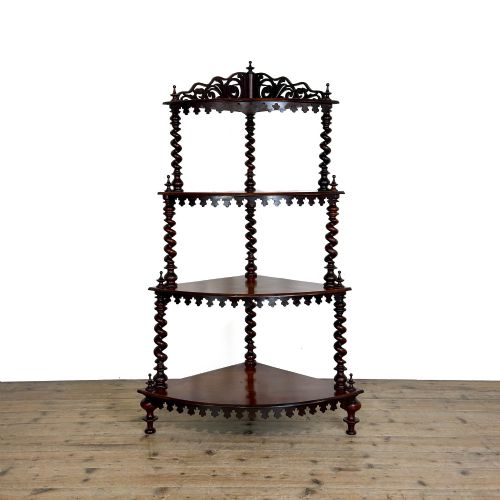
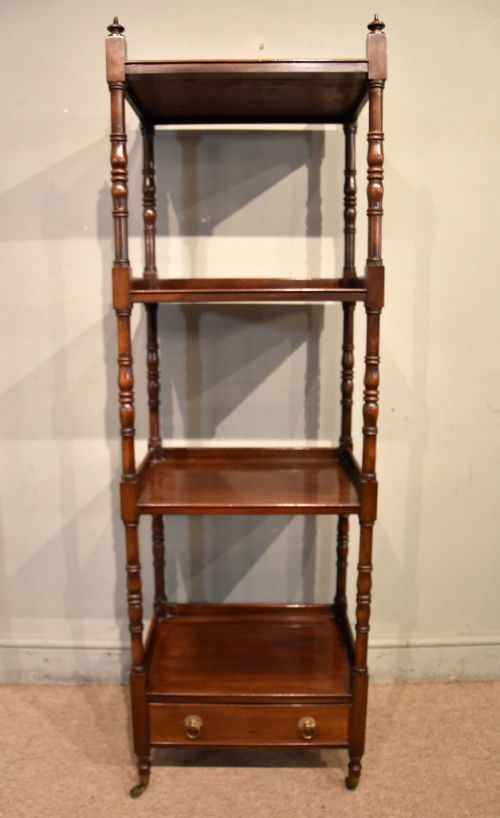
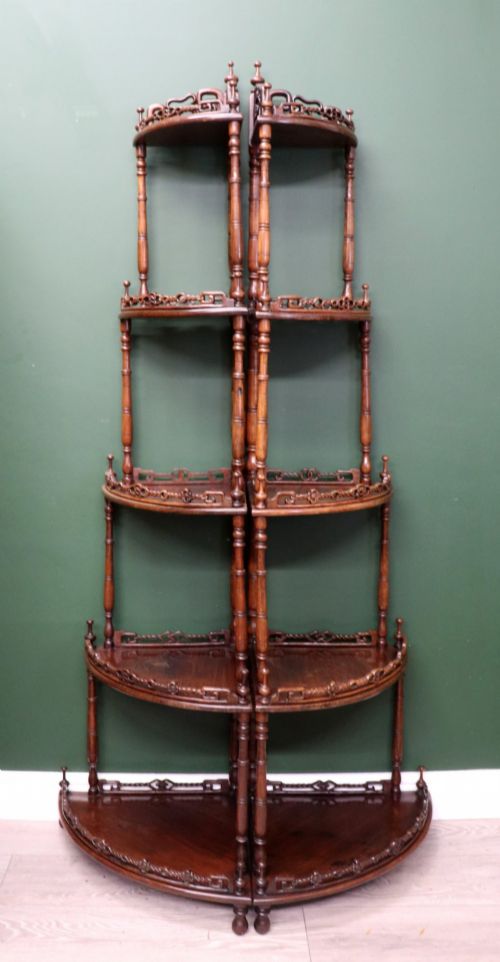
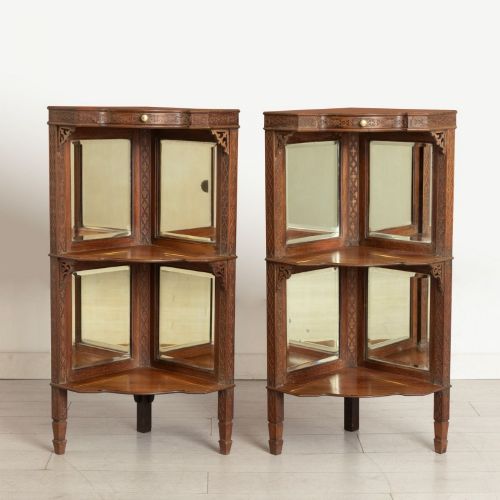
A dark wood corner etagere is typically encountered as a multi-tiered freestanding or wall-mounted shelving unit designed to fit squarely into room angles. The selections span the Georgian, Regency, and Victorian eras, utilising dense timbers like mahogany, rosewood, and walnut to maximise floor space without crowding a room.
Most examples function primarily for display, carrying tiers supported by turned columns, delicate spindles, or carved uprights. The form overlaps closely with nineteenth-century whatnots and corner cabinets, offering open shelves or enclosed lower cupboards depending on the specific period design.
Materials and construction methods
Cabinetmakers built these pieces predominantly from solid and veneered timbers including mahogany, rosewood, and walnut, frequently accented with brass hardware, glass panels, or mirrored backs. Ebonised finishes and inlaid details appear regularly across nineteenth-century variants.
Construction relies on sturdy corner framing, joined shelves, and turned or carved vertical supports that distribute weight securely down to the floor. Finer iterations incorporate burr walnut veneers, intricate marquetry inlay, and carved oak or padouk framing.
Listings feature eighteenth and nineteenth-century periods, showcasing mahogany, rosewood, walnut, oak, brass, glass, and mirror materials.
Distinctions in construction and design quality
Quality rests in the selection of timber grain, the crispness of turned columns and carved decorative elements, and the structural integrity of the tier joints. Dense rosewood and burr walnut with matched veneers signal higher workshop origins.
Simpler pine-backed or plain mahogany pieces contrast with exhibition-quality items featuring elaborate carving, mirrored back panels, and integrated cupboard doors by notable makers.
Edwards & Roberts
The Dark Wood Corner Etagere Glossary
- Etagere
- A piece of furniture consisting of a set of open shelves for displaying small objects or ornaments. These tiers graduate in size or maintain uniform proportions from top to bottom.
- Whatnot
- A nineteenth-century multi-shelved stand used for books or ornaments. The form frequently intersects with corner etagere designs.
- Canterbury
- A low stand with partitioned sections originally designed for sheet music or folios, sometimes incorporated into the lower section of a whatnot. This addition provides enclosed or divided storage beneath the open upper tiers.
- Marquetry
- Decorative veneer work formed by fitting together small pieces of wood, shell, or ivory into complex patterns. This technique appears on Victorian rosewood and walnut surfaces to create geometric or floral motifs.
- Padouk
- A heavy, durable tropical hardwood with a reddish hue used in select nineteenth-century furniture. Its dense grain allows for robust structural framing in corner shelf units.
Dark Wood Corner Etagere: Frequently Asked Questions
What is a corner etagere used for?
These pieces serve primarily to display decorative objects, porcelain, or small collections within the vertical angles of a room. They turn awkward junctions into functional display surfaces.
The open tiers allow light to pass through while keeping precious items visible from multiple angles across the floor.
How do I distinguish a Victorian etagere from a Georgian one?
Georgian and Regency versions tend to rely on architectural mahogany framing with cleaner, simpler lines and restrained mouldings. Victorian variants often introduce darker rosewood, walnut, turned spindles, ebonised touches, and mirrored backs.
Looking closely at the turning style and timber grain helps clarify the chronological shift from restrained Georgian proportion to elaborate Victorian ornamentation.
Are these units stable enough for heavy books?
While sturdy, most etageres and whatnots were built for decorative display rather than heavy library storage. The upper tiers taper gracefully and suit lighter ornaments.
Placing heavier volumes on the lowest shelf helps maintain overall balance, particularly on freestanding three-legged or four-legged corner variants.
Do corner etageres attach to walls?
Most nineteenth-century corner units function as freestanding pieces supported by three or four legs fitted precisely to room angles. Some tall variations benefit from subtle wall securing for added stability.
Freestanding designs allow owners to reposition the furniture easily without leaving permanent fixings in antique plaster.