
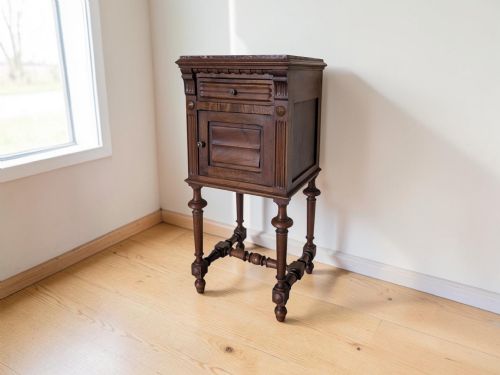
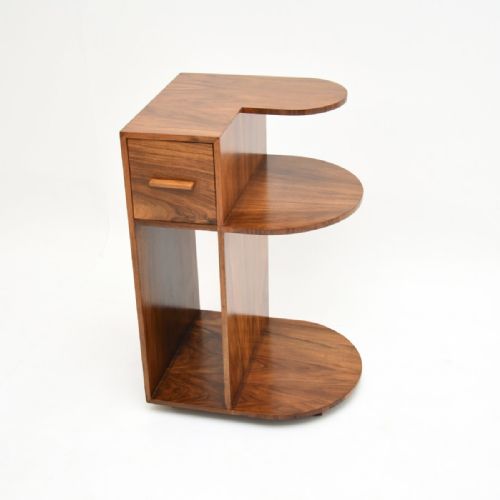


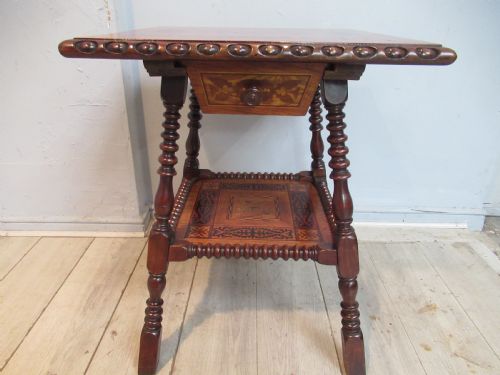


Dark Walnut Bedside Table
These dark walnut bedside table pieces bring rich timber tones and practical bedside storage to a bedroom.
Dark Walnut Bedside Table
A dark walnut bedside table is a practical bedroom piece designed to sit beside a bed for storage and display. The selection here ranges from compact nineteenth century bedside cabinets to art deco chests and tall pairs.
You will encounter various forms across different eras, including single door cupboards, three drawer chests and open occasional tables. Many incorporate marble tops or tambour shutters alongside standard cabinet doors.
Origins stretch from English Victorian workshops to French provincial makers and Italian Tuscan pieces. This variety ensures both single items and matched pairs appear regularly across the centuries represented.
Materials and construction methods
Cabinet makers utilised solid walnut, burr walnut and walnut veneer over supportive woods like pine to achieve rich surface grain. Timber selection dictated the character of each piece, often enhanced by quarter veneering or parquetry patterns.
Fittings and decorative elements relied on brass for handles and hardware, whilst certain cabinets featured heavy marble tops. Carved woodwork and tambour construction demonstrate the diverse carpentry techniques employed by period artisans.
Listings feature walnut, burr walnut, marble, and brass across Victorian, Edwardian, Art Deco, and eighteenth century periods.
Assessing quality in dark walnut pieces
Quality rests in the precision of the timber work, particularly how veneer or burr walnut is applied to the carcass. Superior examples display seamless parquetry and careful matching of grain patterns across drawers and doors.
The integration of materials such as inset marble tops and solid brass hardware elevates a piece beyond standard utility. Construction integrity in the drawers and cupboard doors further distinguishes finer workshop output from simpler utilitarian furniture.
The Dark Walnut Bedside Table Glossary
- Burr walnut
- A figured wood grain derived from walnut tree growths, prized for its swirling patterns. It provides a highly decorative surface on nineteenth century cabinet doors and tabletops.
- Tambour
- A sliding door constructed from narrow strips of wood glued to a fabric backing. This allows the shutter to curve around a cabinet corner smoothly.
- Parquetry
- Geometric patterns formed by fitting small pieces of veneer together on a surface. It creates intricate decorative geometric designs on tabletops and cabinet fronts.
- Pedestal cupboard
- A tall, single pillar cabinet designed to stand beside a bed or in a corner. These closed storage units often feature a single door enclosing internal shelving.
- Quarter veneer
- Wood veneer sliced and arranged in symmetrical quarters to mirror the grain patterns. This technique creates balanced, decorative panels on cabinet doors and tops.
Dark Walnut Bedside Table: Frequently Asked Questions
What periods do these pieces cover?
The selection spans from the eighteenth century through the nineteenth century and into the early twentieth century. You will find items representing Victorian, Edwardian, and Art Deco eras.
Each period brings distinct stylistic traits, ranging from Italian Tuscan pedestals to French provincial cabinets and streamline art deco side tables.
Are matched pairs common?
Matched pairs appear frequently across different decades, particularly from the Victorian and art deco periods. These sets provide balanced symmetry for flanking a bed.
Pairs often feature identical parquetry, matching marble tops, or corresponding door configurations to ensure uniformity on both sides of a bed.
How do I identify burr walnut?
Burr walnut is recognisable by its dense, swirling grain patterns filled with small knot formations. It creates a highly decorative and textured surface across tabletops and doors.
This material was selected by makers for prominent display areas to highlight the natural beauty of the timber.
What storage options are available?
Storage formats include single door cupboards, multi drawer chests, and units featuring tambour shutters. Some pieces combine a drawer with an enclosed lower cupboard.
Open two tier occasional tables are also present for those requiring display space rather than concealed storage.
Do these pieces feature marble tops?
Certain cabinets incorporate fitted marble tops, particularly among Victorian and Edwardian examples. This provided a durable, wipe clean surface for bedside lamps and jugs.
The stone adds weight and a contrasting colour to the dark walnut timber below.